
South Georgia
United Kingdom · Europe
About South Georgia
South Georgia Island is a sub-Antarctic island administered by the United Kingdom as part of South Georgia and the South Sandwich Islands. It lies 1390 km southeast of the Falkland Islands and 2150 km from South America, and is 170 km long by 35 km wide with a mountainous interior. Its bays and islets are home to vast numbers of birds and marine life, but there is no permanent human population, and South Georgia's remoteness makes it a rare destination for tourists.
South Georgia travel guide
Getting there
1 Grytviken, a former whaling station, is the port of entry to South Georgia. In season it hosts the Fishery Research base, the Government of South Georgia and the South Sandwich Islands (SGSSI) and the British Antarctic Survey. There is no airstrip on the island, so the only access is by boat. There is of course no ferry service and tourists arrive on large cruisers or smaller expedition cruisers, often combined with a tour of the Antarctic Peninsula. Research, support and official staff arrive on polar support vessels across a wild heaving ocean. Whatever the size of ship, even the gnarliest old sea-goer can expect sea-sickness. See Antarctica#Get in for companies that sail here - all the companies that visit South Georgia also visit the Antarctic Peninsula, but not vice versa. It's the wrong side of the world for those cruising out of New Zealand to the Ross Sea. You don't need a visa but you do need prior permission to land: see SGSSI for the rules and fees. The cruise operator or expedition leader is responsible for organising this.
Getting around
There are no roads on the island, so all travel is by boat or on foot. The island is mountainous and covered by massive glaciers, so travel by land requires appropriate gear and backcountry travel skills. The SGSSI Government lists 49 sites that may be approached by small-to-medium sized ships of up to 200 passengers. That's plenty to go at, the others are unsafe or restricted, and even the listed sites may be closed in breeding season or not suitable for landing. They're all on the north coast except Haakon Bay on the dangerous south coast. Grytviken is one of the six sites where larger ships are permitted.
See
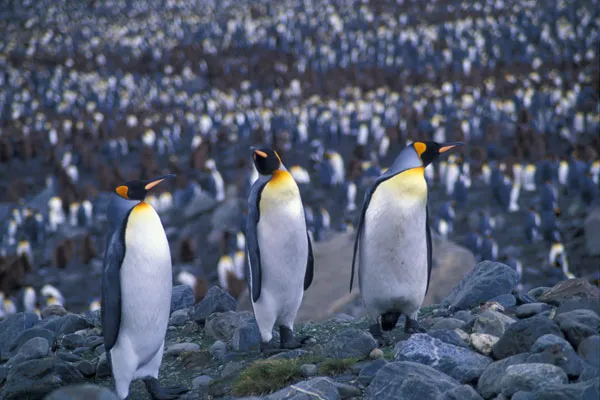
1 Willis Island is accessible only by a hazardous landing onto a rocky cliff, followed by a steep ascent over rock and through tussocks. It's home to massive numbers of black-browed, grey-headed and light-mantled sooty albatross, as well as macaroni penguins. The islet just east is Vaughan Island, the larger one east is Trinity, then the little ones further east are the Verdant Islands. 2 Bird Island is a research area for the British Antarctic Survey and you may not land. The birds include wandering albatross and giant petrels. 3 Elsehul is a mainland cove where it's almost impossible to land Dec / Jan with the vast numbers of grumpy fur seals that overrun the beaches. At other times of the year it's home to elephant seals, gentoo penguins, king penguins, sheathbills, and grey-headed albatross. 4 Right Whale Bay is a bight on the north coast where cruise ships often stop. The Southern Right Whale Eubalaena australis is baleen, a filter feeder, and got its name because it was "the right whale to hunt" - hence the island's stations. Elephant seals and a small colony of king penguins throng the area Sept-Nov then thousands of fur seals take over the beach through February. 5 Salisbury Plain is another enormous king penguin rookery, and hosts vast numbers of other penguins and seals. Albatross Island 3 km off Salisbury Plain has limited numbers of wandering albatross. You may not land here. Prion Island another 5 km east is smaller than Albatross Island but has more of these birds, and parts of it may be visited. There's a boardwalk from the landing point to make access easier whilst protecting the fragile vegetation. 6 Leith Harbour or Port Leith is an abandoned whaling station within Stromness Bay, in operation 1905-1965. It was established by Christian Salvesen Ltd, and named for their home port in Edinburgh. In 1982 it ignited the Falklands War when 50 Argentines landed, supposedly contractors come to remove scrap metal from the old station; but they arrived mob-ha
Do
Hike: The Shackleton Traverse is the 41 km route that Ernest Shackleton took across the island to bring help to his crew marooned on Elephant Island. It's arduous and hazardous across glacier, and demands mountaineering skills. Visiting parties usually just do the last low-lying 6 km from Fortuna Bay to Stromness. Wildlife spotting and photography is the main attraction here. Report a rat. Rats arrived in the 19th century as sealer and whaler ships put in for fresh water and established camps, and the rats set about the island's bird life in much the same way that humans were setting about the seals and whales. Birds here have no trees to nest in, and the ground is too hard for burrows, so they nest on open ground where eggs and chicks are easy prey. The pipit and the pintail were wiped out on the mainland and survived only on a few islands that rats couldn't reach; penguins and other birds were also greatly harmed. In 2011 a huge eradication effort began, involving helicopter drops of poisoned bait, though at the cost of some "collateral damage" to non-target species such as skuas. Three seasons of this, plus extensive searches with dogs, led to probable eradication in 2015, and after two more seasons with no further sightings the island was declared rat-free. So if you think you see one, report it - a photo will help, but don't try to whack it yourself. Don't introduce reindeer. Rabbits into Australia, wallabies into Herm in the Channel Islands, when will they learn? The rats were an early accidental introduction but in the early 20th century reindeer were deliberately introduced as a source of meat and target for recreational shooting. The first herd was released on Barff peninsula across the bay from Grytviken, where they were seldom bothered, and bred and bred. Herds were wanted closer to the whaling stations: a second herd near Leith harbour was squished by an avalanche but a third became the "Busen herd." These latter were kept in check while whaling continue
Eat
Unless permitted for an expedition, no food may be taken ashore, and fishing and hunting are prohibited.
Sleep
Visitors sleep on their boat, it's by far the most comfortable and safe. Staying ashore overnight anywhere in SGSSI makes it an expedition, which requires special approval and an extra fee of £1000 per group.
Go next
In short, wherever the boat that brought you is going next. That might be the Antarctic Peninsula, the Falkland Islands, or a South American port such as Ushuaia or Punta Arenas.
Overview adapted from Wikipedia, travel guide fromWikivoyage (CC BY-SA). Photography via Wikimedia Commons.