
Si Sa Ket
Thailand · Asia
About Si Sa Ket
Sisaket (ศรีสะเกษ, sometimes Si Saket) is a town and a province in Isaan, Thailand.
Si Sa Ket travel guide
Understand
With a long history, the area around Sisaket has had a strong culture and a prosperous economy since the Khmer era over one thousand years ago. Moreover, many ethnic tribes settled here such as the Suay, Lao, Khmer, and Yer. Sisaket became a town in 1759 during Ayuthaya period. In the reign of King Rama V, or around a century ago, the town moved to its present location. With plenty of Khmer Ruins, Sisaket is an interesting destination to visit. It is also the gateway to visit the world famous Preah Vihear ruins, a cliff-top Khmer sanctuary most of which is just across the border in Cambodia. The province grows a wide variety of fruits, such as rambutan and durian. These are typically available at the beginning of rainy season around May. Much of the local population are near-subsistence farmers earning an average of about 100 baht or USD3 per day.
Getting there
By car From Bangkok, use Hwy 1 (Payolyothin Rd) then Hwy 2 (Mitraphap Rd) from Saraburi. Near Korat (Nakhon Ratchasima) take Hwy 24 (Chock Chai-Det Udom) to reach Sisaket. This route is 571 km.
By bus Buses and air-conditioned coaches leave the Northeastern Bus Terminal (Mo Chit 2) in Bangkok for Sisaket daily. The journey takes 8 hours. For more information, visit The Transport Co., Ltd. or call +66 2 9362852-66 or Sisaket Bus Terminal at +66 45 612500.
By train Ordinary, rapid, and express trains regularly leave Bangkok and Bang Sue Station for Sisaket. The route is 515 km. For more information, call the State Railway of Thailand at 1690, +66 2 2204334, +66 2 2204444, and Sisaket Railway Station at +66 45 611525. For getting around in Sisaket City, tricycles are readily available. Moreover, there are buses from downtown Sisaket to other towns as well as provinces nearby.
Getting around
There are no meter-taxis or tuk-tuks, but you can hire a motorbike-taxi or take a samlor (three-wheeled bicycle-taxi).
See
Sisaket Province is famous for its ruins dating to the Khmer Empire.
Phra That Ruang Rong (พระธาตุเรืองรอง) (8 km away on the Sisaket-Yang Chum Noi Rd). A beautiful wat (temple). The whole complex takes about 90 min to visit. Open only in the daytime. The temple's architecture is a blending of art from four ethnic groups in the lower northeast: Lao, Suay, Khmer, and Yer. The Phra That Or stupa is 49 metres tall.
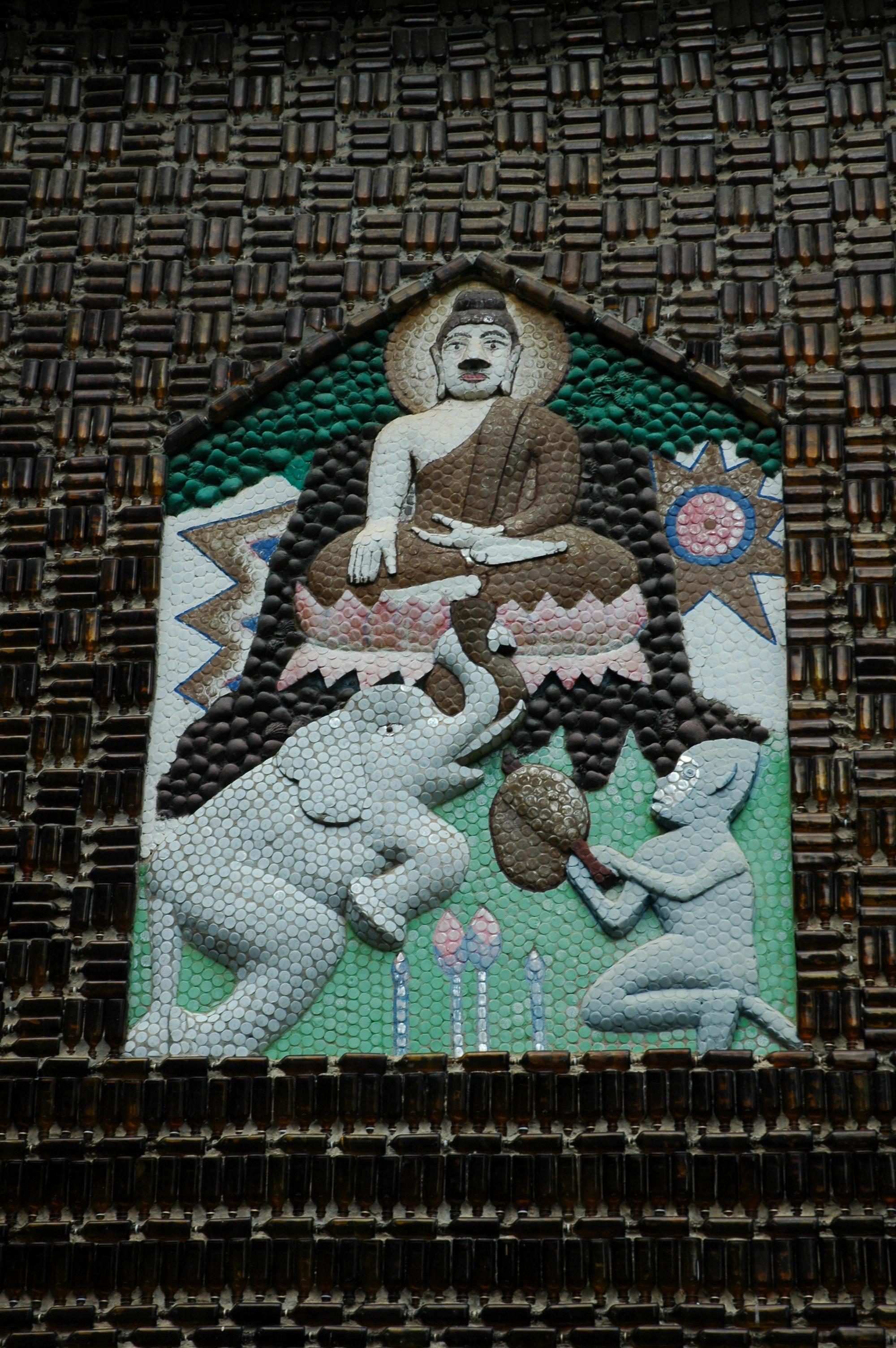
Wat Pa Maha Chedi Kaew (Wat Lan Khuad or Temple of a Million Bottles) (~61 km south of Sisaket; in the small town of Khun Han). A bizarre yet entirely serious Buddhist temple complex constructed entirely out of glass bottles. Even the pictures on the walls were assembled from bottle caps. The temple is a worthwhile detour if visiting Preah Vihear with your own transport. Its architecture is interesting, particularly the pavilion called "Sala Thansmo Maha Jedikaeo", an ubosot located mid-pond. Tamnaksai ปราสาทตำหนักไทร (Tamchan ปราสาททามจาน) Khmer ruins – This is a single stupa of brick on a sandstone base. The stupa is rectangular. There is door on the east, while the other three sides have entrances with a door frame carved into the brickwork. Bas relief – Carved on the red sandstone cliff, this depicts three gods in Khmer style. Khmer craftsmen probably practiced here first before doing the actual carving for Preah Vihear Temple sanctuary. Sra Trao or Huay Trao – This stream runs through rock at the foot of Preah Vihear Mountain, before entering a tunnel strengthened by rock walls. It is assumed that the lowland was once used as a barai, a Khmer reservoir. Sra Kampaeng Noi (ปราสาทสระกำแพงน้อย) – These Khmer ruins include a laterite stupa and chapel with a big pond at front, all within a laterite wall. In the 13th century, additions were made in the Bayon architectural style. It once contained a community hospital known as the Arokaya Sala. Sra Kampaeng Yai (ปราสาทสระกำแพงใหญ่) Khmer ruins – This is the largest and most complete Khmer complex in the
Do
Festivals Dok Lamduan Festivals (งานเทศกาลดอกลำดวน): Held annually between 15–17 March at Somdet Sri Nagarin Park when lamduan trees in the park are in full bloom, The fair consists of cultural performances by four local ethnic groups: Khmer, Suay, Lao, and Yer. Visitors can view handicrafts, local products, and watch reenactments of Sisaket's history. Sisaket's Rambutan and Durian Fair (งานเทศกาลเงาะทุเรียนศรีสะเกษ): The fair is held every June on the field before Kantaralak or Khun Harn. Fairgoers can marvel at the fruits of Sisaket: rambutan, durian, lanson, mangosteen, stink beans and enjoy flower floats, documentary exhibitions, and a fruit tasting caravan. Half- and Quarter-Marathon to Mor E-Dang (การแข่งขันวิ่งฮาล์ฟและควอเตอร์มาราธอนสู่ผามออีแดง): Held annually on the third Sunday of December, the half- and quarter-marathon proceeds from Ban Phume Sarol to Mor E-Dang Cliff, on the way to Preah Vihear.
Buy
Sisaket is known for silk and cotton cloth woven in khit pattern, which is produced mainly in Bung Boon and Uthumporn Pisai. Salted eggs from Prai Bung, red onions, garlic, and preserved garlic in honey are generally available. Sisaket is also known for its tropical fruits. Fruit orchards in Kantaralak District bear fruit such as durian, rambutan, and mangosteen from May to July.
Eat
Sisaket is in the heart of Isaan. You will find excellent Isaan food everywhere. There are quite a few good restaurants in Sisaket. But maybe the best offer in town is the lively evening market adjacent to the railway on the south side of the train station. There you will find a wide variety of cooked, baked and barbequed food for reasonable prices. The evening market opens at 17:00 and closes at 21:00.
Local dishes Grilled chicken on madan (mangosteen) skewer or kai yang mai madan is one of the most popular dishes in Sisaket Province. Chicken is skewered on a stick of madan wood. Madan, being mostly found in Huai Thap Than District, is used by local people because of its aroma, is hard to burn and gives a slightly sour taste. Kai yang mai madan is promoted as the local OTOP (One Tambon (meaning sub-district) One Product) of Thailand. Ma kuear soup is not a soup. It is a combination of Thai eggplant, fish meat, red onion, chili, and Thai herbs. It looks gluey like nam prik. This dish consists of vegetables and herbs, so it is simple for local people to find the ingredients. The dish is served with fresh vegetables like cucumber, coriander, and cow-pea beans.
Leo's, 1579, 11 Si Sumung, Mueang Tai, ☏ +66 45960208, [email protected]. 11:00-23:00 daily, closed Tuesdays. Leo's Bar and Restaurant has an astonishing variety of beer/ciders from many countries, priced reasonably. The farang and Thai food is well presented and some of the Western dishes are sourced from the well-established Staffords of Prasat. Most evenings the place has a mix of Thais and farangs sitting in air conditioned comfort. Beef burger, bacon and cheese, 145 baht. (updated Oct 2022)
Drink & nightlife
There are a few places you can go in the evening or night life. One of the most famous being Sugars on Lak Muang Rd. Then you could
Overview adapted from Wikipedia, travel guide fromWikivoyage (CC BY-SA). Photography via Wikimedia Commons.