
Saxony
Germany · Europe
About Saxony
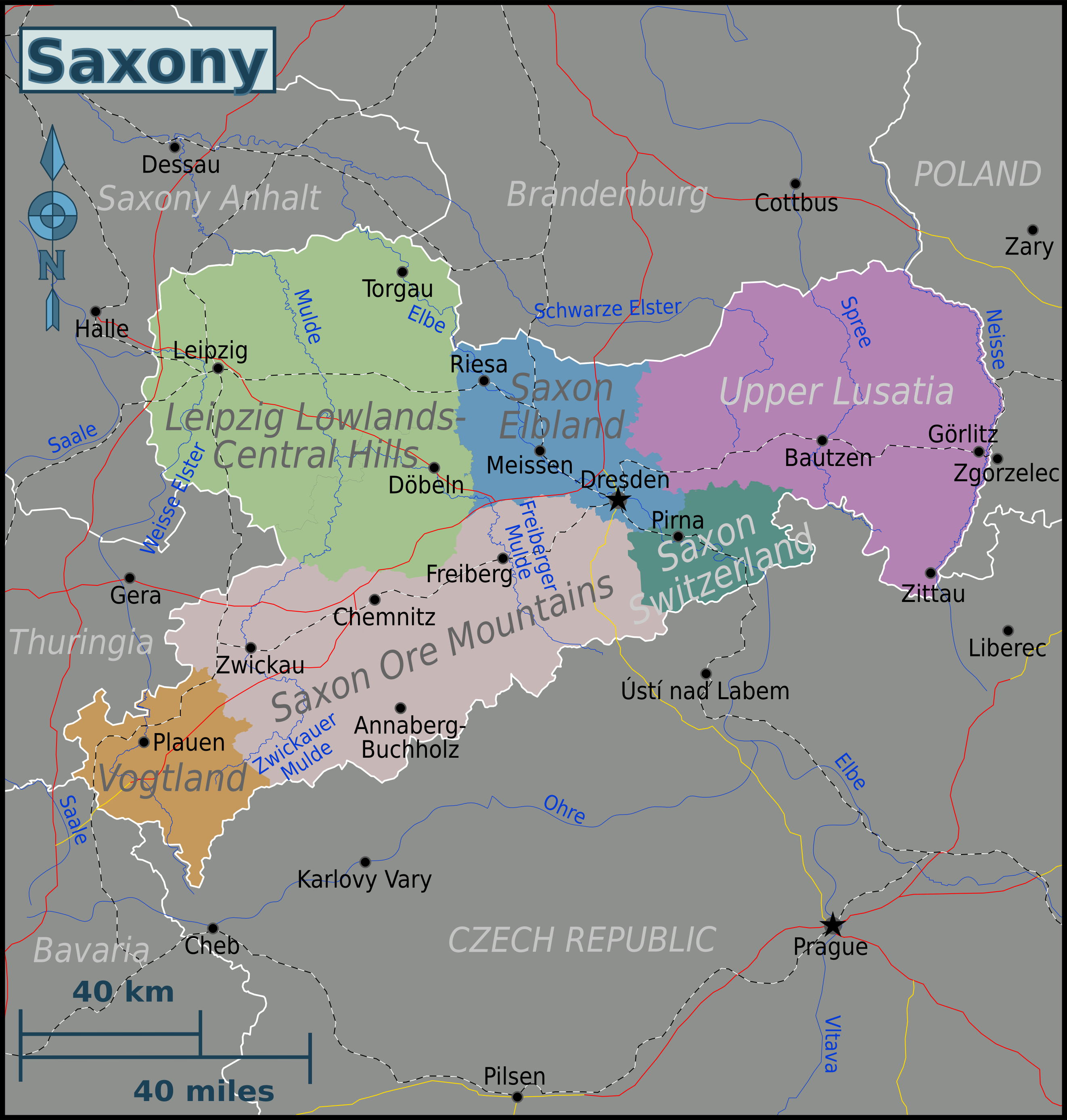
Saxony (Sachsen) is a federal state in the east of Germany, covering an area of 18,450 km² and home to approximately 4 million people. It contains the two largest and most important cities in eastern Germany other than Berlin: Leipzig and Dresden. The state has a long history of independence as a kingdom, much like Bavaria, and retains a strong sense of cultural identity. It is home to many historic towns and the Ore Mountains (Erzgebirge), which it shares with the Czech Republic to the south. It also shares international borders with Poland to the east, where the town of Görlitz was divided along the Neisse river after World War II, with its eastern part becoming the Polish town of Zgorzelec.
Saxony travel guide
Understand
Middle Ages During the early Middle Ages, most of today's Saxony was populated with Slavs. Many place names are of Slavic origin (including the names of the major cities Dresden; Leipzig and Chemnitz), typically ending in -itz or clustering sibilants like 'z' and 'sch' in a way that is difficult to pronounce even for Germans from other regions (one of the most extreme examples may be Zitzschewig). A Slavic population has survived in the ethnic group of the Sorbs, consisting of some 20,000 people native to the Upper Lusatia region of Eastern Saxony who proudly maintain their own language and traditions. Most Slavs however either moved east or were assimilated by the German-speaking majority since the 12th-century German "East Colonisation". The population of Saxony is mostly unrelated to the ancient tribe of the Saxons, native to Northern Germany, who were one of the roots of England's Anglo-Saxon population. The name Saxony was only conferred to this territory for dynastic reasons in the 15th century. Until then, it had been known as the Margravate of Meissen, named after its capital Meißen which is the oldest cathedral city in Saxony.
Early Modern Age
At a time when each of the German tribes spoke its own dialect that was barely mutually intelligible with any other, and most written texts were in Latin, the idiom of the Meissen administrators was considered the exemplary variant of Germany's native language. When Martin Luther translated the Bible into German, he was strongly guided by this language, thus modern Standard German has its roots in Saxony. Until the 18th century upper-class parents from other regions sent their sons to schools in Saxony in order to learn "proper" German. Ironically, the Saxon dialect nowadays is one of the most unpopular ones, being considered very unattractive and derided by most Germans from other regions. Saxony was the first among German states to officially adopt the Protestant teachings of Martin Luther and is therefore co
Getting there
By plane Saxony has two mid-sized airports used for scheduled passenger flights in Leipzig/Halle (LEJ IATA) and Dresden (DRS IATA). Both see mostly domestic connections in addition to flights catering to package tourists from Saxony going to holiday destinations around the Mediterranean Sea. Direct connections from/to major European cities are few. Both have frequent inexpensive (around €2–3 one way) direct S-Bahn service to the centrally located Hauptbahnhof (main station) of their respective cities, from where you may transfer to other parts of Saxony. Leipzig airport station is even served by intercity trains at a two-hourly interval, linking it directly with Riesa and Dresden. Car rentals are available at both airports. An alternative is to fly to Berlin Brandenburg Airport that sees a lot more connections and from where it takes less than two hours to Dresden or Leipzig by public transportation or by car. From Frankfurt airport (FRA IATA)—Germany's main international hub—there are two-hourly direct ICE connections, taking 3 hr 20 min to Leipzig and 4½ hours to Dresden. Flying to Prague (PRG IATA) may be a feasible option for some travellers thanks to good road connections with Dresden (less than two hours by car), but not so much if you are dependent on public transportation or going to the northern or western parts of Saxony. Flying to Wrocław (WRO IATA) is only a serious option if your destination is in the eastern part of Saxony (Upper Lusatia) and you rent a car, otherwise the transfer will be tedious.
By train
The main hubs for rail travel are Dresden and Leipzig, served by the high-speed lines Hamburg–Berlin–Leipzig–Nuremberg–Munich and (Stuttgart)Frankfurt–Leipzig–Dresden, each at an hourly or two-hourly interval. By ICE high-speed train, Leipzig is 1 hr 15 min from Berlin and just over three hours from Frankfurt, Hamburg or Munich. Leipzig boasts one of the biggest train stations in Germany with a wide variety of shops and free Wifi. The third pl
Getting around
Public transport is for the most part good, fast and reliable. If you plan to do a day trip the Sachsen-Ticket might just be what you are looking for. It costs €23 for one person plus €5 for each additional member of your group up to five and covers all regional trains in Saxony, Saxony Anhalt and Thüringen plus public transport in Leipzig, Zwickau, Görlitz, Halle, Erfurt, Gera, Jena and Dresden. It is valid from 09:00 on working days (all day on weekends) until 03:00 the following morning. For single travelers, there is the Regio120 ticket up to 120 km, Regio 120 plus up to 150 km in Saxony, Thuringia and Saxony-Anhalt as well as selected routes in Brandenburg, Berlin, Bavaria, Hesse and Lower Saxony for €17 and €22.50 respectively. These tickets are only valid on regional/local trains on weekdays from 09:00 or all day on Sa Su. With the Regio 120 ticket, you can travel, for example, from Leipzig to Dresden or Zwickau or from Chemnitz to Dresden or Hof; with the Regio 120plus, you can even travel from Leipzig or Dresden to Berlin. A Hopperticket (flat rate for journeys of less than 50 km) analogous to Thuringia or Saxony-Anhalt is only available in Saxony in the tariff area of the MDV and there only as a cell phone ticket for €9.50 (round trip up to a maximum of 6 zones). Saxony has bucked the general German trend towards improved local train service: some routes were cancelled in the 2010s, while others are acutely threatened with cancellation. There are several narrow gauge heritage railways, especially in the Ore mountains. As most of them are privately run (some not-for-profit) the Sachsen Ticket usually isn't valid on them. In some areas of the countryside, buses run only once a day.
See
Saxony features two current and one former UNESCO World Heritage site. The park of Bad Muskau on the German-Polish border is one of the largest and most beautiful English-style landscape gardens in continental Europe. The Ore Mountain Mining Region is a transnational Czech-German cultural area; several of the former mines can be visited in guided tours. The cultural landscape of the Dresden Elbe Valley, including Dresden's old town, Baroque churches, palace, châteaux and mansions, art collections and music traditions, used to hold the World Heritage title as well. But it was retracted from the list due to the construction of a new bridge which the UNESCO committee did not approve of. That does not however make Dresden and its surroundings any less worth visiting. Other natural sights are found in the mountain landscape of Saxon Switzerland with bizarre and pictorial sandstone rock formations (like the Pfaffenstein and Barberine), steep river valleys and picturesque views, e.g. at the Bastei bridge near Kurort Rathen. The Saxon Ore Mountains have their distinctive rock formations as well, e.g. the granitic Greifensteine near Ehrenfriedersdorf. When it comes to man-made sights, Saxony is mostly known for its castles, ranging from medieval fortresses on hilltops
Overview adapted from Wikipedia, travel guide fromWikivoyage (CC BY-SA). Photography via Wikimedia Commons.