
Sarandë
Albania · Europe
About Sarandë
Sarandë, the gateway to southern Coastal Albania, is a small town of about 33,000 inhabitants, situated on a beautiful horseshoe bay between the mountains and the Ionian Sea. The name Saranda is derived from an early Christian monastery dedicated to Agioi Saranta (Forty Saints). In antiquity, Saranda was known as Onchesmus.
Opposite the Greek island of Corfu, Saranda is characterized by a Mediterranean climate and warm sea waters. Saranda typically has over 300 sunny days a year. Due to its location and warm weather, Saranda is one of the most attractive tourist towns on the Albanian Riviera, where honeymooners traditionally spend their holidays. Fronting the sea and along the main promenade, there are some hotels and restaurants.
Nearby Butrint is a UNESCO World Heritage site.
Sarandë travel guide
Understand
1 Saranda Tourist Info Center (Glass sphere building), Shetitorja Naim Frasheri (near the Molo by the beach). There are two Tourist Info Centers (one yellow-domed building on the boardwalk; another more traditional office near the bus center). Both are excellent resources for bus timetables. An added bonus is that the employees speak good English. (updated Jul 2021)
Getting there
By boat 2 Ferry Port. (updated Jul 2021) To the nearby Greek island of Corfu (New Port). The daily ferryboats are at 10:30; 13:00 and 16:30 (fewer out of season - check with the ticket office at the port). The 10:30 passage is a hydrofoil which takes about 25-45 minutes. The 16:30 is a car ferry. Corfu is one hour ahead of Albania. One way costs €19, return €38.
By bus For buses from Tirana there are two itineraries: Tirana-Durres-Fieri-Vlora-Dhermi-Saranda or Tirana-Durresi-Fieri-Mallakastra-Tepelena-Gjirokastra-Saranda. If you travel through the Riviera (the first) you should pay more attention as the way is narrow. There are lines from Vlore that go through the Riviera or "Bregu" (a line of picturesque; gorgeous Mediterranean beaches and villages; Bregu is the summer residence of the Prime Minister and President). The line from Gjirokaster to Tepelene, Fier and Tirana also passes Sarandë. From Ioannina to Kakavi takes around 40 minutes by bus or taxi. When you reach Kakavi, you follow this itinerary: Kakavi-Gjirokaster-Jergucat-Qafe e Muzines-Sarandë. From Igoumenitsa (Greece) there are 3 buses per day to the Mavromati - Qafe Bote border (€3.50; 45 minutes). After crossing the border there are taxis: a ride to Butrint costs €10-15.
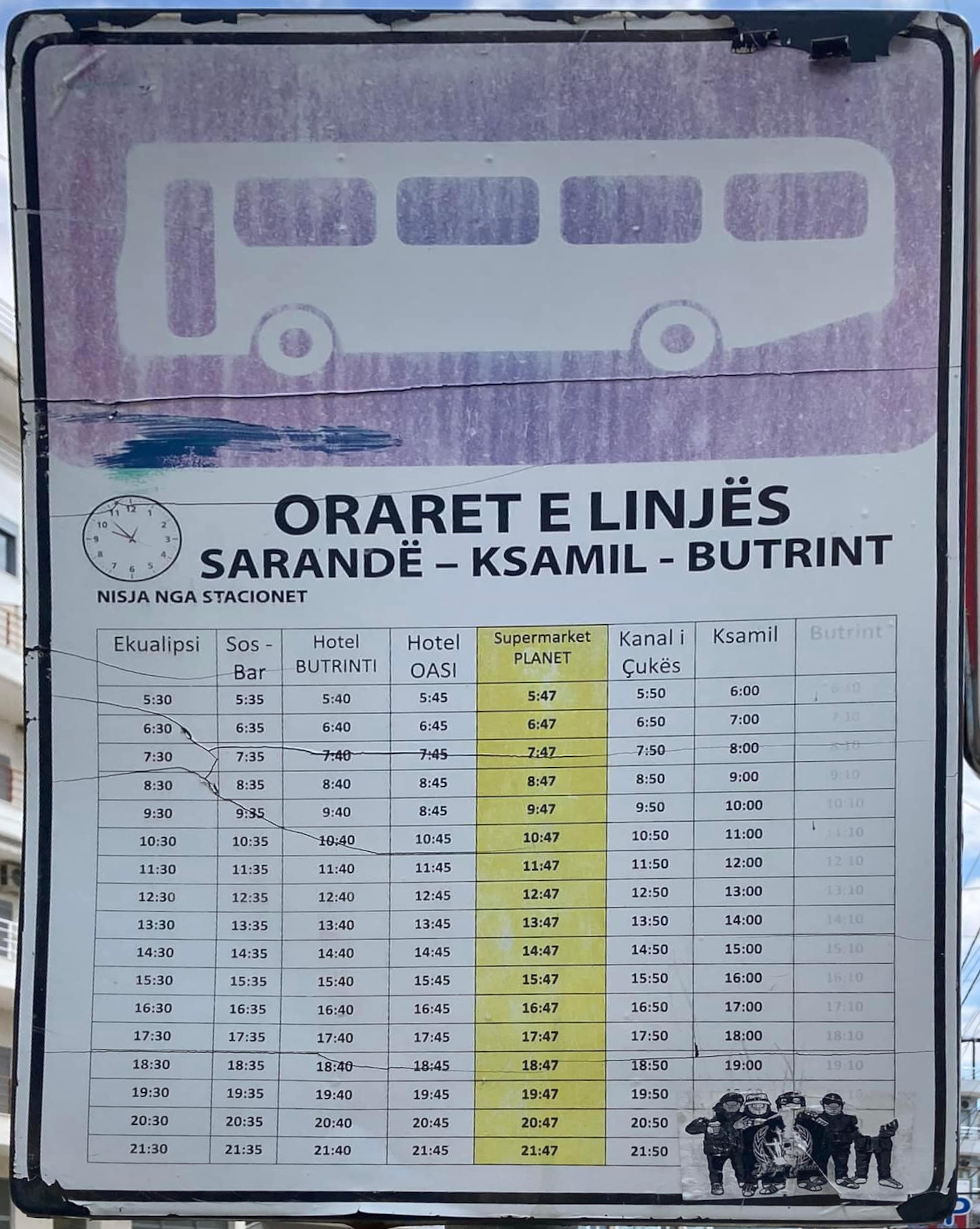
For connections between Sarandë and Butrint/Ksamil check the timetable in the picture. Otherwise, there is always Gjirafa.com to find connections in Albania.
By car From Kosovo and North Macedonia follow this itinerary to reach Saranda: Struga-Qafe Thana-Librazhd-Elbasani-Rrogozhina-Fier and so on. It is connected with Greece by land: (i) By the border of Qafe Bota with Igoumenitsa; (ii) By the border of Kakavi with Ioannina. The tourists, who come here from Greece, reach the border of Kakavi in two ways: from Ioannina and Igoumenitsa. From Ioannina to Kakavi takes around 40 min. When you reach Kakavi, you follow this itinerary: Kakavi-Gjirokaster-Jergucat-Qafe e Muzines-Sarandë. Though Qafe-Bota, the itinerary is Igoumenitsa
Getting around
The local bus from Sarandë center to Ksamil costs 150 lek (last updated 2022-08-18). It 1 starts at the roundabout behind the harbour and public beach (there's even a timetable hanging on a street light) but also stops few times on its way. It runs once per hour in both ways between 06:30 and 19:30. The same bus continues to Butrint. The SH81 road connecting Sarandë, Ksamil and Butrint is heavily congested in high season, especially around sunset when beach day trippers return from Ksamil to Sarandë. This affects not only the cars but also the busses and taxis. This means that a bus ride does not take significantly longer than taking a taxi or own car.
See
1 Ruins of a 5th-century synagogue, Rruga Skënderbeu and Rruga Vangjel Pandi cnr. (updated Jul 2021) 2 Museum of Archaeology (Muzeu i Arkeologjisë). Small collection with remains of a Roman mosaic floor, kept in situ, plus findings from the area (mainly Illyrian; Greek and Roman). (updated Oct 2025) Ethnographic Museum. (updated Jul 2021) Old Castle of Lekures at "Qafa e Gjashtes" (The Pass of Six) (above Saranda). There is a nice outdoor restaurant within the castle from which you have panoramic views of Saranda Bay below, the inland mountains, the Butrint Lagoon and the island of Corfu on the Ionian Sea. (updated Jul 2021)
Further afield
3 Borsh (35 km north). A maritime village. (updated Jul 2021)
4 Butrint National Park and Archaeological Site, Butrint, Ksamil (As of September 2024, there are city buses that run to Butrint, via Ksamil, every half hour from 06:30 until 19:30 (200 lek). The same bus line runs from Butrint to Saranda, every half hour. Bus price is 100 lek per person (up to Ksamil) and can be picked up at the main Saranda bus station or across the street from Hotel Buntrinti.). This is a UNESCO World Heritage site. Butrint was an ancient city throughout Greek, Roman, bishopric and Byzantine periods. The city was finally abandoned during the Middle Ages perhaps due to the marsh surrounding and subsequent malaria epidemic. - Despite being one of the greatest classical cities of the Mediterranean, Butrint remains largely unknown. The current archaeological site includes an impressive Roman amphitheater, a Byzantine Basilica (the largest in the world after Hagia Sophia in Istanbul), a Roman temple with mosaic floor, a beautifully carved lion's gate as well numerous constructions built throughout the periods. Furthermore, what you see is just 15 per cent of what lies beneath. Most of the sights are under tree shadows so you can go even in midday heat. Butrint visitors should allocate approximately 2 hours to enjoy the site; archaeology fans will
Do
1 Central Park (Friendship Park; Parku Miqesia), Rruga Telat Noga & Rruga Onhezmi corner. Sunset at Lekures. In the afternoon, when the sun is setting, you should go to Lekures, and watch the sun set, or you could go to the beach and relax with your friends or family while enjoying the beautiful sunset. Something else that you can do, when it’s not a really hot day is to go camping. If it’s not a hot day, camping would be a really good experience and also allow you to have a good time looking at the stars at night, and it would be a change from going to the beach. Another idea is to visit a new beach each day, such as one day “pllakat” the next day “manastiri” and so on. After visiting Ali Pasha Tepelena Castle, you could go to the Pulbardha Beach and enjoy some great food and relax on the sandy beach.
Buy
1 Myrtaj Shop (Market Vellezerit Myrtaj), Rruga Onhezmi. Skenderbeu Cognac Miniature bunker from alabaster Albanische Mythologie book Souvenirs made from sea shells in Ksamil LLogara honey is a local speciality - it is sold by various merchants on the road.
Eat
Sarandë is bustling with restaurants, cafes and bars. Fast food places offer a surprisingly cheap and tasty variety of options: €1 will usually get you a good souvlaki (usually pork) or a very nice crepe. Look out for yoghurt flavoured ice cream on the boardwalk, near the tourist info office. Fresh fish is abundant in Saranda and available at most restaurants. Establishments next to the sea and fishing ports provide the freshest fish but generally speaking good seafood can be had all around. There are a few places you can eat in Ksamil. At least 4 restaurants in Ksamil are open year-round, but in the summer there are a lot more options and many are just seconds from the beach. Most serve either sea food or a mix of pizza, Greek dishes and heavy meat based fast food.
Budget 1 Restorant Te Bequa, Rruga Telat Noga. (updated Sep 2022) 2 Bar Restaurant "La Banana", Rruga Ismail Tatzat
Overview adapted from Wikipedia, travel guide fromWikivoyage (CC BY-SA). Photography via Wikimedia Commons.