
Santiago de Compostela
Spain · Europe
About Santiago de Compostela
Santiago de Compostela is the capital city of Galicia in northwest Spain. It's named for Saint James, one of the twelve Apostles of Christ, and in legend is his burial site. It's therefore become a pilgrimage destination, the focus of several routes known collectively as El Camino. With a population just under 100,000 in 2024, Santiago has a glorious cathedral and old city centre, a UNESCO World Heritage Site.
Santiago de Compostela travel guide
Understand
"Follow me, and I will make you fishers of men." — Matthew 4:19 In the 8th century the Arabs captured much of Spain, but the Visigoth Christian lands to the north pushed back. Christian leaders sought symbols of cultural identity to rally and unite this isolated region of fishermen and subsistence farmers, with its coastline littered with scallop shells. It would also help, in an era when pilgrimage to Jerusalem was closed off, if there was some icon or relic as a focus. They cast around and landed a whopper. James, cousin of Jesus, was a fisherman in Galilee and together with his brother John (author of St John's Gospel) was among the Apostles. In 44 AD King Herod Agrippa had him beheaded in Jerusalem, where he almost certainly lies; Peter was thrown in jail but busted out by an angel. As the first martyr James became revered, especially in Spain where he was known as Iacobus or Iago, hence Santiago. A story grew up that he'd preached in Spain, with the Virgin Mary coming down to perch on a pillar in Zaragoza and bless him, before he had to rush back so as not to be late for his beheading. The angels then contrived for his decapitated body to sail away in an unattended boat to Iria Flavia, now the town of Padrón 20 km south of Santiago city. Iria Flavia was a much older religious centre, with a Roman shrine and before that a Celtic, and James was reputed to have preached there, so that's where any angelically-transported remains should belong. But the 9th century saw an ecclesiastical upheaval in which Santiago supplanted Iria Flavia. Conveniently, Pelagius the Hermit then beheld showers of stars descending upon a grave in the forest later dubbed the "field of stars", campus stella. He fetched the bishop, who revealed an unexpected talent for forensic archaeology and declared the three bodies there to be James and his disciples Theodore and Athanasius. King and Pope swiftly got in on the act, a chapel then a cathedral were erected on the spot, and Santiago was ac
Getting there
By plane There are several airports around, from which you can reach the city quite easily. 1 Santiago Rosalía de Castro Airport (SCQ IATA), Lavacolla. This has seasonal flights from across west Europe, the UK and Ireland by budget carriers such as Ryanair. As Santiago is some distance to reach overland, it also has domestic flights by Iberia and partners from Madrid, Bilbao, Barcelona, Seville, Malaga, Valencia and the Canaries. The airport has a single terminal with the usual facilities including car hire and luggage lockers. This is the new terminal opened in 2011, replacing the original of 1969, and named for the writer Rosalía de Castro (1837-1885). (updated Feb 2025) To town: Tralusa Bus 6A runs every 30 minutes between 06:30 and 00:30, taking 30 min to the railway and bus stations. A taxi takes 15 min and in 2025 might charge €30. El Camino pilgrimage trail passes right by the airport, so all you need do is retrieve your scallop from your hand luggage. Alternative airports are in A Coruña, Vigo, Avilés, Porto and Madrid. All these cities have direct trains and/or intercity buses to Santiago de Compostela. The airport of Porto has a direct Flixbus to Santiago.
By train From Madrid the train takes just a little over 3 hours to Santiago. Trains from Madrid-Chamartin run every hour or two via Segovia, Zamora and Ourense. About half of the offered rides are direct. The other half require a change in Ourense. From Madrid and Ourense you experience a high-speed train ride with 300 km/h. From Barcelona and Zaragoza change at Madrid from Atocha to Charmartin stations. Media Distancia (Mid-distance) trains from Vigo Urziaz take an hour via Pontevedra and Vilagarcia de Arousa. Slower (1.5 hours) Regional trains runs from Vigo Guixar station. An hourly train from A Coruña takes 30 min to Santiago and continues to Ourense. Trains run twice daily from Porto in Portugal, with a change in Vigo from Guixar to Urziaz stations.. For times, fares and tickets see the R
Getting around
The places of interest in Santiago are in a compact area, so walk. Tralussa is the city bus line. In 2025 a single ticket costs €1 for adults, €0.55 for students under 18. For multiple trips you can buy a bono of 10, 20, or 30 tickets: these cost €0.55 per trip plus a deposit of €3 that's repaid if you return the card in good condition. You can buy and redeem bonos from the bus drivers. One-month passes are also available. Coming in from the airport, for accommodation near the cathedral get off at Rúa da Virxe da Cerca by the marketplace, before the bus carries you south to the stations. Bus 5 plies between the bus station and city centre. Some 15 taxi firms serve the city.
See
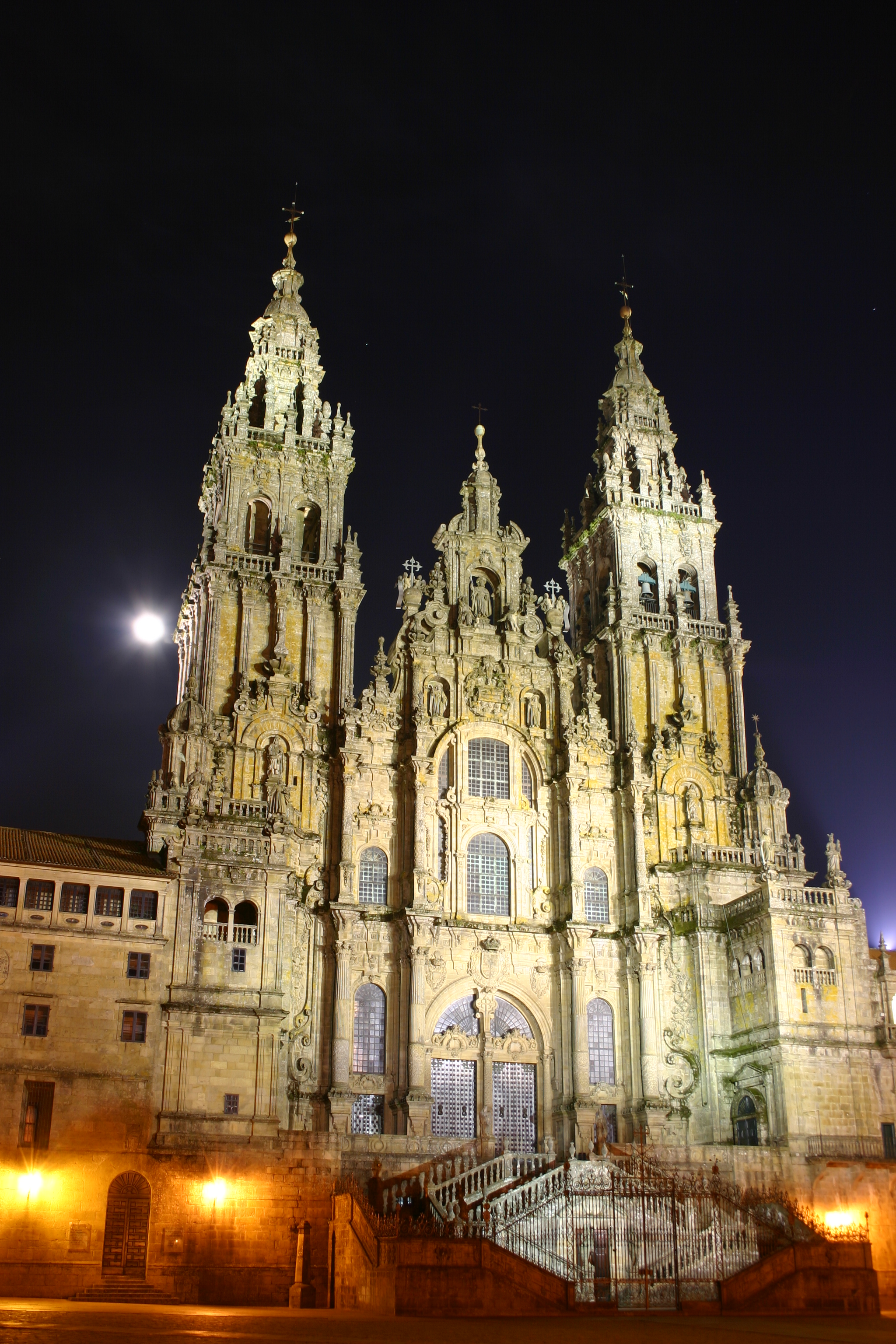
1 Catedral de Santiago de Compostela, Praza do Obradoiro, ☏ +34 98 156 9327. Daily 07:00-21:00. Massive cathedral built from 1075 but only consecrated in 1211. It's mostly Romanesque but each facade is different and fronts onto a plaza. The main entrance is west from Praza do Obradoiro: this facade is 18th century Baroque, with its pair of stonking towers. You pass through the Pórtico da Gloria into the nave, which at first looks plain till your eyes adjust and you see the altar and other decor. The crypt below the main altar has the supposed tomb of Santiago, Saint James. A huge Botafumeiro - an 80 kg silver incense burner - is normally on display in the library but for major religious events it's hitched up on pulleys and swung through the nave by a team of red-robed tiraboleiros. They needed such a big one to disguise the stench of medieval pilgrims who'd been weeks on the road. Adult €20, conc €16. (updated Feb 2025) Palacio de Xelmírez or Gelmírez is the archbishop's residence, named for its first occupant. It's north side of the cathedral, entered via an internal door, and included in the same ticket. Some tickets allow access to the roof. Cathedral Museum, Praza do Obradoiro., ☏ +34 98 155 2985. Daily 10:00-20:00. Entered separately from Praza do Obradoiro but usually on the same ticket, this exhibits the cathedral’s history and artistry. You also see the Cloister, Library (with the Botafumeiro censer), the Chapterhouse, the tapestry collection, and the continuous balcony with views of the plaza and old town streets. (updated Feb 2025) Praza do Obradoiro is the imposing square just west of the cathedral, named for the workshop of its stonemasons. Left of Pórtico da Gloria (the cathedral entrance) is Gelmírez Palace and right is the cathedral museum. North side of the plaza is the plateresque Hostal Real, which was accommodation for pilgrims and is now a Parador hotel, see Sleep. West side is the Raxoi (or Rajoy) Palace, now the city hall. South is San Jeróni
Do
Pilgrim Reception Office (Centro Internacional de Acollida ó Peregrino), 33 Rúa das Carretas (100 yards north of cathedral plaza), ☏ +34 981 568 846. Daily 10:00-18:00. Get your pilgrim's certificate for completing El Camino de Santiago. (updated Feb 2025) Pilgrim House, Rua Nova 19 (100 m south of Plaza de Quinta
Overview adapted from Wikipedia, travel guide fromWikivoyage (CC BY-SA). Photography via Wikimedia Commons.