
Sant Joan de les Abadesses
Spain · Europe
About Sant Joan de les Abadesses
Sant Joan de les Abadesses is a town in the Ripollès region of Girona. It occupies the centre of a valley in the Pre-Pyrenees, crossed by the Ter River and surrounded by high mountains such as the Serra Cavallera.
Sant Joan de les Abadesses travel guide
Understand
The origins of the town lie in the founding of the Monastery of Sant Joan de les Abadesses by Wilfred the Hairy in 887. This was one of the first nunneries founded in Catalonia, and its first abbess was Emma of Barcelona, daughter of Wilfred. The Benedictine community grew in wealth and importance throughout the 10th century. However, in 1017, the nuns, accused of violating the rules by which they were supposed to be living, were expelled in a bull by Pope Benedict VIII. Around the monastery, the town of Sant Joan was founded. At the beginning, the laypeople lived around the Church of Sant Pol, in the neighbourhood today known as El Raval. But the town's growing population necessitated the construction of a walled town (the Vila Vella) on land that had been known as El Vinyal. This part of the town was home to numerous medieval guilds. In the mid-19th century, coal mining began in Ogassa, precipitating the construction of a railway from Sant Joan to Barcelona. The railway was finished on 17 October 1880. This accelerated the town's growth and industrialisation. The town sits at an altitude of 775 m above sea level.
Tourist office 1 Tourist office (Oficina de turisme - Palau de l'Abadia), Plaça de l'Abadia, 9, ☏ +34 972 72 05 99, [email protected]. M-Sa 10:00-14:00, 16:00-19:00, Su 10:00-14:00. (updated Sep 2025)
Getting there
By plane The nearest airports are in Girona (GRO IATA) 85 km (53 mi) and Barcelona (BCN IATA) 130 km (81 mi).
By train Closest train is in Ripoll.
1 Ripoll train station (Estació de tren de Ripoll), pl.de l'estació. R3: L'Hospitalet de Llobregat - Puigcerdà then take Teisa bus until Sant Joan de les Abadesses
By bus Autocars Teisa, ☏ +34 972 70 20 95. (updated Feb 2025)
By car From Barcelona The C-17 (N-152) from Vic (Barcelona) to Ribes de fresser and then the C-26 (N-260) Eix pirinenc from Berga to Figueres From France AP-7 to Figueres and then C-26 (N-260) Eix pirinenc From Girona take C-66 and then C-26 (N-260) Eix pirinenc
Getting around
Parking 2 Sant Joan de les Abadesses Motorhome area (Àrea d'autocaravanes de Sant Joan de les Abadesses). (updated Sep 2025) 3 Can Creuet parking (Aparcament de Can Creuet), passatge de Can Crehuet. (updated Sep 2025)
See
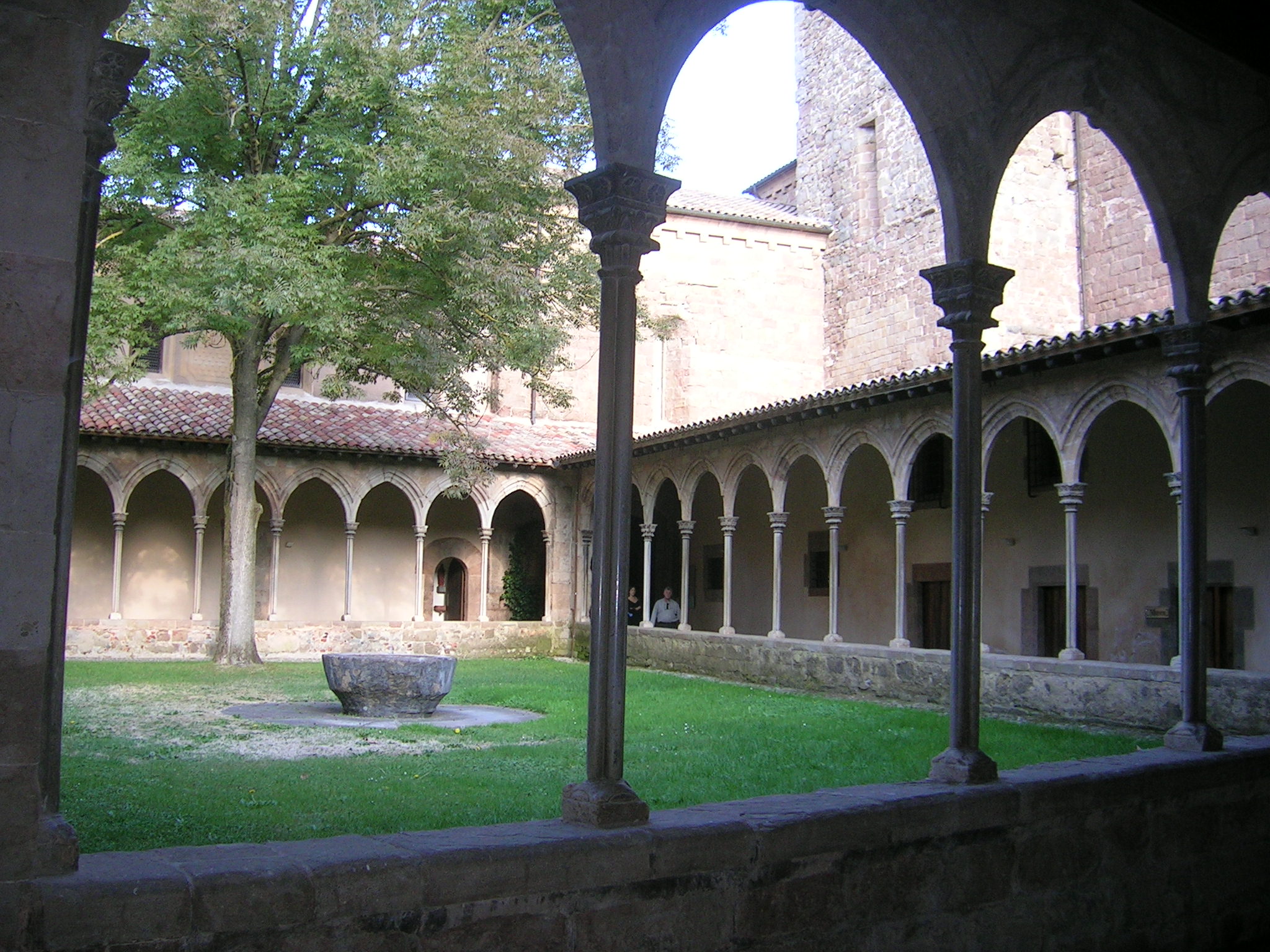
1 Monastery of Sant Joan de les Abadesses, Plaça de l'Abadia. The monastery was founded in 885 by count Wilfred the Hairy, who destined it to the education of his daughter Emma, who later became the first abbess. Wilfred had previously founded the monastery of Santa Maria de Ripoll for his son Radulf.The church was consecrated on 24 June 887 by the bishop of Vic. In 1017, by request of Bernard I of Besalú, a papal bull suppressed the nunnery; Bernard acquired them, and brought into the monastery (now part of the bishopric of Besalú) a community of monks. From 1083 to 1114 it was under the Monastery of St. Victor of Marseille, who sent here a community of nuns of Greek origin. In 1114 the intervention of the Pope allowed a community of Augustinian canons to take possession of the monastery in a definitive way. Ruled by local abbots until 1484, later it was under commendatory abbots. In 1592 the monastery was secularised and converted into a simple collegiate, suppressed in 1856. It was declared a Historical Monument in 1931. (updated Sep 2025). 2 Old Bridge (Pont Vell). The bridge was built between 1128 and 1138 by order of Abbot Berenguer Arnau thanks to the financial and personal help of the nobility and peasantry of the valley. During the 14th century, several repair works were carried out, and the earthquake of 1428 certainly affected its structure. On February 8, 1939, it was dynamited, and on July 4, 1976, the rebuilt Pont Vell was inaugurated. (updated Sep 2025) 3 Old city (Vila Vella). Step into the story of Vila Nova, whose roots reach back to the early 1200s. Imagine visionary abbots—Pere de Soler and Ramon de Blanes—transforming old monastic fields into a bustling medieval settlement. Rather than winding, haphazard streets typical of the era, Vila Nova was cleverly designed in the image of ancient Roman cities, with broad, straight roads crossing each other in neat grids. At its heart lies the Main Square, which for centuries has been the lively center of
Do
Cycling Pirinexus runs along the city Way of Iron and Coal from Ripoll until Ogassa
Events Joan Maragall Literary Contest: everyone from the age of eight can participate and is structured in two categories: schoolchildren with mandatory format and modalities, and adults in poetry or narrative modalities. The prizes are awarded on Saint George's Day. 3 Days Trial Santigosa: the most prestigious trial event in Spain. Organised by the Abadesses Moto Club, it was the first long-term event in Spain and the second worldwide, after the '6 Days Trial in Scotland'. Fira de Sant Isidre: which promotes the world of farming as part of our tradition. Among the emblematic events of the fair, it is worth highlighting the morphological competition of brown cows, the hand-milking competition, the parade of old tractors through the streets of Sant Joan, the craft products fair or the guided tour A trip through the life of a farmer. Reception of the Flame of Canigó: Every year, in June, the traditional reception of the Flame of Canigó is held at the Monastery of Sant Joan. It is an activity organised by the Unió Excursionista. The Aplec de Sant Antoni is celebrated annually on the occasion of the feast of this Saint, around June 13, and is organized by the pabordes de Sant Antoni. Many villagers come to the mountain of Sant Antoni to attend the mass in honor of the Saint. Afterwards, sardanas are danced and a fellowship meal is offered. The day ends with another sardana audition. Festival del Comte Arnau: In July and August, the Festival del Comte Arnau takes place. This is a cultural project with a clear objective: to recover the legend of Count Arnau, one of the main identifying and differentiating cultural features of the town. This cycle includes theater, dance and music shows about the Myth and, around it, other activities are scheduled such as the dinner - show Alimentem el mite, the night walk Cercant les pejades del count Arnau, guided tours. City festival (Festa Major
Go next
Ripoll Camprodon Olot Capçaleres del Ter i del Freser Natural Park
Overview adapted from Wikipedia, travel guide fromWikivoyage (CC BY-SA). Photography via Wikimedia Commons.