
San Pedro de Atacama
Chile · Americas
About San Pedro de Atacama
San Pedro de Atacama is a town of 3,899 (2012) in Northern Chile. San Pedro is a very popular destination among Chilean tourists and international visitors looking for a desert experience and a stepping stone to the amazing landscapes around it. Most attractions are part of the Los Flamencos National Reserve, perhaps Chile's most varied and amazing national park.
Despite its name and tourism industry claims, San Pedro is not "in the heart of" the Atacama Desert (the world's driest desert outside Antarctica), but in a transition zone between the desert's core and the high Andes. In fact, San Pedro de Atacama and its surroundings get more than five times the annual rainfall of many other cities in northern Chile, such as Calama, Antofagasta, Iquique, and Arica. However, it is true that several of the Atacama Desert's astronomical observatories are located in San Pedro's general area.
San Pedro de Atacama travel guide
Understand
Prices in any of the laid back bars and restaurants fare well against Santiago's. Still, it's a fairly expensive location, as it's one of Chile's three most popular destinations, along with Torres del Paine and Easter Island.
San Pedro vs. Uyuni As many people head for San Pedro to continue their travel into Bolivia doing the popular Salar de Uyuni tour, it is important to note that many sights found around San Pedro have similar equivalents on the Bolivian site. Hence, instead of paying twice, it is worth thinking about skipping some tours offered in San Pedro and saving the money. This is also what many travellers that did both countries agree with and recommend to other. In fact, the sights along the Salar de Uyuni tour are equally or even more beautiful and impressive than what can be found around San Pedro, e.g. 1) Geysers del Tatio: 2 hr from the border you will visit a smaller but much more versatile site with mud pools, loud steams and geysers, and shortly after that a nice warm thermal pool with magnificent views which easily tops the semi-warm thermal pool at the Geysers del Tatio. And you do not have to get up at 5, freeze your bottom off, and get hassled along the way due to the limited time. 2) Lagunas Altiplanicas: Already the first stop after the border at the Laguna Verde (or the Lagunas on the second day) and the Laguna Colorado at the end of the first day top this tour, with much more flamingos and more versatile views, not to mention the value of Salar de Uyuni over Laguna Chaxa. 3) Astronomic tour: This can easily be realised in the middle of nowhere on the Salar de Uyuni tour with no lights whatsoever around. 4) Salar Tata: The diversity of the sights along the Salar de Uyuni tour is immense and also covers this tour. Nevertheless, the Valle de la Luna is a must when in San Pedro and cannot be skipped for anything along the Salar de Uyuni tour. Likewise, the Laguna Cejar, and a bicycle, hiking or sandboarding tour around San Pedro are not sub
Getting there
By bus 1 Terminal de Buses, Tumisa Road (Inside Craft Village; about 1 km southeast of the city centre.). (updated Apr 2023) Several buses per day connect the town with Calama (see Calama#Get in for schedules), operated by TurBus, KTUR, Frontera del Norte, Atacama 2000, and Intertrans. The trip takes about 1½-2 hr, and costs 3,000-5,000 pesos. Other buses like TurBus travel also from Antofagasta (4 hr; 9; 000 pesos), Iquique, Arica (12 hr; 22; 000 pesos), and Santiago. It is best and cheaper to transfer in Calama, because it is easy to get there with regular national buses (because of the airport and the mine), and between Calama and San Pedro more frequent and cheaper regional buses operate. Also, buses connect San Pedro with Salta and San Salvador de Jujuy in Argentina. There are also regular buses from Uyuni, in Bolivia (30; 000 pesos). But skipping the Salar de Uyuni Tour between the Chilean border and Uyuni for a simple bus is not recommended—it is one of the most impressive and most inexpensive tours you can do in South America. Nevertheless, cross border bus passes are available from Green Toad Bus which allow you to travel to San Pedro from Argentina, Brazil, Peru, Bolivia and the rest of Chile. Or just ask at the tourist information or one of the booking offices in town.
By plane No airlines fly direct to San Pedro. The nearest commercial airport is Calama. Most flights are direct, and connect Calama with Santiago, but a few also fly to Antofagasta and Iquique. LATAM (has the most flights; and the best support; but isn't always the cheapest), Sky Airline (terrible website; better service than LATAM), PAL and JetSMART fly to Santiago from US$12 one way. To get from the airport to Calama, take a taxi. From Calama to San Pedro is about 90 min by bus (2; 500 pesos). Transvip and Licancabur run minivan transfer to hotels in San Pedro de Atacama for 10,000-12,000 pesos. No need to reserve: you can buy tickets at their airport booth. Be very careful when you are
Getting around
On foot and navigation Once in the town, nearly all points of interest, restaurants, services, are within walking distance, with the exception of a few outlying hotels. Downtown comprises twelve small blocks, between the streets Domingo Atienza and Toconao from west to east, and Licancabur and Caracoles north to south. This last street is the main one, a pedestrian zone. Outside of town you can even reach Valle de Marte on foot. Also, there are many hiking trails north and northwest of town. For reliable trails and GPS navigation in this desert region, consult OpenStreetMap, which is used by many mobile Apps like OsmAnd or Mapy.cz. Or just download the according GPX or KML files through Waymarked Trails for such trails on OpenStreetMap. (Note; you just need to change the OpenStreetMap relation ID to download the GPX or KML files through the same link.)
By bicycle Bicycles can be rented in town: 3,000 pesos for 6 hr, 6,000 pesos full day. The rental usually includes warning vest, helmet, lamp, first aid kit, and pump. Bicycles can be a great and inexpensive way to explore the surroundings of San Pedro, like Valle de la Luna, Valle de Marte, Pukará de Quitor, Aldea de Tulor, and even Laguna Cejar (see below). Reliable tracks can be found with OpenStreetMap (see previous chapter). It is now illegal to ride a bike in the centre of San Pedro. If you look gringo enough, chances are the cops will let you slide — but it's advised not to try. They're fond of ticketing cyclists in the evening.
By car This is the most authentic, least stressful and, depending on the number of people, the cheapest way to do San Pedro and its sights. It is also far easier than you might believe. In 2 days you can cover most of the common and picturesque sights on your own time, even the Tito geysers. Most roads are good in good shape and suitable for regular cars. Also, when you travel along the common routes, there will always be traffic along the way in case you break down (nevertheles
See
In the following the essential places to visit around San Pedro. The description takes emphasis on the tours offered from San Pedro, but the sights can also be visited without a tour. For the entrance fees of just the sites, see the table at the end of this chapter. To keep track of the changing prices, opening times and closures of certain sites, San Pedro tourism office keeps a list outside of its doors.
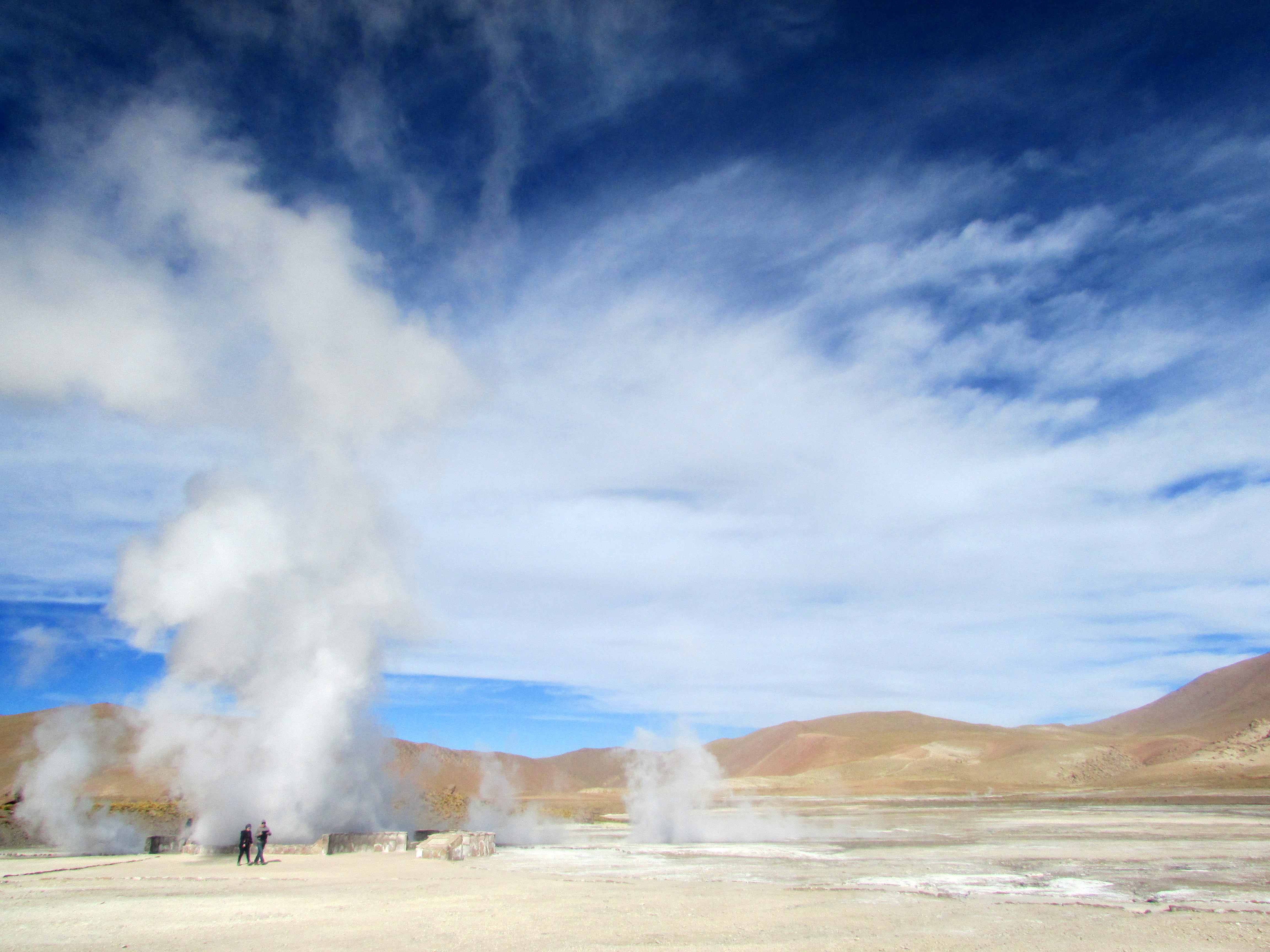
Geysers del Tatio 1 El Tatio. 4,200 m (13; 800 ft) above sea level, and some 100 km (62 mi) away from town, these are one of the highest geysers in the world. It's also the third-largest geyser site on Earth, with over 80 active ones. Most agencies travel there at 04:00. The spectacle is hard to forget-even if the geysers themselves are smallish, the backdrop, lighting, and sheer variety are astounding. Usually, you get to see them from the first stages of dawn, an hour before the sun rises, until sunlight bathes them completely. The best time to take pictures is at exact sunrise,
Overview adapted from Wikipedia, travel guide fromWikivoyage (CC BY-SA). Photography via Wikimedia Commons.