
Ross and Cromarty
United Kingdom · Europe
About Ross and Cromarty
Ross and Cromarty is a region of the Scottish Highlands, to the north and west of Inverness. It has a string of villages along the east coast, more separated villages along the lochs and inlets of the west coast, and lonely moors and mountains in between. There's little industry, and it's very thinly populated. Like neighbouring Sutherland, its population were systematically, sometimes forcibly, removed in the 19th century to make way for sheep, grouse-shooting and deer-stalking.
The local government county of Ross and Cromarty has been abolished by reorganisation, but still corresponds to a natural geographical region.
Ross and Cromarty travel guide
Understand
Ross is an ill-defined area, a wedge of territory with Sutherland to its north and the historic county of Inveness-shire south. It was an earldom by the 9th century, and in the 11th sat uncomfortably between the Vikings and Macbeth, the real-life ruler of Moray. It extended west out to sea to include Lewis, while Inverness-shire included Harris - those are one and the same island, but with no connecting road until modern times, and were reached from different ferry ports. But if Ross was ill-defined, the county of Cromarty-shire was an utter dog's breakfast, a scattering of exclaves far and wide. Ross and Cromarty were combined as a county from 1892, and remained so until 1975. They were then absorbed into Highland Region and lost Lewis, which joined Harris in the new entity of Western Isles.
Getting there
1 Inverness is the region's transport hub, with flights from across UK and Amsterdam. Trains run from Edinburgh and Glasgow via Perth and Aviemore to Inverness, with one direct daytime train from London Kings Cross via Peterborough, York, Newcastle and Edinburgh, and an overnight sleeper from London Euston. Trains from Inverness run north to Dingwall, Alness, Invergordon, Fearn, Tain, Ardgay, Culrain, Invershin and Lairg, continuing towards Thurso, which has ferries to Orkney. There are four trains M-Sa and one on Sunday. Another two trains branch southwest from Dingwall via Achnasheen and Plockton to Kyle of Lochalsh, for buses to Skye. The main road A9 runs north from Inverness across Kessock Bridge and the Black Isle to Tain and Dornoch, continuing towards Golspie, Helmsdale, Wick and Thurso. Stagecoach Highlands Bus X98 / X99 follows this road, four times M-Sa and twice on Sunday. A835 runs inland from Inverness to Ullapool. Scottish Citylink Bus 961 runs twice a day M-Sa and once on Sunday along this route. Calmac car ferries sail between Ullapool and Stornoway on Lewis, taking about 2 hr 45 min. They sail year-round, with two sailings M-Sa, one on Sunday Nov-Mar and two Apr-Oct. The Citylink buses are timed to meet these ferries.
Getting around
You can get around Easter Ross and Black Isle by public transport, just about, and along radial routes from Inverness to the main west coast ports. Anything else is going to need a car. The North Coast 500 is a 500 mile circuit around the coast of Caithness and Sutherland and Ross and Cromarty.
See
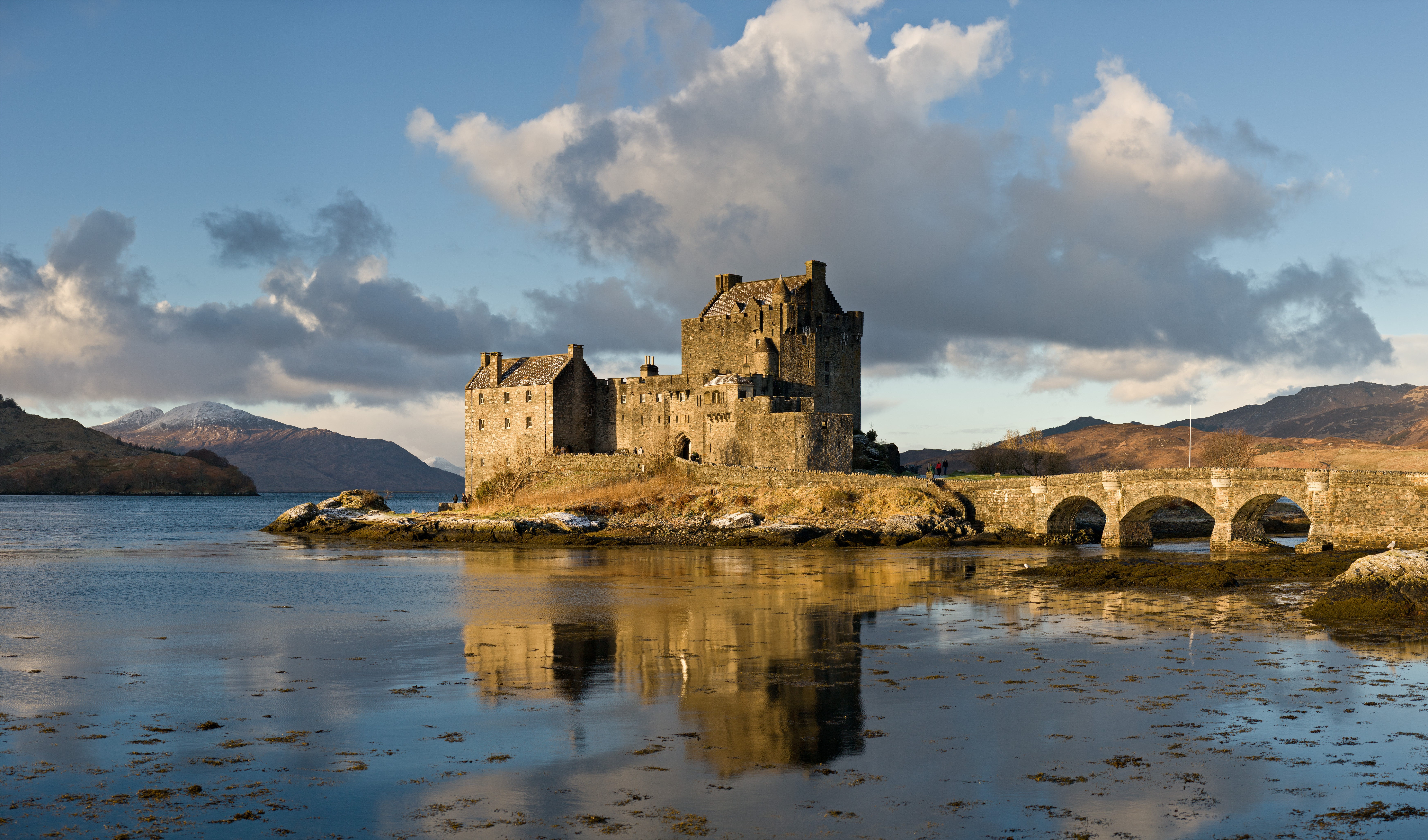
Gardens: best of these is Inverewe at Gairloch. Wildlife: always be watching, especially along the coast. Dolphins are especially common off Fortrose, and there are red kites at Dingwall. Castles: Eilean Donan at Dornie is the standout, but the oldest are the Iron Age brochs (2000 years old) near Glenelg. Weird geology: the UNESCO North West Highlands Geopark stretches up the west coast into Sutherland. The Lewisian gneiss is 3 billion years old.
Do
Highland Gatherings and Games: many villages host an event during summer. Pipe bands, caber-tossing, field & track events and so on; often combined with Agricultural Shows. For instance the Black Isle Show is held in late July-early Aug at Muir of Ord. Visit Scotch Whisky distilleries: best known is Glenmorangie at Tain. There's another at Muir of Ord near Dingwall and a couple more at Alness. Climb mountains: the Torridon hills are very scenic, and there are many "Munros" in this region.
Eat
Best dining option is usually the local hotel restaurant, open to non-residents, but sometimes closed in winter. There's no standout, but the keynote is fresh, locally-sourced ingredients, especially for sea-food.
Drink & nightlife
The larger villages have at least one pub but the small places often have none. Many local hotels have public bars.
Go next
North to Caithness and Sutherland, for the wild north coast of Scotland, with Smoo Cave, cliffs and whirling sea birds. Ferries make the short crossing to the Orkney Islands. The Great Glen and Strathspey: most routes south lead back to Inverness, but it's possible to wind along the west coast via Fort William and Glencoe. Reach Skye by road, or sail from Ullapool to Stornoway on Lewis.
Overview adapted from Wikipedia, travel guide fromWikivoyage (CC BY-SA). Photography via Wikimedia Commons.