
Ronda
Spain · Europe
About Ronda
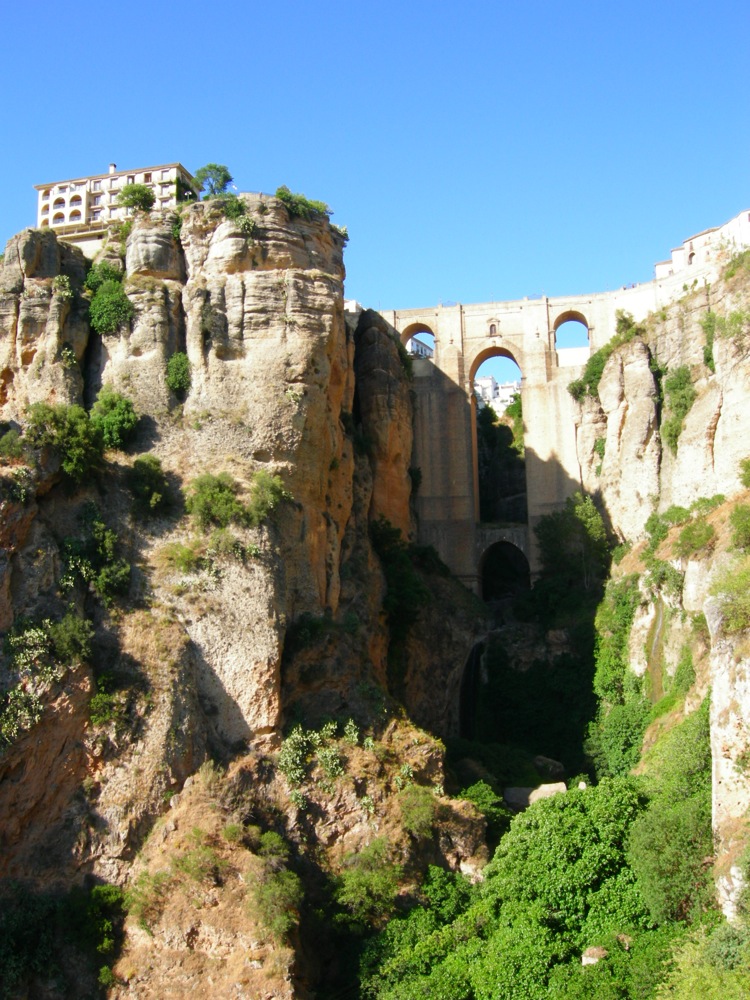
Ronda is a town in Malaga in Spain. Set in and around a deep gorge spanned by an impressive bridge, the relaxing atmosphere here is a great break from some of the more tourist-ridden places on the south coast of Spain, however it can still be packed with day-trippers from the Costa del Sol, especially during the peak summer months.
Ronda travel guide
Understand
Ronda was first settled by the early Celts, and later inhabited by Phoenicians, Greeks, and Romans. The Moors left an indelible imprint in the city, which only fell to the Christian reconquista in 1485. In more modern times, the town has hosted a number of well-known writers, including Ernest Hemingway, Orson Welles, James Joyce, and the German poet Rainer Maria Rilke. Ronda is divided into three neighbourhoods: the more modern Mercadillo, with the bus and train stations and other services; La Ciudad, the old Moorish quarter which has been largely preserved; and the Barrio de San Francisco. The town makes a good base for outdoor pursuits, including hiking, canoeing and river kayaking, and mountain biking.
1 Tourist Information Office (Oficina Municipal de Turismo de Ronda), Paseo Blas Infante, s/n, ☏ +34 952 18 71 19, [email protected]. M-F 10:00-18:00/19:00 (winter/summer), Sa 10:00-14:00, 15:00-17:00, Su and holidays 10:00-14:30. Can help with accommodation and offer suggestions for sightseeing. Has hiking maps for sale, and bus and train schedules are posted in the window. (updated May 2016)
Read Ernest Hemingway, For Whom the Bell Tolls. The execution scene in Chapter 10 is based upon events which took place in Ronda during the Spanish Civil War.
Getting there
By train 1 Ronda Railway Station, Avenida de la Victoria, 31 (approx 900 m NE from the centre), ☏ +34 902 432 343. M-F 07:00-22:00, Sa Su and holidays 07:00-21:00. There are direct connections by train with Algeciras, Malaga, Antequera, Granada, Cordoba and Madrid. Timetables and ticket information are available online. (updated Dec 2024) A taxi from the train station to the quarter of La Ciudad should cost about €7, or it takes about 20 minutes to reach it on foot.
By bus 2 Bus Station, Calle Comandante Salvador Carrasco (approx 400 m west from the railway station along the Avenida de Andalusia). Five companies offer service to Ronda. From Málaga the easiest access is by bus, with Los Amorillos buses costing around €10 and taking about two hours. A comprehensive bus schedule for all lines can be downloaded here. (updated May 2016)
By car From Marbella on the Costa del Sol, the scenic road A-376 leads through the mountains north. Plan on 1-1½ hours for the 43-km journey, which after many hairpin curves reaches an elevation of 1,125 m before descending to Ronda. At the highest point is a monument to the German poet Rainer Maria Rilke, in the form of a stone memorial with a stylized pen nib. For a scenic route from Seville, head south on A-376 to Utrera, and then take A-375 to Puerta Serrana, and A-384/374 further on to Ronda. From Jerez de la Frontera, take A-382 west to Arcos de la Frontera, continue on A-384 past the exit to Puerta Serrana and Seville, and pick up A-374 to Ronda. Distances to Ronda: Madrid 612 km, Algeciras 100 km, Cadiz 150 km
Getting around
Ronda is a small town, both easily and best navigated on foot. While driving in by car may be interesting - once within Ronda - park it! Ronda is difficult to navigate by car, especially in the older quarters. In some parts - non-resident cars aren't even allowed to use the streets! There are two reasonably convenient public car parks in the Mercadillo: an underground garage beneath the 2 Plaza del Socorro; and another 3 car park on Avenida Poeta Rilke, north of the bull ring.
See
1 Puente Nuevo. This large and incredible bridge over the Tajo gorge, finished in 1793, is Ronda's principal attraction. The bridge is 70 m long and 98 m high, equivalent to a 30-floor building, and connects the quarter of La Ciudad with the Mercadillo. It was built following the collapse of an earlier bridge from 1735; this bridge had a single arch of 35m but collapsed six years after construction, killing 50 people. There are beautiful views from here of the Sierra de Grazalema to the west. A small museum is inside.
Mercadillo
2 Plaza de Toros, Calle Virgen de la Paz, 15, ☏ +34 952 874 132 (tickets), fax: +34 952 870 379, [email protected]. Nov-Feb 10:00-18:00, Mar 10:00-19:00, Apr-Sep 10:00-20:00, Oct 10:00-19:00; closed on bullfighting days in September. The oldest and one of the most highly regarded of Spain's bull rings, built in 1785 in the neoclassical style. This is considered to be the cradle of modern Spanish bullfighting, where Pedro Romero (1754-1839) developed a new style of fighting bulls on foot (and not from horseback as had been done previously); he also was the first to begin using a red cloth. Romero retired after he had killed 5000 bulls and remained uninjured. His son and grandson carried on the tradition. €6.50, €8 (with audioguide). Also located inside is a bullfighting museum. 3 Parque Alameda (near the bull ring). A nice park with shady trees and ample walking space. You can see wonderful panoramas from the viewing platforms.
La Ciudad
The old district of Ronda, beyond the new bridge. Full of twisting, narrow streets.
4 Iglesia de Santa Maria la Mayor (Church of Santa Maria la Mayor). M-Sa 10:00-19:00; Su 10:00-12:30, 14:00-19:00. This is most important church in Ronda, built after the reconquista on the site of town's former principal Moorish mosque, with construction lasting from 1485 until the end of the 17th century. The only features remaining from the mosque are the arch of the mirhab and a section of its wall covere
Do
1 Interpretation Center of Ronda Wine, Calle Gonzalez Campos, 2, ☏ +34 95287 97 35, [email protected]. Daily 10:00-20:00. Old winery and now a museum of wine, offering wine tastings and vineyard tours. €4-10. (updated May 2016) 2 La Casa Del Rey Moro (Palace of the Moorish King), Calle de Santo Domingo, 9 (cross the famous bridge into La Cuidad; take the first proper street to the left; La Casa is on the left), ☏ +34 952 18 72 00. Pretty gardens and a castle undergoing renovation. The main attraction, however, is the water mine – underground steps leading all the way down to the bottom of the gorge. Feria de Pedro Romero (Festival of Pedro Romero). Beginning of September. Celebrated with parades and bullfights. Hiking. There are a number of hiking trails around Ronda, including eight with trailheads beginning in Ronda. The tourist information office carries maps and trail descriptions for €1/trail; alternatively their website has a comprehensive list of routes with GPS coordinates and trail descriptions available for free download. One of the most popular routes is Route 3 (SL-A 38), which descends to the bottom of the Tajo Gorge passing by several excellent viewpoints of the Puente Nuevo. (A word of caution is advised; though; as if there is an extended dry spell; the gorge can stink because sewage is still released into the river.) Sportmountain, ☏ +34 664444855, [email protected]. Considered possibly one of the most picturesque and historically charged descents in Spain, a river that divides a city in two, with a 100-meter deep abyss.The descent of the river runs through the centre of Ronda. E
Overview adapted from Wikipedia, travel guide fromWikivoyage (CC BY-SA). Photography via Wikimedia Commons.