
Ploiești
Romania · Europe
About Ploiești
Ploiești is the closest city to Bucharest in Romania (2021 population: 180,540). The city has an attractive core with a collection of 19th-century mansions, unique museums, and excellent rail connections to the rest of the country, making it a convenient base or jumping-off point while exploring Romania.
Known as the birthplace of the modern oil refining industry, it was home to the world’s first large-scale oil refinery in 1856 and remained a major refining hub throughout the 20th century. While not a touristy city, Ploiești draws international visitors engaged with the various local industries and businesses and foreign students at the Oil and Gas University (UPG).
Ploiești travel guide
Understand
Ploiești traces its formal founding to 1596, when Michael the Brave, Prince of Wallachia, is said to have established it as a market town, though the area had been inhabited for centuries before. Its rise coincided with the decline of nearby Târgșor, once one of the most important cities in Wallachia, now a small village barely 13 km away from Ploiesti. As Târgșor’s trade and influence faded in the late 16th and 17th centuries, merchants and craftsmen gravitated to the growing market in Ploiești, drawn by its position on the crossroads linking Bucharest with Moldavia and Transylvania. By the late 19th century, it had grown into one of Romania’s key commercial hubs, thanks to its industries, thriving vineyards on the hills to the east, and strategic position. During this time, merchants from across the country gathered here, and the city gained a reputation for its lively spirited nightlife. At its height, just after the First World War, there was said to be a pub for every 200 residents in Ploiești. During the Second World War, Romania was the largest producer of oil in Europe, with local refineries from Ploiești supplying nearly a third of Nazi Germany's oil needs. This led to repeated bombing raids, the most famous being the 1943 U.S. bombing known as Operation Tidal Wave. Today, Ploiești remains an industrial centre with four active oil refineries, though its proximity to Bucharest has drawn much of the younger residents to the capital or abroad in search of new opportunities.
Local information Ploiești city website Ploiești City App Android / iOS
Getting there
By plane Ploieşti is served by the same airport as Bucharest, the Henri Coandă International Airport that is 45 km away. There is a rail line connecting the airport with the main train station of Bucharest where you can easily hop on a train to Ploiești at any time before 22:30 (€3-5). Taxis/Uber/Bolt can also make the journey from the airport to Ploiești but at a significantly higher cost (€25 to €40).
By train
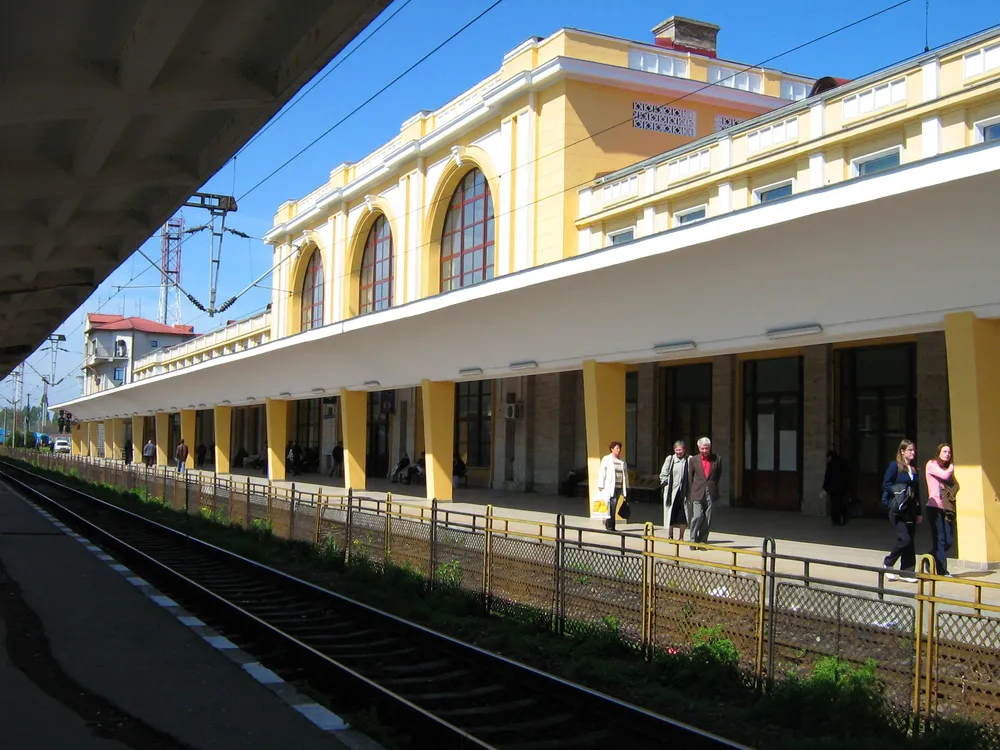
Ploieşti is the second most important railway hub in Romania and is linked by numerous trains with every major city in the country (there are more than 60 trains daily connecting Bucharest) through its train stations. Trains take between 35 and 70 minutes to cover the distance between Bucharest and Ploieşti, depending on the type of train. The train is the fastest way to get to Ploieşti, both from Bucharest and Brașov.
Train stations 1 Gara de Vest (Western train station). Connections between Bucharest and the whole of Transylvania crossing the Carpathian Mountains into Brașov via Prahova Valley and its famous resorts like Sinaia and Predeal. Some international trains to Budapest, Hungary and Vienna, Austria stop at Ploiești Vest. 2 Gara de Sud (Southern train station). Connections between Bucharest and the whole of Moldavia through Buzău. International trains to Chișinău, Moldova and Kyiv, Ukraine stop at Ploiești Sud. 3 Gara de Nord (Northern train station). Only local commuter trains going to Măneciu, a small town at the foot of the Ciucaș Mountains.
Transfer between Gara de Sud and Gara de Vest A dozen or so trains a day connect the two stations, running regularly. The train journey takes 6 minutes. Any train in Gara de Sud with a destination in Transylvania will stop in Gara de Vest and any train in Gara de Vest with a destination in Moldavia or Măneciu will stop in Gara de Sud. Otherwise, bus line 2 connects the two train stations within 20 minutes. Taxis take 10-15 minutes at a cost of roughly €2.
By bus Ploieşti is home to two official
Getting around
On foot Ploiești is quite compact and easy to explore on foot, especially in the central area where most attractions are.
By public transport The city’s public transport network, operated by Transport Călători Express Ploiești (TCE), covers all districts with 38 bus routes, 4 trolleybus lines, and 2 tram lines. Public transport navigation is available on Google Maps, though be aware that timetable timings are often unreliable and some routes run less frequently than expected. Single fares cost 2.5 lei and can be paid directly with a contactless bank card on board. Paper tickets are also available at kiosks near major stops.
Key lines bus 1, 30: Crossing the city from south to north via southern train station. bus 2: Connecting southern and western train stations via city center. tram 101: Crossing the city from southern train station to the main regional hospital at the northern side of the city via city center and northern bus station. tram 102: Following the ring road from the western train station to the north of the city and the main regional hospital via northern bus station. trolleybus 202: Connecting southern train station to western minibus station via city center.
By taxi Taxis and ride-hailing (Uber; Bolt) are widely available at all hours, and a trip across the city rarely costs more than 25 lei. While most drivers are honest, a few may try to overcharge by claiming the meter is broken or taking a longer route if they suspect you’re a visitor. To avoid surprises, confirm that the meter is running before starting your journey or use a ride-hailing app where the fare is set in advance.
See
Ploiești’s historic architecture suffered heavily during the 1943 U.S. bombing raids and in the following decades under Communist rule, which replaced much of the old city with the stark concrete brutalist buildings typical of southern Romania. Quite a bit of the surviving old buildings lay abandoned in a poor state or have been improperly refurbished, not taking the historical design into account. Still, a number of gems remain that reveal the city’s layered past.
1 Cathedral of St. John the Baptist (Catedrala Sfântul Ioan Botezătorul). Romanian-Orthodox cathedral of St. John the Baptist, built in 1923-37 in Neo-Brâncoveanu style, a highlight of Romanian ecclesiastical architecture. (updated Aug 2025) 2 Statue of Liberty (Statuia Libertății). A gift from France erected in 1881, the freedom statue depicts the Roman goddess Minerva. 3 Central Market Halls (Halele centrale). Built between 1930 and 1935, these interwar market halls are one of Ploiești’s most distinctive landmarks. Their neo-Romanian façade, crowned by a clock tower and steel-framed dome, hides a bustling world of traders selling fresh produce, cheeses, meats, baked goods, and Prahova Valley honey. (updated Aug 2025) 4 Palace of Culture (Palatul Culturii). Built between 1912 and 1918 as a courthouse, this striking neoclassical building is one of Ploiești’s architectural gems. Its grand façade features imposing columns and ornate detailing characteristic of early 20th-century Romanian design. Today, the Cultural Palace serves as a vibrant cultural centre housing several museums and exhibition spaces. Visitors can explore local history, art, and cultural heritage showcased through rotating exhibits and permanent collections. (updated Aug 2025) 5 The Grand Synagogue (Marea Sinagoga), Strada Basara
Overview adapted from Wikipedia, travel guide fromWikivoyage (CC BY-SA). Photography via Wikimedia Commons.