
Perpignan
France · Europe
About Perpignan
Perpignan (Perpinyà in Catalan) is the capital of the department of Pyrénées-Orientales, the Northern Catalonia part of France, and about 15 km from the sea. Perpignan is home to about 120,000 people, and has two rivers flowing through it; with the Têt to the north, and the Basse through the centre. Once the continental capital of the Kingdom of Majorca, Perpignan has been an economical and educational centre for centuries, and this is evident in its architecture.
Perpignan travel guide
Understand
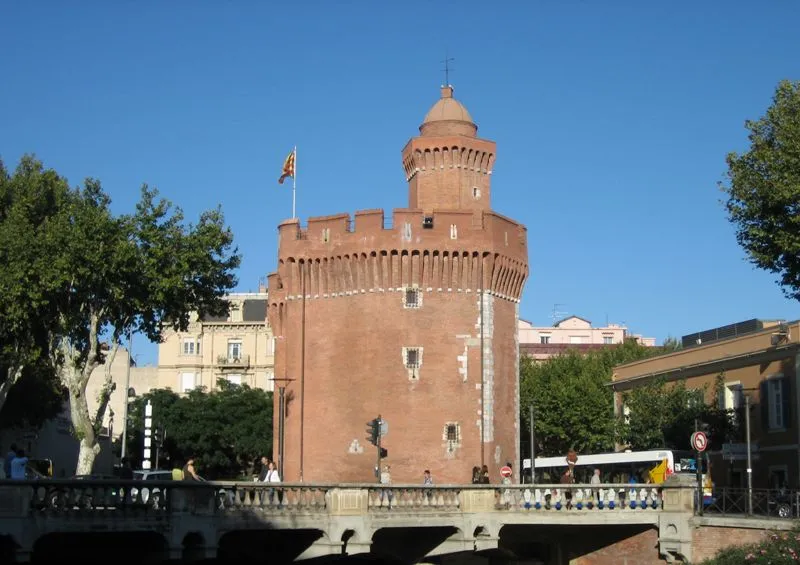
Perpignan sits on the crossroads of the French and Spanish, Catalan and Languedocian cultural spheres. It was the "mainland" capital of the Kingdom of Mallorca for a while and gained further fame as a connection point between France and Spain when the first high-speed standard gauge rail line between the two countries opened from Figueres in 2010 with the missing section onwards via Girona to Barcelona and thence all of Spain opening in 2013. Perpignan gained some questionable fame in the 2020 municipal elections when a member of the far-right RN and former partner of its leader Marine Le Pen, won the mayoral election, making Perpignan the biggest city with a far-right mayor in France. Perpignan is in the heart of the Roussillon plain, about 10-15 km from the beaches of Côte d'Améthyste (Amethyst coast) on the Mediterranean. It sits between the Corbières region and the Albères Massif, foothills of the Pyrenees and the emblematic mountain Pic du Canigou is visible to the southwest. The historical centre has narrow streets with brick houses and one of the highlights here is the quartier Saint-Jacques with the Medieval Jewish quartier. The citadel with the royal palace, the Castillet and ramparts are monuments to the time when the city was the capital of the Kingdom of Mallorca. There's more to the old town than history, it also has many bars and a vibrant nightlife. The outskirts of the city show a sharp contrast to the old town. In the latter half of the 20th century Perpignan grew rapidly, one of the reasons was that people moving from independent Algeria settled here. During this time many suburbs emerged, being built quickly and in a disorderly manner. This article also covers Argelès-sur-Mer, one of the major seaside resorts in the south of France (300 days of sunshine per year). That old and lively Catalan village is built around its church and museum.
Climate The climate is Mediterranean with hot summers and mild winters, which is evident in the vegetation.
Getting there
By plane 1 Perpignan–Rivesaltes Airport (PGF IATA), Ave Maurice Bellonte, ☏ +33 468 526070. The airport is small, with daily flights by Transavia from Paris Orly, and by Ryanair from the UK and Morocco. Bus 6 runs to town every 30 min M-Sa else take a taxi. (updated Jan 2024) Other airports within an hour's drive are:
Girona-Costa Brava, (GRO IATA) is 116 km (72 mi) by A9 (E15) and then AP-7 (E15) Carcassonne, (CCF IATA) is 116 km (72 mi) by A9 (E15) and then A61 Béziers, (BZR IATA) is 118 km (73 mi) by A9 (E15) Further afield, these airports offer more international flights
Toulouse-Blagnac, (TLS IATA) is 215 km (134 mi) by A9 (E15) and then A61 Barcelona El Prat Airport, (BCN IATA) is 208 km (129 mi) by A9 (E15) and then AP-7 (E15)
By train 2 Gare de Perpignan, 1 Place Salvador Dali. TGVs run from Paris (5 hours), Lyon and Marseille via Narbonne, and continue south to Girona, Barcelona Sants (80 min) and Madrid. Trains also run from Toulouse, Nimes and Montpellier via Narbonne. Regional trains run every hour or two to Cerbère and Portbou: this was the old route to Spain (immortalised in a painting by Salvador Dalí), and you can still travel that way. The station has decorative paintings in Dalí's style, plus car hire and "Centre del Món" a small shopping mall.Luggage can be temporarily stored at the Hotel PB at the east entrance of the station for €5 a piece. (updated Jan 2024)
By bus Flixbus runs daily direct from Paris, taking 12 hr 30 min and continuing to Barcelona. Other services from Paris involve changing in Lyon. Blablabus ride-shares are often the most convenient way to Girona, Barcelona and cities in southern France. Local buses run to Argelès-sur-Mer, Thuir, Ille-sur-Têt, Le Boulou and Quillan. Central Bus Station is west side of the railway station.
By road Autoroute A9 (La Catalane; toll) follows the coast. From the north join it off A7 near Orange, and follow it past Nîmes, M
Getting around
Walk: town centre is compact, and much is pedestrianised. Buses are operated by Sankeo: their website has a route planner, timetables and maps. The network extends to nearby towns. Taxis wait at the airport and railway station. Firms in town are Accueil Perpignan (+33 468 351515) and Alternative Taxi (+33 652 664318). Driving: not if you can avoid it. Especially in summer, the streets are congested and central car parks are full.
Parking 3 Parking Square François Arago, Square François Arago. open air Paid parking. (updated Jan 2026) 4 Q-Park Perpignan République, 9 Pl. de la République. Underground €2.9/hr, €37.5/day. (updated Jan 2026) 5 Parking François Palmarole, 22 Cr François Palmarole, ☏ +33 4 6866 3066. open air Paid parking, free on Saturday. (updated Jan 2026) 6 Parking Poncet, Boulevard de la France Libre, Mas des Caroubiers, el. open air Paid, free on Saturday. (updated Jan 2026)
See
Quartier Saint-Jean Established south of the Basse River, Saint-Jean is the historic part of Perpignan. In the 11th century the counts of Roussillon established a fortress around the small church of Saint-Jean le Vieux. It's a lively part of the city largely composed of brick buildings with or without coating and small alleys and squares between them. Many streets are pedestrianized and lined by shops and restaurants. Place de la Loge is the most famous square, and was known in the Middle Ages as Plaça dels Richs Homens (the square of the rich people in Catalan). It's surrounded by buildings of great importance during the time; Loge de Mer (court and commercial exchange), Palais de la Députation, and the city hall. In the middle stands "La Vénus au collier", a statue by painter and sculptor Aristide Maillol (1861-1944). Nearby Place de Verdun sits right next to the Castillet and around the corner is the Basse, surrounded by greenery. In addition to walking around on your own, in the warmer half of the year there are guided walking tours departing from the tourist office, a tourist train going around the historical centre, and a boat with electric motor plying the Basse.
1 Perpignan Cathedral (Basilique-Cathédrale de Saint-Jean-Baptiste de Perpignan), 1 Rue de l'Horloge, ☏ +33 468 513372. Daily 08:00-17:00. Work on this large brick cathedral began in 1324 during the rule of King Sancho I of Majorca. The fall of the kingdom and the Black Death impeded works, and the building was only finished in 1509. It became a cathedral in 1602. It's been modified many times over the centuries and the oldest part is the choir with its seven-sided apse. Attractions include the white marble main altarpiece with scenes from the lives of Jesus and St John the Baptist, and altarpieces of Notre-Dame-de-la-Magrana and Saint-Pierre. There's also a small chapel with sacred art of the early 14th century, and a wooden crucifix brought here from the Rhine Valley. The western façade of the
Do
1 Théâtre municipal, Place de la Republique, ☏ +33 468 663354. Theatre. (updated Mar 2026) 2
Overview adapted from Wikipedia, travel guide fromWikivoyage (CC BY-SA). Photography via Wikimedia Commons.