
Passau
Germany · Europe
About Passau
Passau is a city in Bavaria, Germany, close to the Austrian border. Nowadays, Passau is known for its historic buildings, its university, and its location at the three rivers, and for the last German train station before Austria.
Passau travel guide
Understand
Passau has a population of around 50,000, and an additional 8,000 when university is active. The city is situated at the point where the river Inn and the river Ilz meet the Danube (Donau), and therefore is often called the "Three River City" (Dreiflüssestadt). It is approx. 2,000 km (1; 200 mi) upstream from the estuary of the Danube, at the Austrian border, and enjoys a small but thriving local tourist trade. The area of Passau was first settled by the Celts, who were living in southern Bavaria ages before the Romans came and founded a fortress here because of the excellent strategic position of the peninsula of Passau. Later on, the fortress grew and Passau became a real city. Much of the money in the city was made from the salt trade with nearby Bohemia (in the present-day Czech Republic), with the salt coming from Bad Reichenhall near Salzburg. In the Middle Ages, Passau's Saint Stephen's Cathedral was the head of the regional church district, which extended all the way to Hungary. Most of the old buildings have survived to this day and are still in active use. Like much of Bavaria, it's also predominantly Catholic. If you look very closely, however, you can spot Protestant churches. Most tourists arriving in Passau are on river cruises along the Danube, but there are also many buses that arrive here from all over Germany and Austria. Because Passau is not far from the Czech Republic and Austria, there are many Austrians and Czechs here to work or shop. Although most tourists are native German speakers, you will get around town without much of a problem with only English, given the large number of students.
Getting there
By plane Linz International Airport (LNZ IATA), 80 km (50 mi) to the south-east of Passau in Austria, is the closest airport to the city, but also the smallest and least likely to host international flights, with the exception of flights from London Stansted. Munich International Airport (MUC IATA), one of the busiest airports in Europe is 150 km (90 mi) to the west of Passau and is most likely the place you will arrive, if you are on a flight from outside Germany. You can take a bus to Freising train station and from there a train to Passau (2 hr 20 min). Taking only the train is less convenient: the quickest way is to take a S-Bahn to Neufahrn, then another to Freising before taking a regional train to Passau (2½ hours). Taking the S-Bahn to Munich and then a train to Passau is longer as it involves a significant journey in the wrong direction. You'll save time by driving. Nuremberg International Airport (NUE IATA) is situated 200 km (120 mi) to the north-west of Passau and has mostly domestic and a few European connections. That seems quite far away, but given the excellent train connections from Nuremberg to Passau by ICE high-speed trains, that might even beat Munich Airport in terms of travel time to Passau.
By train 1 Passau Central Station (Hauptbahnhof) is located by the River Danube, only 300 m (330 yd) west of the city centre. Due to its location along a high-speed mainline, the city sees quite a lot of train traffic, most notably the hourly ICE high-speed trains between Frankfurt, Nuremberg, and Vienna, as well as direct hourly express trains to and from Munich, Wels, and Linz. There are also regional trains to towns and cities in the Bavarian National Forest.
By car Passau is on the German A3 autobahn (which continues into Austria; as the A8) with three exits, Passau-Nord (115), Passau-Mitte (116), and Passau-Süd (117), and is also well connected to the German and Austrian federal highway network.
By boat Passau is a regular port of call for
Getting around
Passau is a little spread out, but most places you will want to see are within walking distance, and buses run frequently (until 23:00) and are fairly cheap. On the other hand, if you walk 20 min from the city center in the right direction you are in Austria. You can catch taxis, but they can be a little pricey.
See
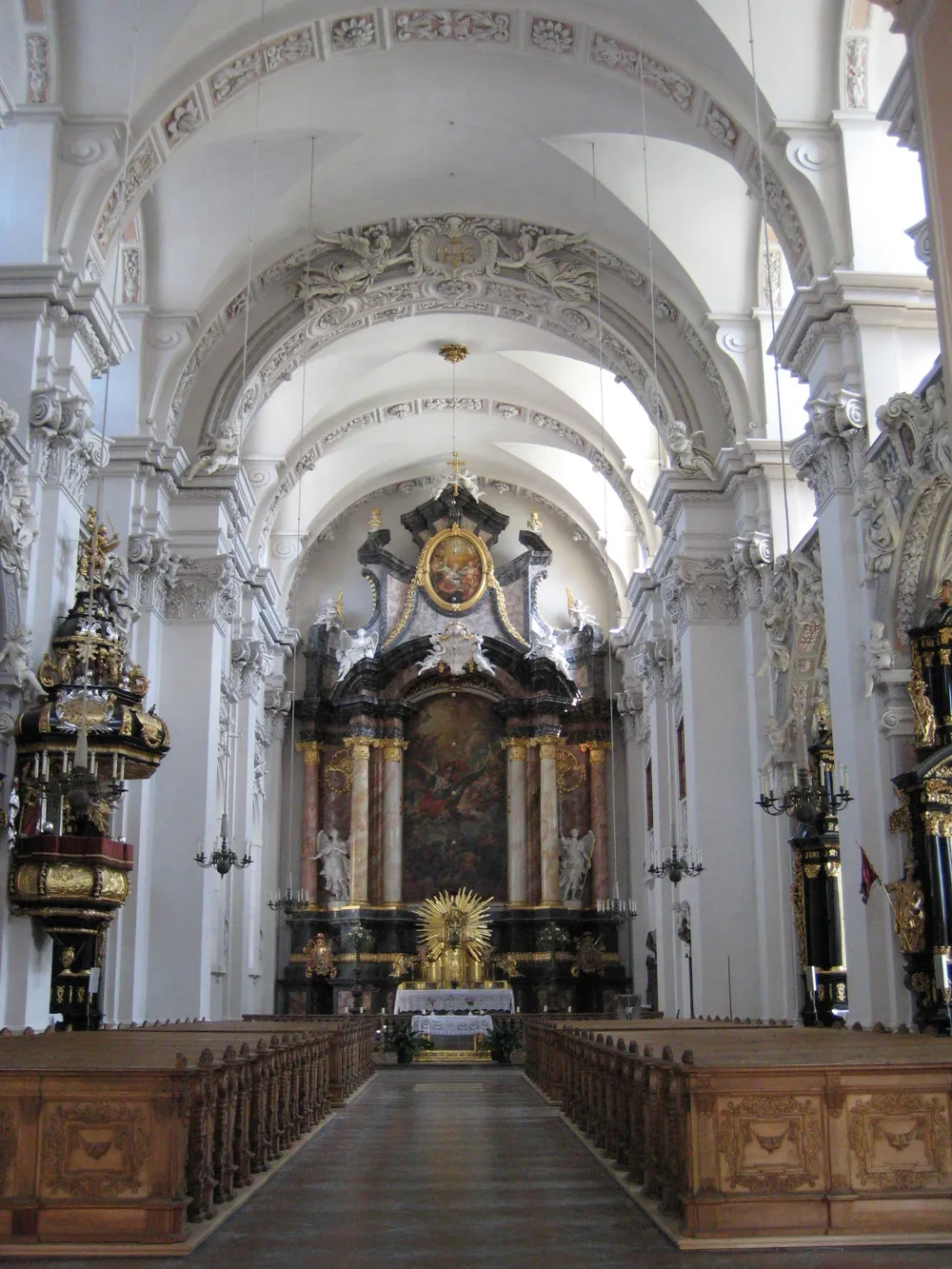
1 Fortress Veste Oberhaus (Veste Oberhaus), Oberhaus 125, ☏ +49 851 396800, [email protected]. Mar-Nov M-F 09:00-17:00 & Sa Su 10:00-18:00. The fortress was built in 1219 by Passau's Prince-Bishops in order to control commerce across the rivers. During the Napoleonic Wars the castle was one of the strongholds against the Austrians (Bavaria sided with Napoleon at the beginning of the war). Due to several changes over the centuries today's castle consists of Gothic, Renaissance and Baroque parts. Today the fortress houses a museum focussing on the history of Passau and its surroundings. It also offers one of the best views over the city and the confluence of the rivers. Adult €5, concession €4. 2 Glass Museum (Glasmuseum), Schrottgasse 4, ☏ +49 851 35071, [email protected]. 13:00-17:00. The museum focuses on the most important era of glass manufacturing from 1650-1950 with exhibits from Baroque, Rococo, Art Noveau, Art Deco, and Modernism. Friedrich Dürrenmatt once called it the world's most beautiful glass house. Adult €7, concession €5. 3 Mediaeval Pillory (Pranger), Marktplatz (Hals). At the market place of the Hals district of Passau, a little outside of town, there is a reproduced pillory, a mediaeval form of punishment in which people were exhibited, secured by their hands and neck, to be publicly humiliated and taunted by passers-by. 4 Old City Hall (Altes Rathaus), Bahnhofstraße 28, ☏ +49 851 955980, [email protected]. Mar-Oct: M-F 09:00-17:00, Sa Su 10:30-15:30; Nov-Feb: M-F 09:00-16:00, Sa 10:30-15:30. The Old Town Hall was completed 1405 in Venetian style and has ever since kept its design. The interior is designed in a baroque style. It still houses parts of the city administration. 5 St. Michael's Church (Jesuitenkirche St. Michael), Schustergasse, ☏ +49 851 955980, [email protected]. Mar-Sep: M-F 09:00-17:00, Sa Su 10:30-15:30; Oct-Feb: M-Th 9:00-17:00, F 09:00-16:00, Sa 10:30-15:30. This baroque church on the river banks gives Pa
Do
1 Beer festival (Maidult und Herbstdult). A week in May & Sep. Passau has two beer festivals, one in May and one in September, that last one week each. 2 Danube Bike Path (EV6) (Donauradweg). The Danube Bike Path is a European long-distance cycle route, that begins further upstream the river, but the section between Passau and Vienna is the most travelled by far. The surface and signage along the route is very good and there are many places that invite the cyclist to stop and have a wine or beer. Ilztalbahn. mid-May to mid-October. Scenic trains from Passau to Freyung in the Bavarian Forest (updated Apr 2018)
Buy
There's a bunch of tourist shops around Passau, so you can easily find some original Bavarian Lederhosn or a Bavarian hat to take home as a souvenir. In and around the central shopping mall as well as in close by Bahnhofstraße you will find the typical highstreet shops like H&M, Orsay, New Yorker and C&A, several shoe shops (Sutor; Görtz 17; Roland), home decoration stores (Butlers; Depot) as well as several book shops. On the
Overview adapted from Wikipedia, travel guide fromWikivoyage (CC BY-SA). Photography via Wikimedia Commons.