
Palekh
Russia · Europe
About Palekh
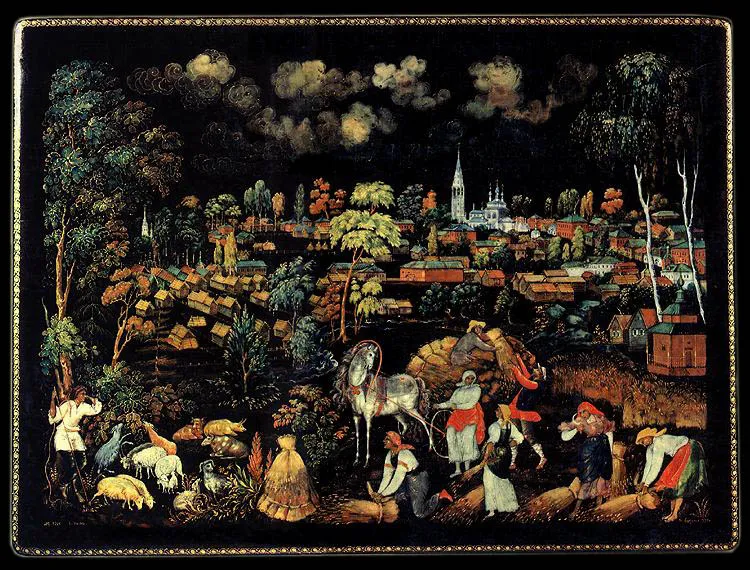
Palekh is a small town in Ivanovo Oblast. A very artistic town, Palekh is the origin of the prominent 19th-century Palekh school of icon and mural painting, exhibited prominently at the Church of the Exaltation of the Cross. In the 20th century the town distinguished itself by the innovation of distinctive lacquer painted miniatures, famous across Russia.
Palekh travel guide
Understand
Palekh is a small village, and everything interesting is concentrated in it on the central streets of Lenin and Bazhanov or within a radius of a couple of hundred meters from them. There is no public transport. An hour is enough for an external inspection of Palekh, although it would be a mistake not to look at the museums, so try to come here during the day and expect 3-4 hours.
Getting there
By train The nearest railway station is in Shuya, where the Lastochka stops four times a day, traveling from Moscow to Ivanovo. From Moscow to Shuya it takes a little over 3 hours, and then another half hour by bus. Buses run on average every half hour. The bus station is located in Shuya next to the station. The same route can be made through Ivanovo, but the railway and bus stations there are very far from each other, and there are not much more trains than in Shuya.
By bus Ivanovo buses stop in Palekh and go to regional centers in the southeast of the region: Yuzha, Pestyaki, Puchezh, Verkhniy Landeh, and Nizhny Novgorod. Movement interval: 1-2 times per hour, travel time is no more than one and a half hours; all these buses make an intermediate stop in Shuya. Direct buses from Moscow run a couple of times a day (7 hours).
1 Bus station (Автовокзал), ul. Shuiskaya, 1 (next to Magnit), ☏ +7 49334 2-11-74. A small pavilion with a ticket office and a waiting room. (updated Feb 2019)
By car The P152 highway passes through Palekh, connecting Ivanovo (65 km) and Nizhny Novgorod (180 km). The road from Palekh to the south is essentially a dead end and will be useful only to those who go to see Kholui or Yuzha.
See
1 Holy Cross Church (Крестовоздвиженская церковь), ul. Lenina, 59. A complex elongated silhouette, an elegant hipped bell tower and the lilac domes of the Holy Cross Churches. The church was built in 1762–1774 in the spirit of the Naryshkin baroque, which by that time had long gone out of fashion, but remained mainstream on Ivanovo land. All the churches here are like this, although the Palekh church is still unusual. Firstly, its creator Yegor Dubov is immortalized with a large inscription on the western wall. Secondly, the matter was not limited to the Dubov project: later the bell tower and the refectory were connected, chapels were added, and the structure acquired a completely intricate shape, the decor of which did not lag behind. On the eastern wall of the temple there used to be a composition “Elevation of the Cross”, created by the Salapin brothers in the middle of the 19th century and is now difficult to distinguish, so all that remains is to look at the interior, where the paintings made in 1807–1812 are well preserved. local artists under the leadership of the Muscovites Sapozhnikov brothers, as well as an iconostasis of the early 20th century, stylized as Baroque examples of the 18th century. All this is a good opportunity to see Palekh religious painting in its natural surroundings, unless, of course, you are disturbed by parishioners, of whom there are quite a lot here even when there are no services. (updated Oct 2019)
2 Elias Church (Ильинская церковь), ul. Gorky, 6. The second Palekh church was built in 1790, although to the eye it seems older than the Exaltation of the Cross. There is no Naryshkin baroque here, but instead the usual Russian style of the 17th century: poskonny, rough, but cute. The church stands in the center of a pretty public garden, with several old tombstones around it. (updated Jan 2016) Unfinished workshops (Недостроенные мастерские), ul. Pushkin. The colorful ruins of an unfinished red brick building are one of the remind
Buy
Palekh miniatures — In the 20th century the town distinguished itself by the innovation of distinctive lacquer painted miniatures, famous across Russia.
Overview adapted from Wikipedia, travel guide fromWikivoyage (CC BY-SA). Photography via Wikimedia Commons.