
Osijek
Croatia · Europe
About Osijek
Osijek is a city in Eastern Croatia. Osijek is the largest city and the economic and the cultural centre of the eastern Croatian region of Slavonia, as well as the administrative centre of Osijek-Baranja county. It is an important transport hub and the principal city of Slavonia.
Osijek travel guide
Understand
Due to its important location near the junction of the Drava and Danube rivers, this large and prosperous town (the fourth largest city in Croatia with a population around 96; 000 in 2021) bore much of the brunt of the conflict in the 1990s. Many fine buildings have been restored to their former glory, though do not be surprised to see some scars still remaining. Some buildings still have bullet holes or shrapnel markings in them, though like the local economy, the town is mostly back to where it was in pre-war days. Osijek has a large student population, as it home to the University of Osijek where approximately 15,000 students attend (2018).
Getting there
Osijek is the major rail and road hub for eastern Croatia.
By rail Rail services to Osijek terminate at the grand 1880s railway building at the bottom edge of the central town. In addition to the numerous train services operate each day to Zagreb (including the high-speed tilt train which completes the journey in around 3 hours), there are services to Koprivnica and Rijeka as well as other local services within Croatia to places like Slavonski Brod and Đakovo. The Croatian Railways has information on train times and tickets. The railway station is being renovated and modernised. There are daily connections with places in the city area. There are also daily connections to Bizovac spa.
By bus The bus station adjoins the train station and offers international as well as domestic services. Some of the many originating cities for trips to Osijek are Vukovar, Zagreb, Novi Sad, Belgrade, Pecs and Tuzla. Timetables, tickets and information are easily accessible. The Central Bus Station is being renovated as of February 2025 and will become the biggest one in south-eastern Europe. Bus companies Panturist, Polet, APP, Croatiatrans and many other smaller companies connect other parts of the country with Osijek daily.
By plane 1 Osijek Airport (OSI IATA) (some distance from the city). There is a twice-weekly international service (on Mondays and Fridays) by Croatia Airlines from Munich. In summer months, there are flights from the Adriatic coast from Split and Dubrovnik to Osijek Airport. This can be very useful to save back-tracking through to Zagreb once again, or the very mountainous and windy journey through Bosnia. Buses and taxis connect the airport with the city center and hotels. (updated May 2022) There is also a secondary airport, used exclusively for sport and private flying purposes (Sport Airport Čepin). It is also used for exhibitions. When Pope John Paul II visited Croatia, this was the place where the service was held. The annual car-show is also held
Getting around
Osijek is divided into two main regions - the upper town (focusing on the city square; Trg Ante Starcevic), and Tvrđa, the preserved fortress town to the east of the town centre along the Drava River. The whole city has 12 districts/blocks: Upper Town, Lower Town, Fortress, New Town, South 1, South 2, Green Field, Retfala, New Retfala, Industrial District, Tvrdjavica and The Left Coast. Osijek has a tram system dating back to 1884, and the three main lines connect the railway station, town square, Tvrđa, industrial district, all city borders (tickets can be bought from the driver; or you can purchase a BUTRA-universal bus/tram card for unlimited riding). The network is being completely overhauled and more than doubled in length, and the city's old trams are being modernized. Local buses fill the gaps where the trams do not run and are quite frequent. A map of the local transport system can be found on the Tourist Board's website. [1]. You can also experience the ride with the oldest tram in Europe, which has been renovated for sightseeing tours. Buses are riding about every 10-15 minutes in the city area, and every 20-25 minutes those which are connecting the settlements around the city (Tenja; Sarvas; Visnjevac; Josipovac; Cepin; Vladislavci; Bilje; Darda; Bizovac; Nemetin; Bijelo Brdo). There are numerous bicycling routes all around the city, such as Donji grad-Bilje, Jug II.-Industrijska četvrt, and so on. Taxis are serving the line within the main railway station/airport to the city centre. Otherwise, it is fairly straightforward and well-designed city to traverse by foot with few hills.
See
Kino Europa. Modernist architecture. Kino Urania. Secessionist architecture. Europska Avenija (Europe Avenue). Magnificent secession style buildings.
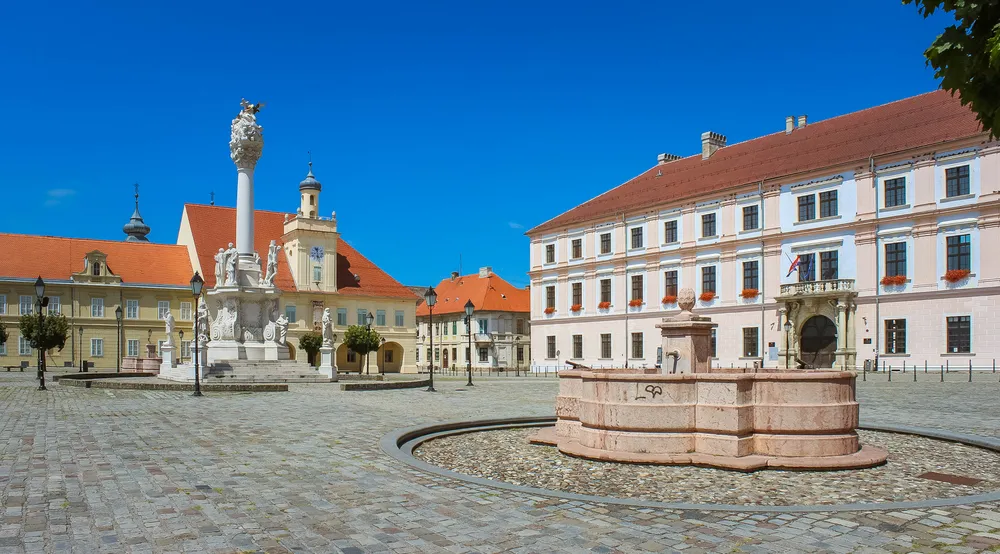
Tvrđa is the self-contained 18th-century Hapsburg defensive fortress just east of the city centre. This immaculately-preserved baroque military compound, designed by Maximillian de Gosseau in 1721, contains many fine buildings to view by day, and at night becomes the hotspot with bars and clubs. Luckily there was no damage during the 1990s conflict to the site, ensuring great viewing and photos. Tvrđa is based around the main square, Trg Svetog Trojstva, and the Museum of Slavonia is located here with artefacts throughout history as early as Roman times. There are also situated high schools, and university of Osijek. On the main square is also archaeological museum, and music school. Fortress is also the place for a good night-life with numerous bars, discos and restaurants. Co-Cathedral of St Peter and St Paul This is the tallest church in Croatia and has a spire of 90 m. The Co-Cathedral was planned by Josip Juraj Strossmayer, and the internal stonework is by renouned Austrian sculptor Hauser. The church contains many stunning stained glass windows and a large, fine-sounding pipe organ constructed by the Walcher firm of Linz, Austria. Co-Cathedral is often place for big concerts of classical and religious music. Croatian National Theatre, Zupanijska Ul. A beautiful building designed in 1886 and severely damaged in the 1990s conflict. A painstaking restoration has restored it to its former glory, though shortly afterwards a McDonald's restaurant opened up on the ground floor. Shows, concerts and opera are performed weekly. Promenada is located along the banks of the Drava River and is a pleasant walk past the marina, cafes, and parklands. In the winter port are also many bars, and the second tallest building in the city, Hotel Osijek (4-star hotel). Pejacevic Castle is on the edge of the Upper Town and on the e
Do
Visit the Franciscan monastery of St. Cross, situated in Tvrdja (Fortress). Franciscan monks will be delighted to show you the beautiful church, with interior decorated in high baroque style. They can also take you to see the rich monastery library. Franciscans are very, very polite and they will help you if you have any questions, not only about the monastery, also about the city. There are numerous shops and mall centres across the city, such as Esseker Centre, Emezetta, Ipercoop, Kaufland, Interspar, Mercator etc. Company Konzum has shops and market centres all around the city, and it is really easy to notice them. Go with a bicycle on a route from Osijek to village Bilje (about 10 km from Osijek), and explore the b
Overview adapted from Wikipedia, travel guide fromWikivoyage (CC BY-SA). Photography via Wikimedia Commons.