
Northern Netherlands
Netherlands · Other
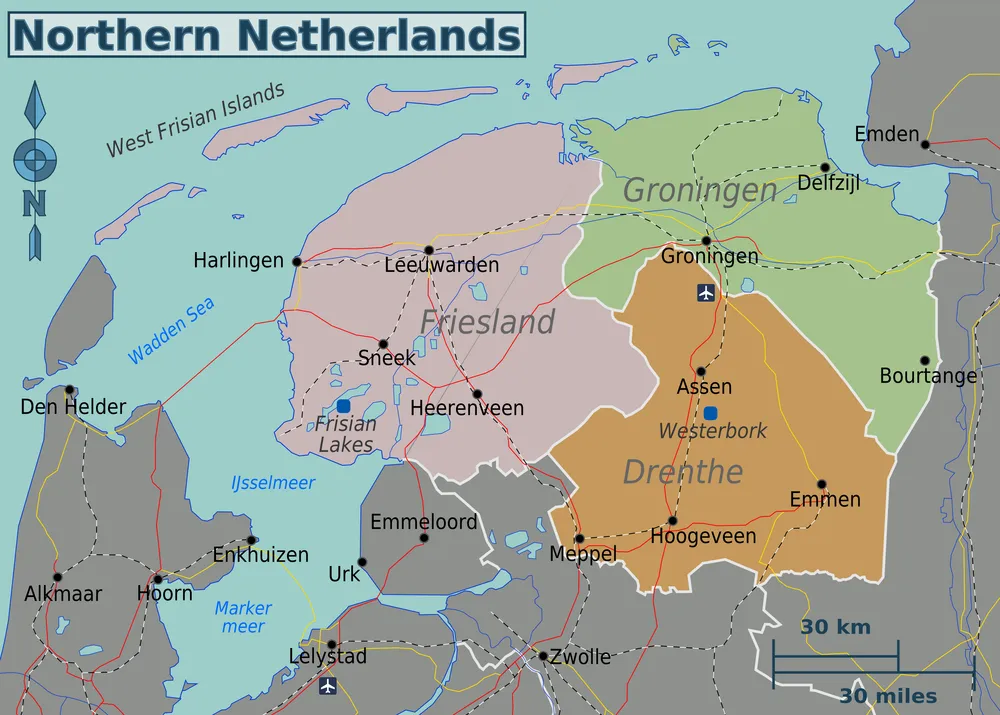
About Northern Netherlands
Obscure among foreigners, the Northern Netherlands can be a pleasant surprise. This sparsely inhabited region is home to some stunning historic fortifications, lovely cities, great museums and excellent watersports opportunities. Its nature varies from vast heathlands to beautiful lake areas.
As soon as winter shows its face, the odd chance of the "eleven-city-tour", a major ice-skating event passing 11 pretty towns in Friesland and last held in 1997, becomes the talk of the day in all of the country. Although nature rarely allows for the tour to be held, it seems to have become part of the Dutch identity. There's a small chance you'll find yourself caught in the middle of that massive event (estimations state that, would the tour be held, it would become the biggest single event in the history of the country), but the region is a lovely destination even in high summer.
Most of the Northern Netherlands consists of a flat polder landscape, with the exception of Drenthe, which lies on a plateau and consists of heathlands.
Northern Netherlands travel guide
Understand
Outside settlements, Friesland and Groningen mostly consist of meadows and arable land. Also, they are great areas for water-based activities such as sailing. Drenthe is a little different in that it also boasts large forests and more hilly terrain. Finally, the West Frisian Islands have a character all of their own. Life is generally lived at a somewhat slower pace than in the west. Drenthe in particular is popular with people looking to move to a more quiet area after their retirement. Conversely, many young people leave the region looking for work.
Getting there
There are several highways heading north, and forming a backbone for the road system in the region. The A7 motorway takes you over the Afsluitdijk, and entering the Northern Netherlands from the North Holland Peninsula. Then there's the A6, running north from Amsterdam via Flevoland, and the A28 from Utrecht and the Eastern Netherlands. From Germany, there is the A7 from East Frisia leading into Groningen, and the A37 from the Western Plains leading into Drenthe. For the rest, a good network of provincial roads make the region well accessible by car, motorbike and even bike, as apart from the highways, you'll find plenty of bike lanes. All domestic train connections to the Northern Netherlands run via Zwolle. For the major destinations you will not have to change, however, as intercity trains run straight through from Leeuwarden and Groningen to destinations like Amsterdam, Schiphol Airport, Utrecht, The Hague and Rotterdam. Typically, two intercity trains run north every hour. In addition, there is a regional railway from Germany (the town of Leer) leading into the Northern Netherlands. However, due to a damaged railway bridge, the railway border crossing is not operational (there are replacement bus services). There are several bus routes that may be used to enter the Northern Netherlands. Bus route 350 is a bus connection over the Afsluitdijk, and if you want to get from Alkmaar to Bolsward or Leeuwarden, this is your fastest option (2 hr, €17). This bus can get pretty crowded during rush hour. For most other points of departure, trains are typically more convenient and faster to get to the major places. Long-distance bus routes are served by companies including Flixbus. Such long distance buses connect the city of Groningen (a transport hub for the Northern Netherlands) to Amsterdam, Enschede and Eindhoven, as well as international destinations including Oldenburg, Bremen, Hamburg. Berlin, and Brussels. As for options via the air, Groningen Airport Eelde in Tyn
Getting around
Flat and wide, the Northern Netherlands are highly suited for biking and hiking, and many visitors explore at least a bit of the area that way. There are many ready-made routes, some indicated along the way and others to be bought at the tourist information centres you'll find in every mid-sized or larger town. As the Dutch love biking in general, there's also an abundance of route information online. However, with countless bike lanes and other biking facilities around, you'll have no trouble at all making your own way between the destinations of your choice, so hop on and get going! In most larger places you'll be able to find a rental bike; check the individual articles for listings. The extensive public transport system serves virtually every corner of the region and leaves very few places truly unreachable by public transport. Trains are operated by NS (Dutch national railways: key connections to other parts of the country) and by Arriva (regional trains in Groningen and Friesland provinces). Although this region is remote in the eyes of the Dutch living in the Western Netherlands, it has over 60 train stations. Most are small, but they are a great help in terms of accessibility. Note however that there will be no staff of offices at most of these village stations. Buses are operated by Arriva in the north and west of Friesland, and by Qbuzz in the remainder of the region, and include local, regional and fast interregional Qliner services. Large destinations like Groningen, Leeuwarden and Assen are typically served by a wide variety of bus services, and make good starting points to get to smaller towns. The website 9292.nl provides a route planner for all public transport. Roads are good and extensive, although the network of major highways is not as tight as it is in the west. If you're on your way to smaller destinations you may have to take the somewhat smaller N-roads, which are fine but have a speed limit of 80 or 100 km/h rather than 120/130. On the bri
See
Whether you're a history buff, a nature lover or an arts fan; there's plenty of sights well worth visiting. Having survived the test of time, the massive stones of prehistoric dolmen are a silent reminder of the early inhabitants of the region. Some 54 of these Hunebedden (as the Dutch call them) remain and make for an interesting stop when exploring the region. If you want to know more, head for the one near Borger, as it is the largest one and has an archaeological museum next to it. Although there's no dolmen at the spot, the Drenths Museum in Assen also has information and a fine collection of prehistoric artefacts, including well-preserved bog bodies. There's a lot of heritage from later times. The magnificent Fort of Bourtange is not only well restored, but also houses a history museum. There are several other fine examples of strongholds, including the Fraeylemaborg near Slochteren which is also a museum. The city of Groningen has a beautiful historic centre, with the tall Martini tower as a major landmark. If you have any interest in arts, don't miss the renowned Groningen Museum with ever changing but typically excellent collections of modern and classic arts. Of the many charming smaller historic towns, Appingedam with its hanging kitchens stands out, as does Franeker, with its monumental city hall and tiny but great 18th century orrery. Wonderful nature can be found on the extensive heathlands in Drenthe, the tranquil Frisan Lakes area and on the northern coast line. Hop on a boat to spend the night on Texel or another one of the small islands in the Waddensea, all popular holiday destinations for the Dutch. Visit the earless seal rescue centre at Pieterburen or watch animals at the Emmen zoo.
Do
Landscapes in the Northern Netherlands are wide and flat, making for perfect outdoor activities.
Hiking and biking is popular, as the countryside offers anything from heathlands to forests and agricultural fields to lake areas. The rural areas are dotted with villages and the meadows with cows hold some typically Dutch vistas. Whether you're a trained biker or just rented a bicycle to explore some of the natural surroundings, the lack of hills and mountains offers great routes for everyone. Mudflat hiking deserves a mention of its own. At low tide, as the shallow Wadden Sea pulls back, it's temporarily possible to walk from the northern coast to one of the Frisian islands. These activities are best
Overview adapted from Wikipedia, travel guide fromWikivoyage (CC BY-SA). Photography via Wikimedia Commons.