
Airborne Museum 'Hartenstein'
Netherlands · Other
About
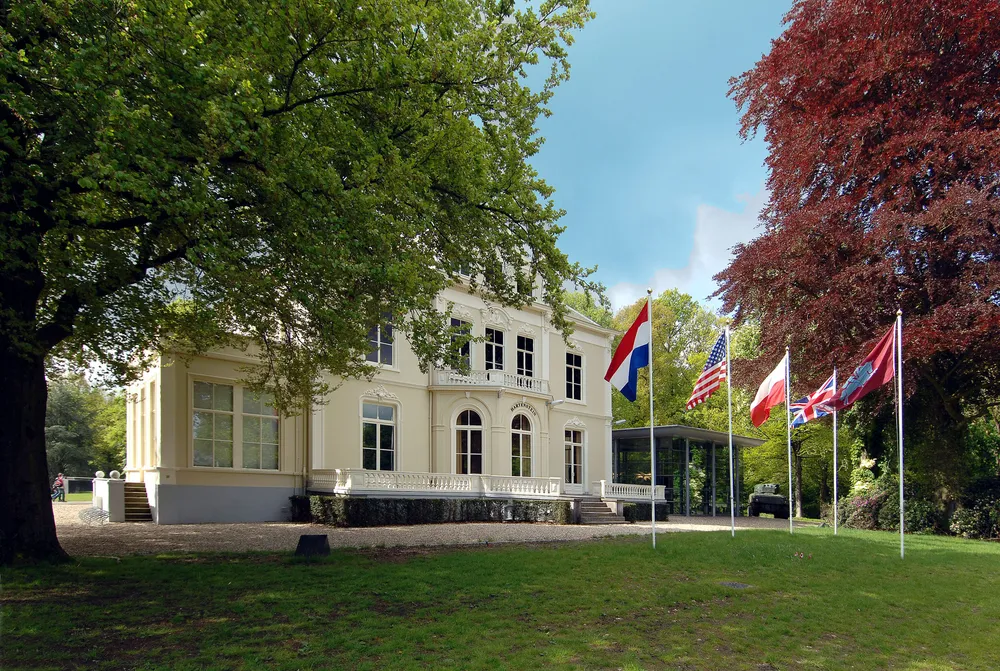
The Airborne Museum ‘Hartenstein’ in Oosterbeek, The Netherlands is dedicated to the Battle of Arnhem in which the Allied Forces attempted to form a bridgehead on the northern banks of the Rhine river in September 1944. Hartenstein served as the headquarters of the British 1st Airborne Division. In the museum an extensive and diverse collection is displayed consisting of original weaponry, genuine uniforms and equipment used in the battle. The numerous photos and films on display provide a realistic picture which is enhanced by interviews with Allied soldiers. In addition the museum has an award-winning Airborne Experience exhibition, that depicts the area around Arnhem and Oosterbeek during the battle. The museum also provides German and civilian perspectives.
Historical records from 1728 indicate that an inn called ‘Het Rode Hert’ (‘The Red Deer’) stood at the important crossroad of the 'Utrechtseweg' in Oosterbeek. In 1779 the inn and the surrounding land was acquired by a wealthy attorney to the Court of Gelderland named J. van der Sluys. The inn was demolished and in its place a mansion was constructed complete with adjacent annexes. The new mansion was named ‘Hartenstein’. After the death of Van der Sluys, ‘Hartenstein’ was passed along to a variety of owners. In 1865 the present building appeared on the site and a coach house was built next to it (now the site of restaurant ‘Hartenstein@Laurie'). In 1905 the villa was extended with two conservatories. Finally, in 1942, the Municipality of Renkum became Hartenstein's new owner and transformed it into a hotel.
After the invasion of Normandy in June 1944, the Allied troops made a quick advance towards Germany. The supply troops could not keep up with the troops on the front line causing the advance to a halt. A new frontline was formed in Belgium and France. To avoid the Siegfried Line, Field Marshal Bernard Montgomery had planned an operation in which British and Commonwealth forces would occupy several bridges in the Netherlands between Eindhoven and Arnhem. If this mission succeeded, the road to Germany would be open. Operation Comet as it was called was ultimately cancelled. At the behest of Eisenhower, General Lewis Brereton adapted Montgomery's original Operation Comet and renamed it Operation Market Garden. Starting on September 17, 1944 and ending in the morning of September 26. Operation Market Garden failed due to a combination of factors: a lack of airlift to transport the British 1st Airborne Division and the Polish Brigade on the first day, 1 AAF's choice of poorly chosen drop and landing zones around Arnhem that were too far from the bridge over the Rhine and, intense German opposition by the disregarded presence of SS armored forces in the Arnhem area. The time table for XXX Corps was ahead of schedule by some 36 hours when it arrived at Nijmegen expecting to cross unhindered. They arrived to find that the American 82nd Airborne under General Gavin had failed to take the bridge in Nijmegen upon landing as ordered whilst it was lightly defended, this now forced XXX Corps to deploy and clear the town of Nijmegen and then assault across the bridge themselves with the assistance of the 101st Airborne, delaying their advance on Arnhem by 3 days which allowed the German forces to reinforce and seal off Arnhem from relief.
In the area around Arnhem more than ten thousand men of the British 1st Airborne Division and the Glider Pilot Regiment landed north of the Lower Rhine, whilst the Polish 1st Independent Parachute Brigade landed on its southern banks in order to capture the Arnhem Road Bridge. Over 700 men under the command of John Dutton Frost did manage to reach the bridge and held its northern ramp for 4 days, but the bulk of the British forces were engaged by superior German forces (including the II SS Panzer Corps) and became trapped in Oosterbeek. Major General Roy Urquhart chose ‘Hartenstein’ as his headquarters. After holding out north of the Rhine for nine days, the division had to be withdrawn, although just over 2,000 of the 10,000 men who had landed reached the Poles south of the river. The Allied troops lost the Battle of Arnhem and ‘Hartenstein’ was left in a heavily damaged condition.
Adapted from Wikipedia (CC BY-SA). Photography via Wikimedia Commons.