
Naoshima
Japan · Asia
About Naoshima
Naoshima is an island and town in the Seto Inland Sea of Japan. Naoshima is famous for its contemporary art museums as well as outdoor contemporary art installations throughout the island.
Naoshima travel guide
Understand
It has a population of approximately 3,000 people. Although the island is much closer to the main Japanese island of Honshu, administratively it belongs to Kagawa Prefecture in Shikoku. Avoid visiting the island on Mondays, as most of the museums will be closed.
History The first settlement on the island was at the now-diminutive fishing port of Tsumuura on the southeastern tip of the island. The most prominent settlement on the island was Honmura which was established as a coastal castle town during the warring states period (1467–1568). The main industry is a smelter and refinery operated by Mitsubishi Materials.
Tourist information site The local tourist association has a bilingual guide site.
Getting there
By boat To reach Naoshima from the main Japanese island of Honshu, take a train to Okayama, transfer to a local train to Uno Station in Tamano, walk across the street to the boat terminal, and then transfer to a boat to Naoshima. Boats are also available from cities on other islands: Takamatsu (Shikoku) and Inujima. Naoshima has 2 passenger ports:
1 Miyanoura Port, 2249-40 Naoshima-cho (on the west side of the island). It's the main port and tourist entrance to the island. There's 56 lockers of various sizes for luggage storage and free Wi-Fi. 2 Honmura Port (on the east side of the island). Only small passenger boats arrive here. Ferries cost approximately ¥300 each way. Check the schedules and fares online.
Getting around
Detailed bilingual maps are available at the Marine Station Naoshima in the front of the Miyanoura ferry quay. The maps list guesthouses, restaurants, and major exhibits on the island.
By foot The island is quite hilly but pleasant enough along the coasts for biking and walking, except for the road from Miyanoura to Chichu Art Museum, which is a climb. Since the island is quite small, you can easily reach any place on foot in 30 to 60 minutes: the two villages, the ports and the museums.
Miyanoura port to Chichu Art Museum: about 30 minutes on southwest course (anti-clockwise). Miyanoura port to Honmura (Art House Project): about 30 minutes. Honmura to Benesse House: about 30 minutes. Try the high route that passes by the dam to see a surprising art exhibit near Benesse House. Start from the west side of Honmura, the first left after the Haisha art house. Benesse House to Chichu Art Museum: about 20 minutes.
By bicycle Information on bicycle rental in Naoshima is available online. There are 6 shops on the island that offer bicycle rental. Fees are ¥300-500/day for a push bike or ¥1,000/day for an electric bicycle.
By bus Town Bus circumnavigates the island and costs ¥100. Press the button to indicate that you want to get off at the next stop. Corresponds to the ferry schedule. Check the schedule since this bus is not frequent. Benesse House free shuttle bus operates approximately every 30 minutes between the major sights on the southern portion of the island. Benesse House Hotel's guests bus goes around the major spots from Miyanoura Port to Chichu Art Museum via Honmura and Benesse House hotels.
See
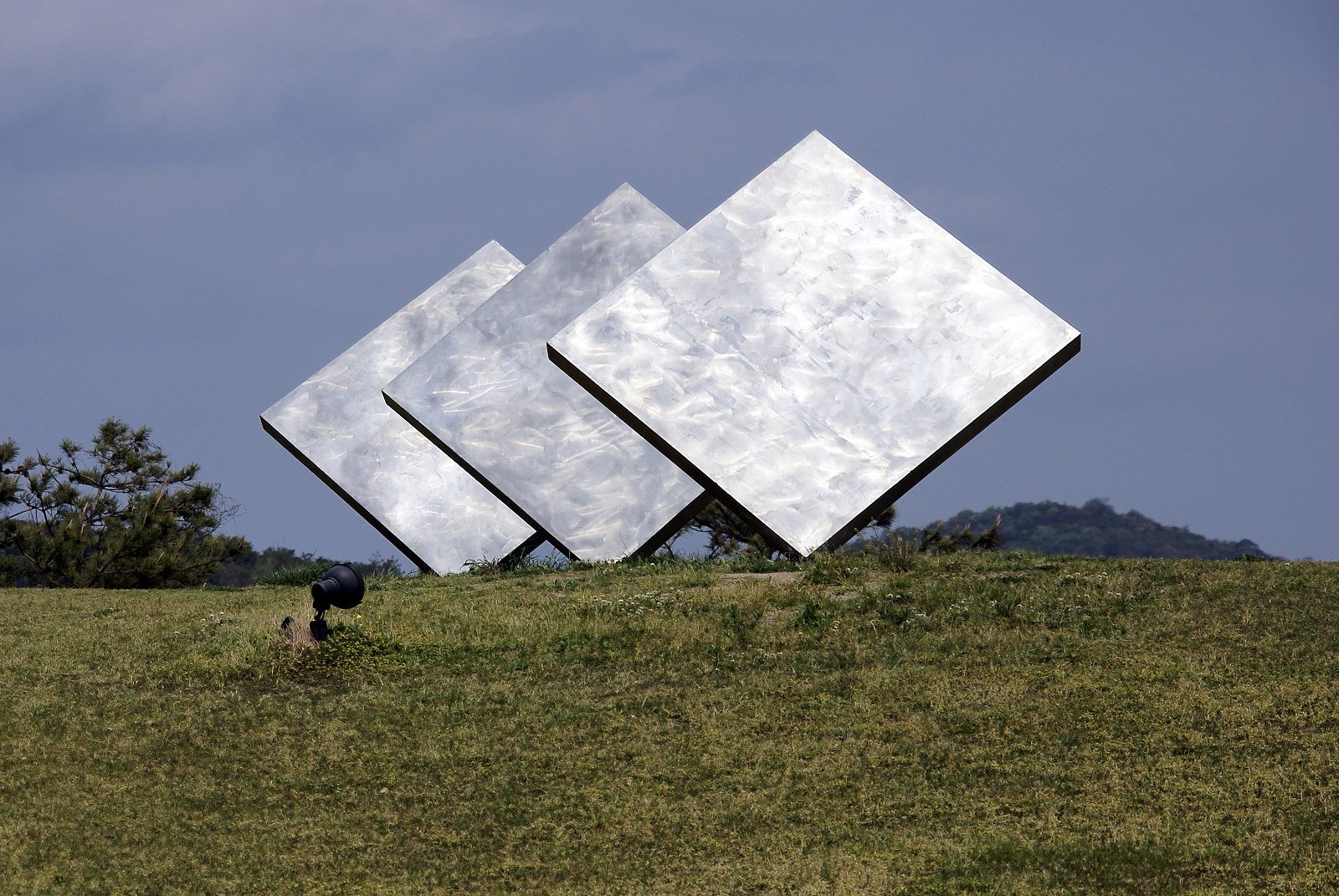
Naoshima is famous for its contemporary art museums and its outdoor contemporary art installations throughout the island. Be sure to take photos of the giant red gourd near Miyanoura port and the giant yellow gourd on a pier at the southern edge of the island.
Museums Like in most contemporary Japanese art museums, photography and touching the exhibits are prohibited.
1 Chichu Art Museum, 3449-1 (Last stop of Benesse shuttle bus), ☏ +81 87-892-3755, fax: +81 87-840-8285. Oct—Feb: Tu-Su 10:00—17:00, Mar—Sep: Tu-Su 10:00—18:00; closed on the day following a public holiday. Designed by the architect Tadao Ando and entirely underground, this museum integrates art and architecture. The museum only has a few exhibits: 5 paintings by Claude Monet, a room with a giant sphere and 27 wooden sculptures designed by Walter de Maria, and 3 works by James Turrell, including one where you walk into a room with variable lighting that changes your perception. The James Turrell work is certainly best appreciated with as few people around as possible, so visit early in the day before the crowds arrive. Tickets must be purchased at the ticket center approximately 50 m down the road. Next to the entrance is a garden modeled after the scenery that inspired Claude Monet. A special night program on Friday and Saturday is offered to view Turrell's 'Open Sky' work at sunset for additional fee of ¥500. Advance online reservations are required. ¥2,060. 2 Benesse House Museum (10 minutes by town bus from port; then transfer to Benesse shuttle bus.), ☏ +81 87-892-2030, [email protected]. Daily 08:00-21:00 (last admittance: 20:00). The first contemporary art museum on the island remains one of the best. A superb fusion of nature, art and architecture that displays the works of Andy Warhol, Richard Long, Bruce Nauman, and others. The Museum building, now one of 4 buildings in the complex, was designed by world famous Japanese architect Tadao Ando. There are al
Do
1 Naoshima Bath House I ♥ Yu (I♥), ☏ +81 87-892-2626. Tu-F 14:00-21:00, Sa Su 10:00-21:00, closed Mondays. A fully functional art installation with Japanese traditional public bath. Designed by Shinro Ohtake collaborated with graf. Naming "I ♥ Yu" is a pun, word playing on you and yu means hot water in Japanese. Adult ¥510; child ¥210. Gotanji Swimming Beach. July and August only. No lifeguards. Naoshima Slag Ceramic Art Experience Studio, ☏ +81 87-892-2299. Tu-Su 13:00-17:00, last admittance at 14:30. Make pottery and have it shipped to you when it dries! From ¥1,500.
Buy
There are several banks with ATMs and ATMs are also available in the convenience stores. The museums take credit cards but many shops do not. Most shops close in the early evening and most of them are closed on Sundays and Mondays. There is a 7–11 convenience store in Miyanoura. There are also 2 small Co-op supermarkets in Miyanoura and Honmura.
Head shop at Washinomatsu, north of Miyanoura Port. Open M-Sa 10:00-19:30, Su 10:00-13:00.
Sleep
It is recommended to book accommodation in advance, especially for weekend stays; however, many places do not have online booking or English-speaking staff. There are several dormitories and ryokan-style (sleep on a tatami mat) lodges on the island. Western-style accommodation is available across the sea, near the Uno Port in Tamano.
Budget Naoshima Backpackers Guest House (Near Honmura Port), ☏ +81 80-9130-2976, [email protected]. Dormitory: ¥2,500. Dormitory Kowloon (in) (In front of Miyanoura port; behind a snack bar), ☏ +81 87-892-2424. Check-in: 17:30, check-out: 09:30. This hostel is a former Japanese snack bar. Facilities are basic. Walk-up: ¥3,500, advance reservation: ¥2,900. Guest House Roji to Akari, ☏ +81 80-3058-3887, [email protected]. Check-in: 16:00-18:00, check-out: 10:00. Women and couples only. Dormi
Overview adapted from Wikipedia, travel guide fromWikivoyage (CC BY-SA). Photography via Wikimedia Commons.