
Mozia
Italy · Europe
About Mozia
Mozia (Sicilian: Mozzia, also known historically as Motya and San Pantaleo) is an island in the Stagnone Lagoon, off the west coast of Sicily between Marsala and Trapani. A remarkable site of Phoenician ruins, the island preserves traces of a once-thriving settlement—stone roads, defensive walls, temples, and homes—making it one of the most evocative ancient landscapes in the western Mediterranean.
The island also hosts a museum and a viticulture project that has revived the historic vineyards once cultivated on Mozia. The museum displays Phoenician artefacts uncovered on-site, including the celebrated marble statue known as the Motya Charioteer. The vineyard is cultivated using traditional methods adapted to the island’s intense sun and sea winds.
Mozia travel guide
Understand
Mozia is rich in archaeological remains from what was once a fortified Phoenician city. Today, the entire island is a walkable heritage landscape, with ancient roads, city walls, temples, and homes spread across its quiet terrain.
History
Founded in the 8th century BC by the Phoenicians, Mozia flourished as a commercial hub due to its strategic location between East and West. Naturally protected by the shallow waters of the Stagnone Lagoon and the sheltering Isola Longa, it developed into one of the most prosperous Phoenician colonies in the western Mediterranean. The city was fortified with defensive walls and infrastructure, including temples and a remarkable ‘submerged road’—a stone causeway that once connected the island to the mainland even through the lagoon. Mozia attracted merchants, artisans, and settlers from across the Mediterranean, thriving until its destruction in 397 BC by Dionysius I of Syracuse during the conflict between Carthaginian and Greek powers in Sicily. In the Middle Ages, the island was inhabited by Basilican monks and renamed San Pantaleo. The site was largely forgotten until 1888, when it was acquired by Joseph ‘Pip’ Whitaker, an Anglo-Sicilian archaeologist, ornithologist, and wine merchant. His excavations uncovered the ancient city’s remains and laid the foundation for ongoing archaeological research on the island today.
Ecology
The island lies in the heart of the Stagnone Lagoon and Islands Nature Reserve, a protected area known for its rich biodiversity. Its vegetation includes Mediterranean scrub species such as lentisk, myrtle, and prickly pear, as well as exotic plants introduced by the Whitaker family in the 19th century. The salt marshes and calm, shallow waters support numerous migratory birds, including flamingos, herons, and black-winged stilts, making the island a resting and nesting site of ecological importance.
Climate Mozia lies within the Stagnone Lagoon, which creates a distinctive microclimate. The island
Getting there
Mozia is located about 9 km south of Trapani and 10 km north of Marsala. Most visitors reach the island by taking a short boat ride from the mainland at Punta San Teodoro, just off the SP21 coastal road. Regular boat service runs approximately every 30 minutes, and the trip across the lagoon takes 10–15 minutes. A round-trip ticket costs €5 for adults and €2.50 for students; children under 5 travel free. Group rates are available. Boats operate year-round but service may be suspended in bad weather—refunds or alternate dates are offered in such cases. Opening hours for the island and museum are:
April – October: 09:30 – 18:30 (museum closes for a lunch break 13:30 – 14:30) November – March: 09:00 – 15:00 On holidays (25–26 Dec; 1 & 6 Jan), the last boat departs the island at 13:00. Mozia is often visited on organised day tours from Trapani or Marsala, frequently combined with other local attractions such as the Salt Pans of Trapani and Paceco or visits to vineyards in the Val di Mazara Wine Region.
Getting around
Mozia is about 1.6 km (1 mi) in circumference and can be explored on foot along signposted paths. Excavation areas are found throughout the island, with many active in the summer. Vineyards occupy parts of the land, and the surrounding lagoon provides a scenic and peaceful backdrop. The island is partially accessible to wheelchair users, especially along the main avenues. Key sites such as the museum, the village area, and the House of Mosaics are reachable with assistance. Visitors are given a map and guide leaflet at the entrance, and guided group tours can be arranged in advance.
See
Mozia is an island-sized archaeological park, with ruins scattered across its paths, fields, and shoreline. The entire island is walkable, and many sites can be visited independently with the help of the free site map provided at the entrance. Excavations continue today, offering new insights into Phoenician life in the central Mediterranean.
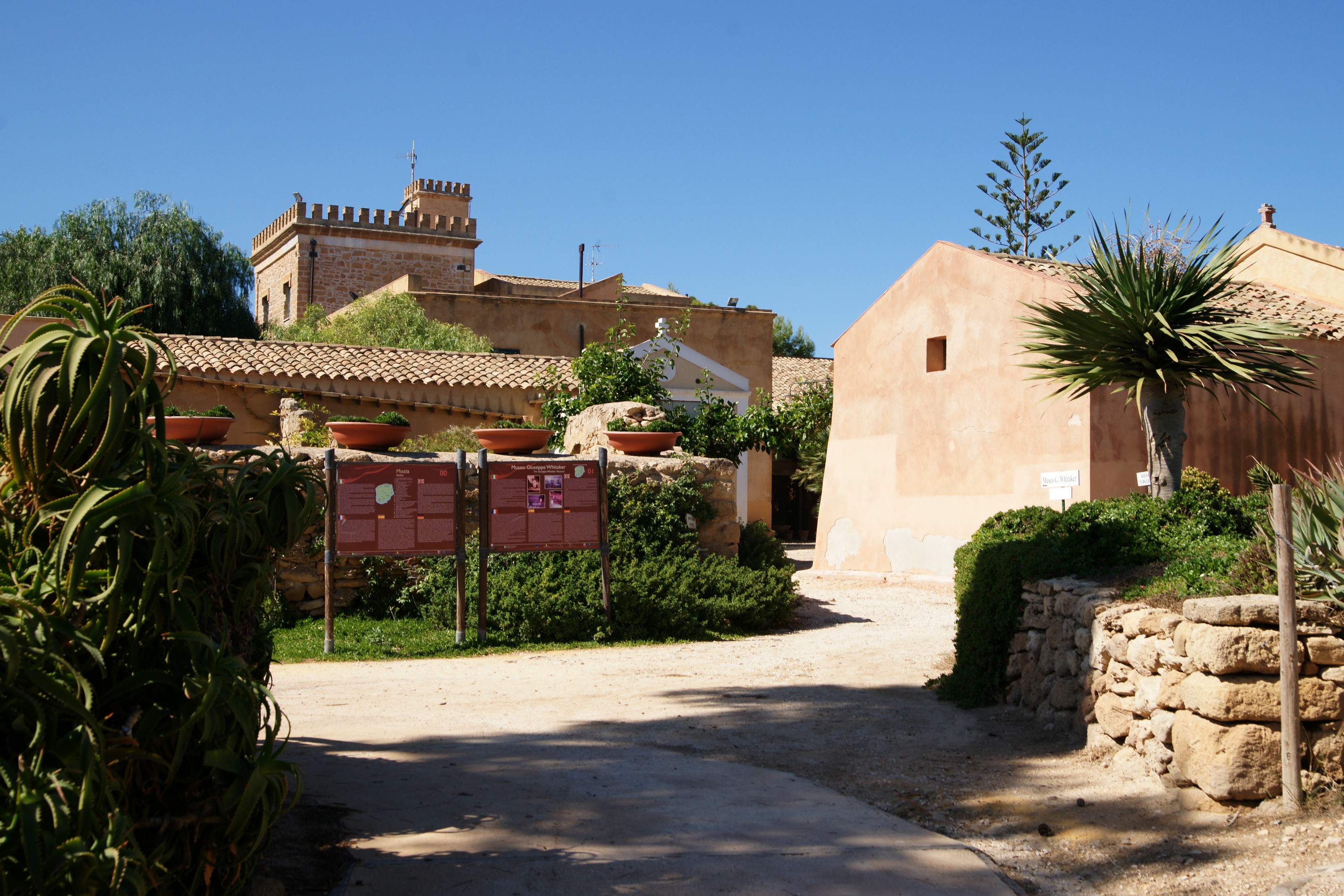
1 Whitaker Museum (Museo Whitaker). Housed in the Palazzina Whitaker, this museum displays Phoenician–Punic finds from the island, including tomb stelae, ceramics, and the famous Motya Charioteer—a rare 5th‑century BC marble statue of Greek origin. 2 House of Mosaics (Casa dei Mosaici). A domestic residence featuring a courtyard with intricate pebble mosaics, depicting geometric and hunting scenes typical of later Phoenician‑Greek influence. 3 House with Domestic Shrine (Casa del Sacello Domestico). V‑century BC aristocratic house including a small domestic shrine, destroyed and burnt during the 397 BC siege. 4 Kothon & Temple Area (Kothon e templi). A rectangular freshwater basin carved into the rock, fed by a spring and surrounded by temples to Baʿal and Astarte—interpreted as a sacred pool rather than a harbour.
5 Barracks (Casermetta). Ruins of a military barracks destroyed and burned during the 397 BC siege by Syracuse—evidence of the city’s fierce final defence. 6 Porta Nord & Submerged Causeway (Porta Nord e strada sommersa). The Northern gate complex features triple arches flanked by towers, and leads onto the stone-paved submerged causeway—a 1 km link to the mainland, once visible above water and now still detectable underwater. 7 City Walls & East Tower (Mura cittadine e Torre Est). Opus quadratum stone walls up to 5 m thick, reinforced with square towers—the East Tower is well-preserved and offers a view into Phoenician military architecture. 8 Tophet (Tofet). Phoenician‑Punic sanctuary and burial ground with layers of urns, stelae, altars—a rare site of child‑cremation rituals from the 8th–4th centuries BC.
Do
While the focus of a visit to Mozia is archaeological, the island and its surroundings offer opportunities to enjoy nature, local wine culture, and scenic walks.
Walk the island circuit – A full loop around Mozia is about 1.6 km and can be done in 1.5–2 hours. Paths are generally easy, with occasional uneven terrain. The route passes major ruins, coastal viewpoints, and the vineyard area. Birdwatching – The Stagnone Lagoon is a protected wetland and home to flamingos, herons, egrets, and other migratory birds. Bring binoculars if visiting in spring or autumn.
1 Vineyards. While not a working winery, the island’s historic Grillo grape vines—maintained by Tasca d’Almerita—can be seen near the centre of the island. Interpretive signs explain cultivation methods and the unique terroir. Join a guided tour – Group tours can be arranged through local operators or the Whitaker Foundation. Guides provide context that enhances the experience, especially for understanding the significance of recent excavations.
Eat
There is a small café near the museum entrance on Mozia, serving snacks, sandwiches, cold drinks, and coffee. It's the only food outlet on the island and a good spot to take a break during your visit. For full meals, head back to the mainland. The coast along the Stagnone Lagoon has a number of trattorias and casual restaurants, especially near Punta San Teodoro and the Ettore
Overview adapted from Wikipedia, travel guide fromWikivoyage (CC BY-SA). Photography via Wikimedia Commons.