
Monterey
United States · Americas
About Monterey
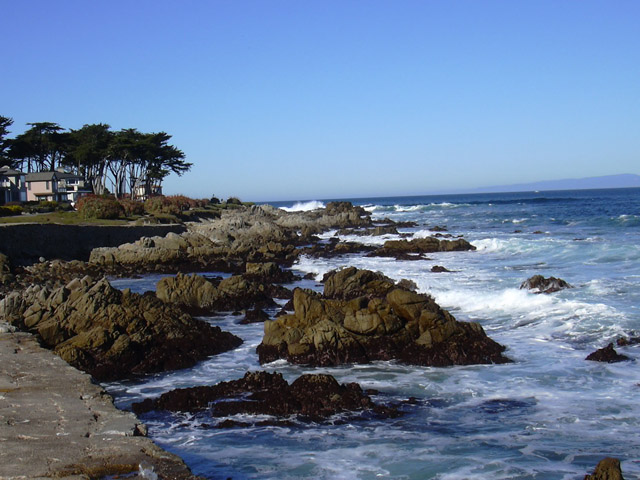
Monterey is a city (population 28,000 in 2018) in the Monterey County area of Monterey Bay in California. Monterey is one of the more beautiful coastal cities of California, and then a historic city can make for a great two-day trip for those visiting San Francisco or a weekend getaway for California natives. It has more historic buildings in its downtown than any other city west of Santa Fe, and a world-class aquarium.
Monterey travel guide
Understand
Monterey was once the capital of California. Today it is widely known for its beautiful coastline, and from the many John Steinbeck novels set there, including Cannery Row and Tortilla Flat. Rugged terrain and vicious Pacific currents made much of the California coast virtually unexplorable to European ships. After a disastrous attempt to explore this new territory by sea, Spanish missionaries in Mexico launched a series of overland expeditions from San Diego. Monterey was established in 1770 by Father Junipero Serra and soon became a Spanish military base with a small fort or "presidio" located near a calm harbor that could provide shelter to supply ships. The military presence eventually gave way to a thriving commercial trade that brought in many enterprising foreign merchants. Once Mexico gained its independence from Spain, Monterey became the capital of Alta California under Mexican rule. From this era come many classic stories of flirtation, fashion, and politics in the Mexican colonial era. Lands once owned by the government began to come into private hands, and local families began to consolidate their property and power into business enterprises based on the ranches or "ranchos," where they raised cattle or invented the famous Monterey Jack cheese. Monterey soon fell under American power in the Mexican-American War and remained the capital of the territory. A delegation of writers drafted the constitution which marked the entrance of the State of California into the United States of America. This era saw the mass northward migration of ambitious people in search of gold, which led to a near desertion of the town. Monterey soon recovered, however, and today is known for its magnificent natural beauty, world famous Aquarium, and temperate year-round climate. The Monterey Peninsula has the largest population of sea otters on the California coast. The abundance of marine wildlife visible from the shoreline is one of the primary attractions of the region. Se
Getting there
By plane 1 Monterey Regional Airport (MRY IATA Monterey Peninsula Airport). It has regular flights from Dallas/Ft. Worth, Denver, Las Vegas, Los Angeles,Phoenix, San Diego, San Francisco, and Seattle/Tacoma on Alaska Airlines dba Horizon Air or SkyWest Airlines, Allegiant Air, American Eagle, and United Express. From the airport it is a short drive west along Highway 68 and onto southbound Highway 1, where the two right lanes lead straight downtown. Monterey-Salinas Transit (MST) runs local bus 93 between the airport and downtown a couple times a day on weekdays only. (updated Feb 2022) Due to the high fares and limited schedules, you may want to consider flying into San Jose International Airport (SJC IATA) or San Francisco International Airport (SFO IATA), and travelling by bus or car to Monterey. The Monterey Airbus provides scheduled service from both airports.
By car (the Pacific Coast Highway) runs through Monterey, providing access from the north Santa Cruz (50 minutes), and from the south along the world-famous Big Sur coast. to From the San Francisco Bay Area, take US 101 south through San Jose and Gilroy to State Highway 156, going west at Prunedale (inland of Monterey Bay, 9 mi (14 km) north of Salinas). Go west 5 mi (8.0 km) on State Highway 156 (a two-lane highway that often gets congested on touristy weekends) through Castroville, at which point State Highway 156 becomes a freeway and shortly thereafter merges with southbound Highway 1. Monterey is then 15 mi (24 km) south along Highway 1. If heading to Cannery Row or the Aquarium, look for brown signs that advise which exit to take. (If Highway 1 has ceased to be a freeway; you've gone past Monterey and are near Carmel-by-the-Sea.)
From the San Francisco Bay Area, internet map sites, mapping software, and GPS systems will advise you to take State Route 17 to Santa Cruz and then State Route 1 south. Although State Route 17 through the Santa Cruz Mountains is shorter than US 101, it is filled
Getting around
4 Monterey-Salinas Transit (MST), 201 Pearl St, ☏ +1 888 MST-BUS1 (678-2871). provides convenient public bus service within town, as well as to the nearby towns of Carmel, Pacific Grove, historical Salinas and breathtaking Big Sur. Fares vary from $1.50-3.50 depending on whether you take a Local, Primary or Regional bus. GoPasses are available from $10/day, $25/week, $95/month. There's a 50% discount for children, seniors, people with disabilities, medicare cardholders, and US veterans. (updated Feb 2022) MST Trolley. daily Memorial Day weekend through Labor Day. MST also runs a free trolley between Monterey's downtown and the Aquarium on Cannery Row daily during the summer months. free. (updated Feb 2022) For car drivers, garage parking is available, and street parking is often free for periods of two hours on weekends and after 6PM. Many hotels offer parking for an additional charge. The Cannery Row area (where the Aquarium is located) has an aggressive, expensive parking ticket policy. A few minutes over at a meter and you will be welcomed to town with a $35 parking ticket.
See
1 Monterey Bay Aquarium, 886 Cannery Row, ☏ +1 831 648-4888. 9AM or 10AM to 5PM or 6PM, depending on time of year and day of week. This large aquarium specializes in exhibiting local sea life in typical local habitat displays and has many spectacular exhibits. It is particularly known for its Kelp Forest exhibit, three stories high, filled with several varieties of giant kelp and a wide variety of marine animal species, and also for its million-gallon Open Sea exhibit with large blue fin and yellowfin tunas, mahi-mahis, sharks (including an occasional Great White Shark as a very temporary visitor; before being released back to the ocean), ocean sunfish (mola-molas) and sea turtles. The best exhibits include a large tank of silver sardines that swim around and around above one's head, and one of rescued sea otters deemed unreturnable to the wild and therefore kept at the aquarium. (The aquarium has rescued and released back to the wild over 500 sea otters.) Quite expensive, but for a good cause (the aquarium is privately funded; and much of the money goes for conservation research), and most visitors will consider a visit well worth the charge. $65/adult, $50/youth and seniors, $45/child. (updated May 2024) 2 Monterey State Historic Park, 20 Custom House Plaza, ☏ +1 831 649-2907. Gardens open daily 9AM–5PM summer; 10AM–4PM winter; museums vary. This park is the historic downtown area known as Old Monterey, containing a number of historic buildings and gardens. Most of the buildings are from the first half of the 19th century, and most of the historic gardens are about a century old. Start at Custom House Plaza, in downtown Monterey, near the Old Fisherman's Wharf, and look for the yellow plaques that mark the Monterey Walking Path of History to take in some of the town's most intriguing buildings. Informational signs are posted at each stop. Maps and tour information are ava
Overview adapted from Wikipedia, travel guide fromWikivoyage (CC BY-SA). Photography via Wikimedia Commons.