
Mesoamerica
Mexico · Americas
About Mesoamerica
Mesoamerica, today being made up of southern Mexico and the Central American countries of Belize, Guatemala, and parts of Honduras and El Salvador, has been populated since at least 11,000 BC.
Mesoamerica travel guide
Understand
The indigenous cultures of North America and the indigenous cultures of South America have had a long and diverse history both before and after the Columbian exchange of 1492. The Mesoamerican cultures have been recognized for their cities, their rich monumental architecture, their complex societies with organized religion and specialized labor, the independent development of agriculture, as well as long-distance trade of crops and other commodities. This stands in contrast with the indigenous cultures of today's United States and Canada, which were less urbanized and lived in farming villages or nomadic tribes, with less hierarchical organization. Indigenous cultures seldom fit neatly into modern political maps, and that is certainly the case with Mesoamerica, which does not include the northern third to half of Mexico, nor does it include the southern countries of Central America.
Geography
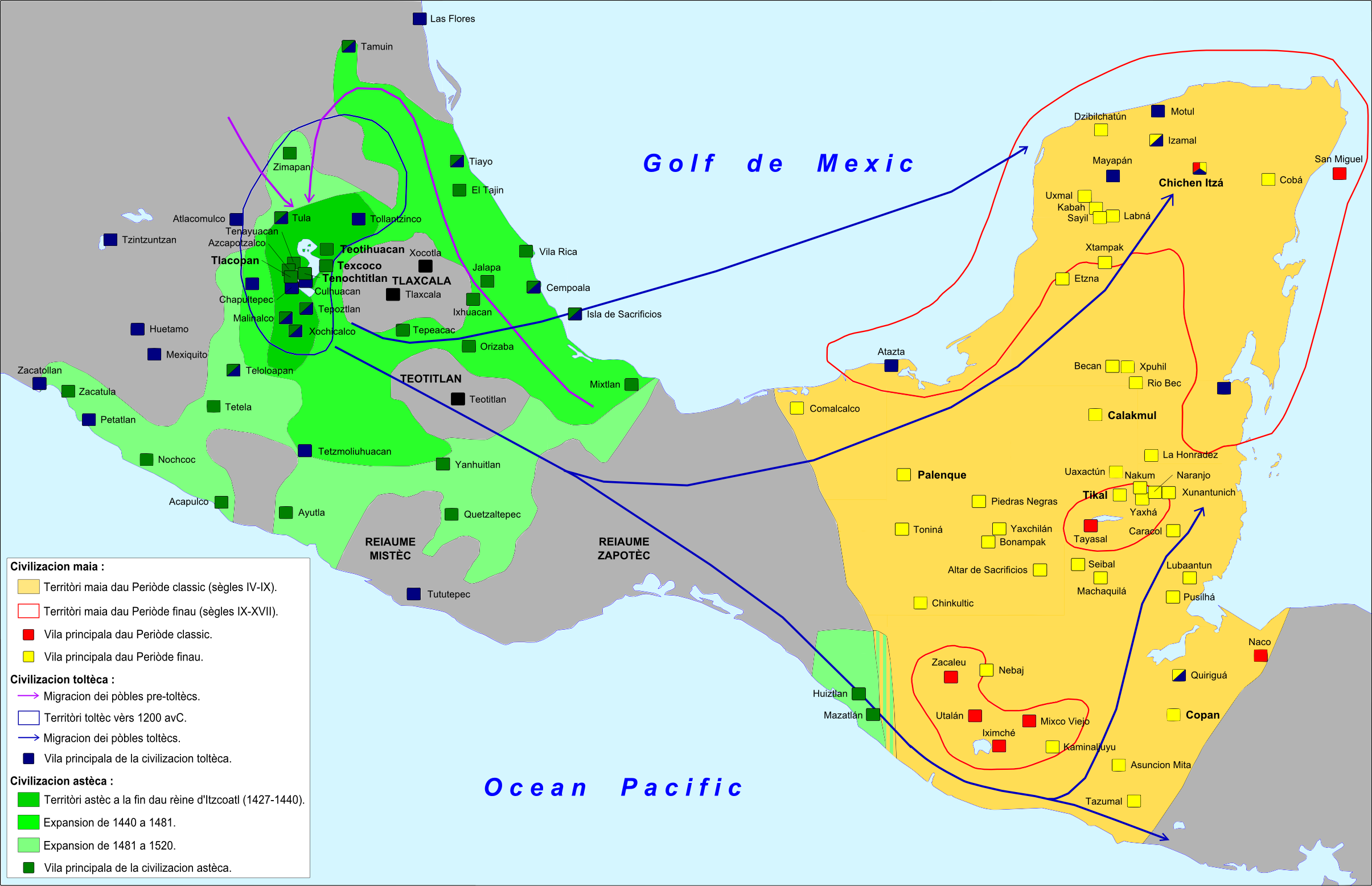
The Mesoamerican civilizations differed sharply from their northern and southern neighbors. At the time of the Spanish conquest, there were two major civilizations in Mesoamerica: the Aztec in what is today Central Mexico, and the Maya in what is today the Yucatan and northern Central America. (There were also dozens of less influential civilizations.) In the map shown here, green is the Aztec realm of influence and yellow is the Maya realm of influence. Gray areas were dominated by other, less influential or more isolated civilizations, including the Purepecha, Zapotec, Tlaxcala and other peoples.
Peoples The Mexican government recognizes more than 60 indigenous groups and a similar number of indigenous languages, most of which are offshoots of three language families: Mayan, Aztecan, and Manguen. Mayan languages are spoken in the Yucatan Peninsula of Mexico and in Guatemala, Belize, and Honduras. The Huastec people of eastern Mexico are a Mayan people whose language is also a branch of the Mayan family. The Aztecan family of languages (Uto-Aztecan to linguists) includ
Overview adapted from Wikipedia, travel guide fromWikivoyage (CC BY-SA). Photography via Wikimedia Commons.