
Marburg
Germany · Europe
About Marburg
Marburg is a small university town north of Frankfurt in the Lahn valley, Hesse. The castle ("Landgrafenschloss") on the hill, the university's historical buildings and the old city ("Oberstadt", upper city) are the top sights of the city.
Marburg travel guide
Understand
Walk the labyrinth of narrow, cobblestone streets lined with extremely well-preserved examples of 17th and 18th century Hessian architecture while taking surprisingly many stairs outdoors. Hearing nearby church bells toll while strolling through this part of Marburg is a life changing experience. This is the Germany you expect from the tour books and here you can enjoy it free from the crowds of tourists. The Philipps-Universität (founded 1527) is the oldest Protestant university in the world. Marburg has approximately 76,000 residents. With 23,500 students and 6,000 people working for the university, a saying in Marburg is: "Other cities may have a university, Marburg is a university." Those who have a grasp in biology or epidemiology may also remember the Marburg virus, which is equally fatal as the Ebola virus. The virus is named after the city after an outbreak in 1967, causing dozens of infections and several deaths.
1 Tourist Information Marburg, Pilgrimstein 26, ☏ +49 6421 - 99 12-0, [email protected]. M-F 13:00 - 17:00, Sa 14:00 - 18:00, Su 13:00 - 17:00.
Getting there
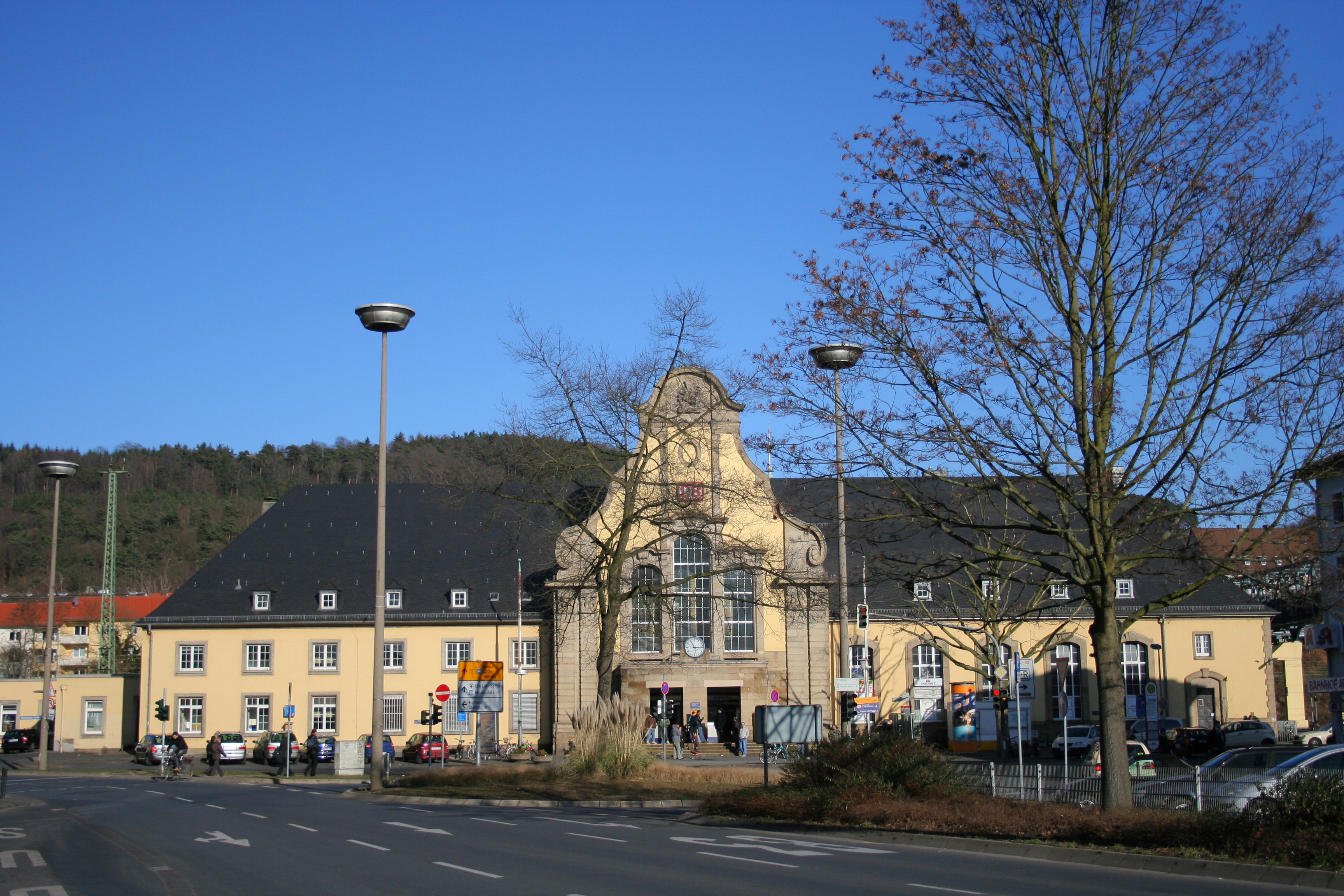
By train
in addition to suburban trains Marburg is also a stop for InterCity IC trains. The city is well connected to Frankfurt and Kassel. From there you have extensive connections on the German InterCityExpress ICE train network.
By plane Marburg has no airport so head for Frankfurt/Main, Germany's busiest airport.
By car Marburg is not connected to an Autobahn, but you will find that coming from the south via Frankfurt and Giessen the Autobahn seamlessly leads to Bundesstraße 3a, which is developed equivalently.
Getting around
As a small town it's best explored on foot. Other possibilities include the public bus services and bicycle. A touristic tour is offered by the Schlossbahn. If you need, ask the inhabitants. Most people are very friendly and will go out of their way to point out the sights.
By bus Schedules and connections should be checked with the supra-regional transport association RMV. Since stairs and ways to the castle are especially step and long, bus line 10 is a great alternative: Starting downtown it also stops at the old town's market and then drives all the way up to forecourt of the castle! Single trips ("Einzel-Fahrkarte") cost around €2 and are quite expensive compared to a day ticket ("Tages-Karte") for less than €5 as of 2018. Tickets can be bought directly from the bus driver, but a mobile journey planning & ticketing app is also available. Some bus drivers can be rather harsh and impatient, no matter if you're a foreign tourist or local resident. So better be prepared which kind of ticket you want to buy or where you want to go and have some basic German words prepared.
By bike The direct neighbourhoods of the old city can easily be explored by bike. However, since the old city itself is on a hill and streets are cobbled, riding a bike there is not recommended. A bike trip to the south along the Lahn river is a perfect addition to a sightseeing trip in Marburg. Elevation is no problem there and bike ways are well developed. A rental bike system is also available from Nextbike. 30 minutes will cost €1. Registration should be done in advance and rentals should be managed via Nextbike's app.
By Schlossbahn The "Marburger Schlossbahn" is a private service, which offers sightseeing tours through downtown, old town and up to the castle. The whole vehicle is styled like a train with locomotive and waggons. Tour guides come from loudspeakers and are available in other languages as well. The service is not operated in winter.
By elevator To reach the "Obersta
See
Stroll around the old city and enjoy the medieval atmosphere in combination with the spirit of a university town. Visit the Elisabeth Church, Germany's oldest Gothic church, and the old castle at top of the "Oberstadt". Also worth seeing are the old university building, the city hall, and Weidenhausen (the old part of the town on the other side of the river Lahn).
1 Castle (Landgrafenschloss). 2 St. Elisabeth's Church (Elisabethkirche). 3 Historical town hall (Historisches Rathaus). 4 Old town market (Marktplatz). 5 Spiegelslustturm (Kaiser-Wilhelm-Turm), Hermann-Bauer-Weg 2.
Do
Take a romantic pedal boat trip on the river Lahn, which starts from the bridge opposite to the old university building. Take a hike up to the Spiegelslustturm and enjoy a wonderful view over Marburg at night. There is an exhibition on the culture and history of Hesse in the old castle and also guided tours through the "Kasematten", the cellars of the castle. Consult the tourist information office for details. There is the Aquamar, a relatively new swimming pool with a spa area. If you are looking for culture, art and a special place to enjoy a glass of wine, visit the Kulturzentrum Waggonhalle, right behind the train station. Placed in the historic wagon halls, you will find art exhibitions, theater, concerts, flea markets and cabarets. The Rotkehlchen Cafe/Restaurant serves great food, tasty cakes, and offers outside seating. If you should visit the town in summer, the city laid 3TM is held during the second weekend in July, while on the 3rd weekend in July the international open-air short-film festival OpenEyes Filmfest starts. The Marburg Mercenaries play first division (GFL Süd) American Football. The season runs roughly April-September with Playoffs in late September to October.
Buy
Self-caterers and low-budget travelers can find all the big discounters in Marburg. There is also no shortage of health food stores. Furthermore, there is the possibility of getting supplies on Wednesdays and Saturdays at the markets in the south quarter, in the upper town and at the Elisabethkirche / Firmaneiplatz. In the old town you will find many smaller specialist shops with an extensive range, including several bookshops. There are several shopping centers in Marburg; Marburg, on the other hand, does not offer large shopping areas and miles. A typical souvenir from Marburg is the "Marburger Nachtwächter", a herbal liqueur made according to a traditional recipe with 38% vol. It can be bought in the liquor and tobacco shop, Marktgasse 17, in the upper town.
Eat
The city caters for the needs of more than 18,000 students so it is not difficult to find a nice cafe or pub. Most of the good pubs are located in the Oberstadt. During the university terms they are sometimes crowded. Next to the lower level of the lift (Oberstadtaufzug) in the middle of Marburg you will find numerous restaurants, great Doner and a very good Lebanese Imbiss. If you arrive at the train station and like to eat Asian food just walk straight away from the train station and cross the river bridge behind the highway. On the right side is a small, but good place for Asian food. The area in the historic centre around the Marktplatz and Barfuesserstraße is full of good, affordable restaurants for all tastes, many with outside seating. Most restaurants in the Oberstadt offer breakfasts or brunches, a
Overview adapted from Wikipedia, travel guide fromWikivoyage (CC BY-SA). Photography via Wikimedia Commons.