
Maarssen
Netherlands · Other
About Maarssen
The Vechtstreek is a scenic region in North Holland and Utrecht. It is a popular get-away destination known for its natural beauty, castles, parks and stately homes. Muiden and Weesp, while a part of the Vechtstreek, are covered in separate articles.
Maarssen travel guide
Understand
The Vechtstreek is known for its many vestiges of the Dutch Golden Age, including castles, homes, parks and tea houses. They are remnants of the greatness and wealth of that period, the important commercial role played by the Vecht and the area's history as a residential area for the nobility and wealthy. The landscape east and west of the river is also remarkable. Peat extraction in the 17th and 18th century turned vast low-lying fens into a collection of shallow, man-made lakes and bogs. Water lilies, reeds, swamps and wooded areas have developed spontaneously from the old peat canals (trekgaten) where the peat was extracted. About 70 km² have been designated as a series of nature reserves and are part of the European Natura 2000 scheme.
Orientation The Vechtstreek is the area between Amsterdam and Utrecht, and many travellers stay in the region to be close enough to visit those cities. Orientation is difficult, as there are many small villages in the area but no definite central place to go. Maarssen is the largest town by inhabitants, but it's an outlier in terms of geography. Many travellers would spend the night near Loenen or Loosdrecht, as they are centrally located and have plenty of water sport facilities. If you're reliant on public transport, stay near Breukelen as it has a train station on the Amsterdam-Utrecht line. If ignoring Muiden and Weesp, the Vechtstreek is administered by the three municipalities:
Stichtse Vecht Wijdemeren De Ronde Venen Stichtse Vecht is a merger of the former municipalities of Breukelen, Loenen and Maarssen. Wijdemeren is a merger of 's-Graveland, Loosdrecht and Nederhorst Den Berg. And De Ronde Venen is a merger of Mijdrecht, Vinkeveen, Wilnis and Abcoude. If that wasn't complex enough, Stichtse Vecht and De Ronde Venen are in the province of Utrecht, while Wijdemeren is in North Holland. 's-Graveland and Kortenhoef are both in the Vechtstreek and a part of the Gooi area.
Tourist information VVV Stichtse Vecht. (upd
Getting there
By train The main Amsterdam-Utrecht railway line runs right through the Vechtstreek, but fast Intercity trains do not stop here. But Sprinter, slower trains, do. Maarssen, Breukelen and Abcoude have stations along the line. Depending on the village you leave from, reaching Amsterdam or Utrecht will take about 20-30 minutes. Trains to Woerden and Gouda do not pass Maarssen.
By bus Buses are infrequent and unreliable, and it's hard to reach certain places, but if you don't have a car, you don't have a choice. Generally, buses leave from the train stations and go to the surrounding villages. 's-Graveland, Loosdrecht and Kortenhoef are reached via Hilversum. First go to that town by train, then take either bus 105 or 106. Bus 105 has Bussum Station as its last stop and leaves every 30 minutes from 07:00 till around 00:00. It takes around 10 minutes to reach bus stop Smidsbrug at the centre of 's-Graveland. Bus 106 ends at Weesp station, but it only leaves once per hour. After 10 minutes, get out at bus stop Kerklaan, also in the center of 's-Graveland. Bus 38 runs between Maarssen train station and Utrecht Centraal, but not through the centre of Maarssen. Other buses that run through Maarssen are the 35 and 36.
By car The Vechtstreek is well connected by road. Motorway A2 runs between Amsterdam and Utrecht and is the main access road for all important villages in the Vechtstreek. From Amsterdam, Schiphol Airport, Leiden and Utrecht, drive onto the A2 and then take exit 3 for Abcoude and Nigtevecht, exit 4 for 's-Graveland, Kortenhoef, Loosdrecht, Loenen aan de Vecht, Mijdrecht, Vinkeveen, and Wilnis, exit 5 for Breukelen, and exit 6 for Maarssen. This is a busy road with a lot of traffic jams during peak hours.
Getting around
Getting around by public transport buses is possible, but complicated. The easiest way to get around is by car, by bike, or even better, by boat. Bikes can be rented at railway stations.
See
Castles
1 Slot Zuylen (Zuylen Castle), Tournooiveld 1, Oud-Zuilen (Oud Zuilen village). from 1300. (updated Jun 2016) 2 Bolenstein (Ridderhofstad Bolenstein), Bolensteinseweg 1-3, Maarssen. 14th century, alterations in the 19th century. (updated Jun 2016) 3 Oudaan (Oudaen; Oud Aa), Zandpad 80, Breukelen. The castle origins are probably dating back to the end of the 13th century. Its name comes from the river Aa which was used to be a tributary of Vecht. (updated Jun 2016) 4 Nijenrode, Straatweg 25, Breukelen. An imposing castle dating from the middle of the 13th century. It is now a part of the Nyenrode Business Universiteit. (updated Jun 2016) 5 Gunterstein (Ridderhofstad Gunterstein), Zandpad 48, Breukelen. 1680. (updated Jun 2016) 6 Nederhorst, Slotlaan 3, Nederhorst den Berg. (updated Jun 2016)
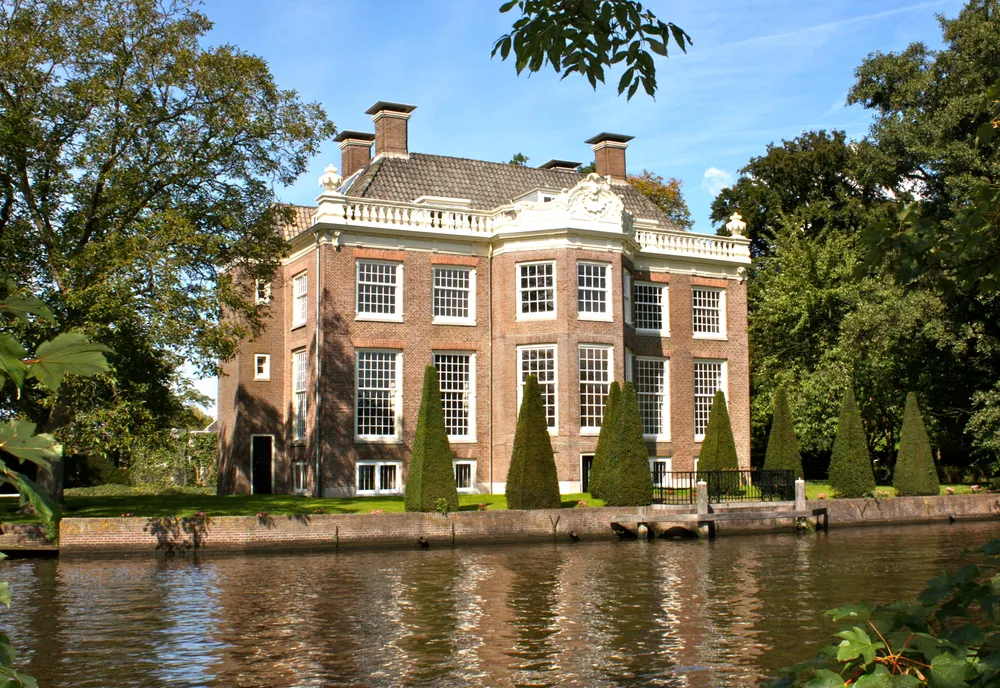
Along the Vecht Many visitors come to the Vechtstreek for its magnificent 17th- and 18th-century estates (Dutch: buitenplaats or landerij). Estates are dotted along the complete course of the Vecht.
Maarssen
7 Hazenburg, Binnenweg 66, Maarssen. 1697. (updated Jun 2016) 8 Herteveld, Amsterdamse Straatweg 19-A, Maarssen (1630). (updated Jun 2016) 9 Vechtenstein, Zandpad 1, Maarssen. 1637, rebuilt 1870. (updated Jun 2016) 10 Huys ten Bosch, Zandweg 44, Maarssen. 1628, architect Jacob van Campen. now Town House. (updated Jun 2016) 11 Doornburgh, Diependaalsedijk 17, Maarssen. 1655. (updated Jun 2016) 12 Goudestein, Diependaalsedijk 19c, Maarssen. 18th century, Drugstore Museum. (updated Jun 2016) 13 Vechtoever, Diependaalsedijk 31-33, Maarssen. 18th century. (updated Jun 2016) 14 Leeuwenburg, Zandpad 24, Maarssen. 1649 (updated Jun 2016) 15 Gansenhoef, Zandpad 26, Maarssen. 1655, architect Philips Vingboons (updated Jun 2016) 16 Cromwijck, Zandpad 42, Maarssen (between Maarssen and Breukelen). 1637. (updated Jun 2016)
Breukelen 17 Boom en Bosch, Markt 13, Breukelen. 1673, now the Town Hall. (updated Jun 2016) 18 Vecht en Dam, Dannegracht 16, Breukelen (1682).
Do
There are lakes and waterways on both sides of the Vecht. These lakes and interconnecting waterways are referred to as the Vechtplassen ("the Vecht Lakes"), a series of man-made lakes resulting from the peat extraction. The lakes near Loosdrecht are especially popular for sailing. West of the river Vecht there is another important area of man-made lakes, the Vinkeveen lakes. A good way to spend a day is by making a bicycle tour through the area, passing many estates, polders and lakes.
A popular activity with the locals in the summer is to rent a boat and hit the lakes.
Museums 1 Vechtstreekmuseum (Vecht Museum), Diependaalsedijk 19b, Maarssen (in the park of Goudestein). May-Sep W-Su 11:00-17:00; Oct-Apr W-Su 14:00-17:00. €4.50. (updated Jun 2016) The Skating Museum (Schaatsmuseum Tienhoven), Laan van Niftarlake 49, 3612 BM Tienhoven, ☏ +31 346 281789, [email protected]. By appointment. Learn about the history of ice skates and other winter objects.
Buy
Breukelen's historic town centre has some nice shopping options.
Eat
Due to the affluent d
Overview adapted from Wikipedia, travel guide fromWikivoyage (CC BY-SA). Photography via Wikimedia Commons.