
London Wall
United Kingdom · Europe
About London Wall
Walk the London Wall is a walking tour of the ancient boundary of London (and before it, Londinium).
London Wall travel guide
Understand
The London Wall
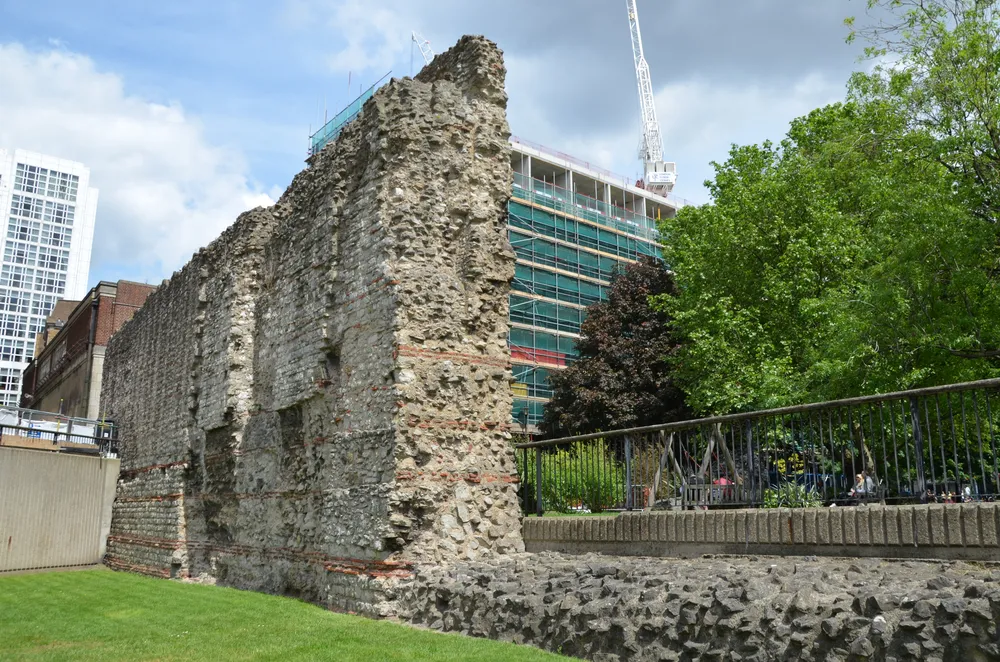
The defensive wall that would define London for millennia started with a fort built by the Roman Empire close to the modern Barbican in 120 AD. When the wall itself started to appear decades later at the start of the 3rd century, between 190 and 225 AD, it incorporated this fort, strengthening its outer walls, and encompassed an area that now makes up most of the City of London. The riverside wall was added near the end of the century from about 280 AD in response to Saxon raids. During the medieval period the wall was maintained and some modifications were made. Additional fortifications were added such as crenelations and more bastions. The largest changes were the construction of the Tower of London in the south-east corner of the wall, the extension of the wall on the western side and the expansion of Moorgate from a pedestrian postern to a full gate. As London expanded, the wall became redundant and most of it was eventually demolished or lost under later construction. Some buildings were constructed against the city wall, using it as one of their own walls. The heavy bombing of the City during World War II and subsequent reconstruction revealed buried sections of the wall near the Barbican. Sections within and near the Tower of London also survive.
Gates Traditionally, London had seven gates, although this is not entirely correct. The original wall had only four gates: Newgate, Ludgate, Aldgate, and Bishopsgate; and the gate of the legionary fort, which is now Cripplegate. Aldergate was a late Roman addition to the wall, possibly to replace one of the gates in the fort. The original Roman names of these gates, and the roads that passed through them, are now lost to history; the names we have now are based on their Anglo-Saxon names. However, traditionally the main intersecting roads of a Roman fort would be called "Cardo" and "Decumanus" so those two names are at least plausible. There were also small pedestrian gates in the wall
Getting there
This walk assumes a start at the Barbican underground station but it can be started at any point. Tower Hill station is the main alternative.
By tube Primary starting point:
1 Barbican tube station. On the Circle, Hammersmith & City and Metropolitan lines. Note that Barbican does not have step-free entry or exit. The closest station that does is in Farringdon. 2 Farringdon tube station. On the Circle, Hammersmith & City and Metropolitan lines. Alternative starting point near the Tower of London:
3 Tower Hill tube station. On the Circle and District lines. 4 Tower Gateway station. On the Docklands Light Railway (DLR).
Eat
For snacks and meals along or near the route:
Drink & nightlife
If you get thirsty, there are a few places to drink along the route:
1 Ye Olde London, 42 Ludgate Hill, EC4M 7DE, ☏ +44 20 7248-1852. M–Sa 10:00–23:00, Su 10:30–23:00. Built on the site of London Coffee House (1731–1867), in which juries from the Old Bailey were housed overnight if they had not yet reached a verdict. Famous drinkers at the coffee shop include Joseph Priestley and Benjamin Franklin. A Roman altar and a statue of Hercules have also found on this site.
Go next
Keep sightseeing in the City of London Take the London South Bank Walk – a similar style of itinerary on the other side of the Thames Explore other parts of London, like Holborn-Clerkenwell or the East End
Overview adapted from Wikipedia, travel guide fromWikivoyage (CC BY-SA). Photography via Wikimedia Commons.