
Lochranza
United Kingdom · Europe
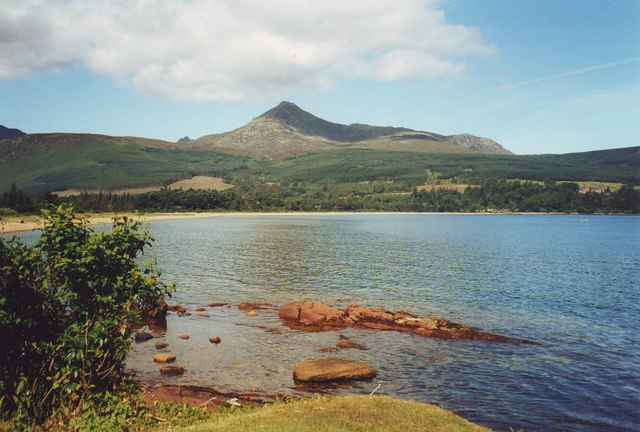
About Lochranza
The Isle of Arran is part of Ayrshire in southwest Scotland. It lies in the Firth of Clyde, the broad reach of sea southwest of Glasgow and enclosed by the Ayrshire coast to the east and the Kintyre peninsula to the west. With a 2011 population of 4629, Arran extends for about 20 miles north-south and 10 miles east-west, with all its settlements strung along the coast road, and a hilly interior.
The tourist agency calls it "Scotland in Miniature", though if you try cycling the roads over the hills, or the midges attack, the experience will not feel miniature. However that slogan is a good summary of Arran's balance of highland versus lowland, amenities versus empty glens, and accessibility versus "far away from it all".
Lochranza travel guide
Understand
How old is this Earth? Arran is where geologists began to see that it was vastly older than they’d supposed, and was continually re-shaped by sometimes violent forces – look at that huge plug of granite thrust up through the island’s centre. So it was only an eyeblink ago in geological terms when Neolithic settlers erected the great stone circles of Machrie Moor. Arran was, and is, a farming and fishing community, but from the late 18th century it was systematically depopulated, as its residents were evicted or chose to leave for better prospects elsewhere. Tourism developed in the 19th century as city workers came “doon the water” for their summer holidays along the “Glasgow Riviera” or “Costa Clyde”, in resorts such as Troon, Largs, Ayr, Girvan and Arran. In the late 20th century they moved on to the Med, but good ferry connections brought in different visitors. Traditional life persisted alongside the caravan parks and B&Bs, but the last native Gaelic speakers died out, fortunately having survived into an era when recordings could capture their oral history and distinctive dialect of Arran Gaelic. The main strip of settlement is on the east coast between Brodick (the ferry port), Lamlash (historically the main village) and Whiting Bay. This can be busy, and is within sight of mainland Ayrshire. Get across the hills to where population is sparse and the view is of Kintyre, it suddenly feels a hundred miles from anywhere. Visitor information is on the Visit Arran website. The tourist office by Brodick pier closed in 2025. For the weather outlook see the Mountain Weather Information Service (MWIS) for the Western Highlands, which includes Arran.
Getting there
You reach Arran by ferry, almost always by the Ardrossan/Troon-Brodick route; Ardrossan and Troon are both well-connected with Glasgow. A ferry also sails between Lochranza and Claonaig in Argyll, described below, but this is a very long way round, best considered as part of a road tour of the Western Highlands and Islands. All routes are operated by Calmac and sail year-round, weather permitting. The ferries are often booked up in summer, especially for the weekend get-away and the Sunday-Monday return. The other problem is elderly ferries that frequently break down, with their modern replacements way overdue and over budget. Always check service status on the Calmac website before setting out. Ardrossan-Brodick ferry sails 7AM-7PM every 90 minutes or so April-Oct, but with only five sailings Nov-Mar. It carries around 100 cars and 1000 passengers, and has toilets, play area, lounge, tourist information desk, bar, café and restaurant; there is disabled access. Extra peak-period sailings may be on smaller vessels, with size limits for vehicles. Return fares (until end of March 2027) are £42.40 for a car, £10.60 per adult including the driver, and £5.30 per child 5-15; toddlers, bicycles and dogs go free. Your car must be at the pier 30 minutes ahead (toilets; café and waiting area at both ports), foot passengers are okay till ten minutes ahead. The crossing takes just under an hour. People sometimes take a round-trip without landing, enjoying a scenic lunch on the way. Unless it’s filthy weather, do stay on deck and watch for marine life: dolphins, porpoise, seals and basking sharks are not uncommonly seen. For day-trippers, a tour coach sometimes meets the morning ferry at Brodick and takes you round the island’s main sights then back in time for an afternoon return. Ask at the tourist desk on board. There's a long stay car park at Ardrossan harbour. So if you're only staying a couple of days, don't have much luggage and don't plan to venture beyond Brodick and La
Getting around
The road around the island is the busy A841 on the east side between Lochranza, Brodick and Whiting Bay, and just a lane — but perfectly driveable — from Whiting Bay round the west side back to Lochranza. Two small and scenic roads climb across the hills in the middle. The “String Road” or B880 runs from Brodick to Blackwaterfoot. The “Ross Road” is that quintessential Highland experience, a narrow single track lane with passing places, unsuitable for large vehicles (thus; no bus service). It wends and winds from Lamlash to re-join the main road between Kilmory/Lagg and Sliddery. Especially in the quieter parts of the island, people are often happy to pick up hitch-hikers who don’t look too weird or muddy, but passing traffic can be very sparse.
By car Most visitors bring their own vehicle. Fill the tank before coming over: it’s a large island so you may do more mileage than you expected, and filling stations on Arran are few and expensive with Brodick, Lamlash and Whiting Bay your best hope. Car hire is available from Arran Motors at Bay Garage next to Brodick ferry terminal in Brodick (☏ +44 1770 302839). You can also pick up / drop off at their garage in Whiting Bay. They also have a taxi service and do tours of the island. Arran Cab Company is the other taxi (+44 7802 542495).
By bus Bus routes all start from Brodick ferry terminal and ply all the island roads except the Ross Road. So you can get places by bus, but you might not get much of a view through the mud-splashed windows. Buses are operated by Stagecoach West Scotland, under the aegis of SPT (Strathclyde Partnership for Transport) so bus stops and timetables may carry either logo. See SPT or bustimes.org for the timetable. Printed timetables are on the ferries, at Brodick ferry terminal, on the buses themselves and from convenience stores. The routes are:
322 Brodick - String Road - Blackwaterfoot (M-Sa roughly hourly; four on Sunday) 323 Brodick - Lamlash - Whiting Bay - Kildonan - Lagg - Bla
See
Brodick Brodick town centre is like a dozen other "Costa Clyde" resorts, with a line of Victoriana along the sea front, and a gush of traffic whenever a ferry arrives. 1 Heritage Museum, Rosaburn, Brodick KA27 8DP, ☏ +44 1770 302636. Apr-Oct: daily 10:30AM-4:30PM. In an attractive old farmstead at the north edge of town, this covers Arran's geology, archaeology and social history. Adult £5, conc £4, child £3. (updated Oct 2023) 2 Brodick Castle, Brodick KA27 8HY (2 miles north of town centre. 10 minute walk from bus 324), ☏ +44 1770 302202. Apr-Dec: daily 10AM–5PM. This splendid pile is Arran's top sight. It dates to 14th century but most of what you see is grand baronial Victoriana. Plus gardens and country park. Adults £16, conc £12, child £8, NTS/NT free. (updated Mar 2026) Goat Fell rears up behind the castle, see below for the walking trail. Glen Rosa stone row is three tall stones in the fields west of the castle. It's likely that farming has shifted their original alignment. Saltwater Gallery is by the pedestrian entrance to the castle, open year-round Tu-Sa 10AM-5PM.
South 3 Lamlash village (three miles south of Brodick). It is sheltered by Holy Island so it has the safest anchorage and was the traditional port of arrival. It still has the island admin and hospital though Brodick outgrew it o
Overview adapted from Wikipedia, travel guide fromWikivoyage (CC BY-SA). Photography via Wikimedia Commons.