
Lausitzer Seenland
Germany · Europe
About Lausitzer Seenland
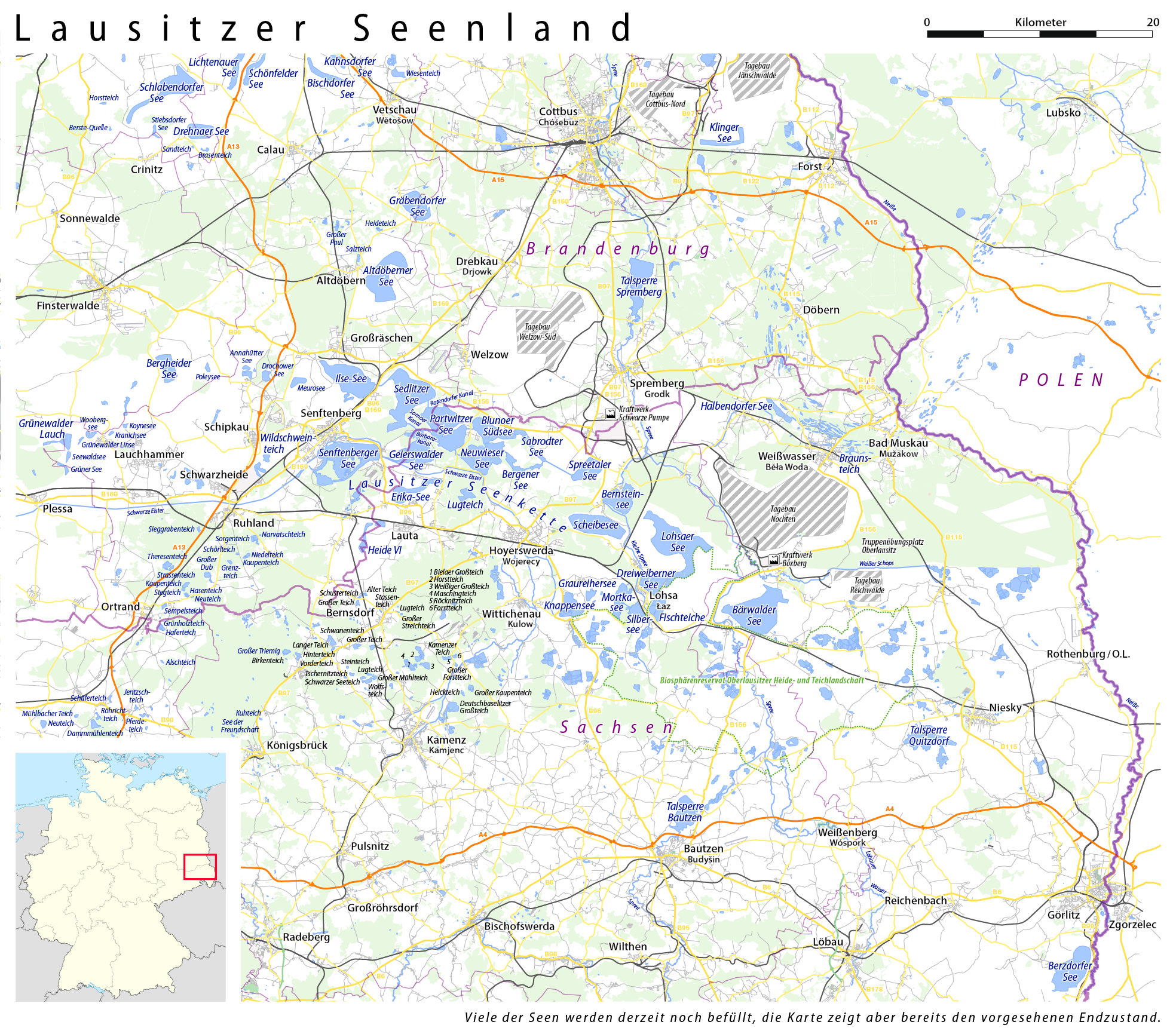
The Lusatian Lake District (German: Lausitzer Seenland, Lower Sorbian: Łužyska jazorina, Upper Sorbian: Łužiska jězorina) is a chain of artificial lakes which are the product of lignite mining in the German states of Brandenburg and Saxony
Lausitzer Seenland travel guide
Understand
The region shares part of its history with the Central German Lake District which has similar origins, but they differ in a few ways, too.
The "brown gold" of Lusatia
An old Sorbian saying goes that "God created Lusatia, but the Devil put coal underneath it". And it has indeed been blessing and curse in one that underneath the gently rolling hills and plains of Lusatia is one of Europe's richest deposits of lignite or "brown coal". Blessing because for over a century it gave people work and turned what would otherwise have been a forgotten backwater into boomtowns, but curse because to get to the coal, entire villages had to be moved, the water table had to be lowered and immense damage was done to nature and environment by mining and burning the decidedly "dirty" fuel.
While the first attempts at getting the coal out of the ground date to the 19th century and before, the inferior fuel compared to black coal or even wood was long regarded as an afterthought and its unpleasant smell when burned caused it to be regarded as "poor people's fuel" until the First World War decimated Germany's industrial capacities and forced it to deliver parts of its coal production to the victorious allies. Plans to start another war to right what the German right wing saw as an injustice done to Germany necessitated energy and resource self-sufficiency and ingenious chemists discovered ways to turn any carbon feedstock (including low quality lignite) into all manner of chemical products, gearing the mining into overdrive. After Germany lost the war, the new state of East Germany (commonly called "GDR" in English due to its long form name "German Democratic Republic") came to rely even more heavily on brown coal as it was virtually the only fossil fuel available. Homes were heated with it, trains were run with it (whether steam trains or - via lignite fired power plants - electric trains) and a huge chemical industry relied on it. The price was devastation of an entire landscape
Getting there
By plane 1 Berlin Brandenburg Airport (BER IATA). Berlin's snazzy new airport opened in late 2020 lies north of the area and can be a good entry point if arriving from other parts of Europe. There are, however, only a handful of intercontinental routes. (updated Nov 2020) 2 Dresden Airport (DRS IATA). Sitting just south of the main action, this airport has only a random grab-bag of destinations and if you aren't headed in from there, it is unlikely to help getting here easier. If you have to change in Frankfurt Airport or Munich Airport anyway, chances are, you're faster doing the last leg on a train instead. (updated Nov 2020)
By train 3 Cottbus main station. Cottbus sits on the northeastern edge of the Lake District, but "its" lake, the "Cottbuser Ostsee" (Cottbus eastern lake) only started flooding in 2019 and it'll be some years (depending on precipitation and water levels in the Spree river) before it is more than a sad collection of ponds. (updated Nov 2020)
By motorcar Federal highways A13 and A15 lie to the north and west
Getting around
By public transit Unfortunately the state boundary between Saxony and Brandenburg makes getting around by public transit a little less seamless than it would otherwise be. For information on routes, schedules and prices in Brandenburg (and Berlin) check out VBB. The Saxon part of this area is covered by VVO and in the east by ZVON.
Train stations in the area The following is a selective list of train stations in the area, not listing all there are.
4 Bahnhof Senftenberg. 5 Bahnhof Altdöbern. 6 Bahnhof Forst (Lausitz). 7 Großräschen station. 8 Bahnhof Guben. 9 Bahnhof Hosena. 10 Lauta. 11 Neupetershain. 12 Bahnhof Ruhland. 13 Bahnsdorf Bahnhof. Despite the name, this village well predates the rail line. 14 Sedlitz Ost. 15 Bahnhof Spremberg. 16 Bahnhof Weißwasser.
By boat Several of the lakes are linked to each other via canals and some are open to motorized shipping whereas all are open to unmotorized watercraft. There are two passenger boats, both run by Reederei M. Löwa one is called "M.S. Santa Barbara", the other "Aqua Phönix".
See
Lakes
Northern All these lakes are in the state of Brandenburg.
1 Lichtenauer See. 2 Schönfelder See. 3 Bischdorfer See. 4 Schlabendorfer See. 5 Drehnaer See. 6 Gräbendorfer See. 7 Grünewalder Lauch. 8 Bergheider See.
Central Some of these lakes are in Saxony, others in Brandenburg and a substantial number straddle the state line.
9 Großräschener See. 10 Senftenberger See. Flooding ended in 1973, making this one of the "oldest" lakes in the region and already a popular bathing spot in GDR times (with the obligatory naturism (FKK) beaches to show for it). 11 Partwitzer See.
12 Geierswalder See. Flooded and usable since 2006. It has a beach, restaurants, hotel and a marina. 13 Neuwieser See. 14 Blunoer Südsee. 15 Sabrodter See. 16 Bergener See. 17 Spreetaler See. 18 Erikasee. 19 Felixsee. 20 Halbendorfer See.
Southern All these lakes are in the state of Saxony.
21 Bernsteinsee. 22 Knappensee. Already flooded in the 1950s, this lake served as a "model" for subsequent development. Particularly lucky circumstances led to excellent water quality early on and a rich fauna of freshwater fish and waterfowl. 23 Graureihersee. 24 Speicherbecken Lohsa I. 25 Dreiweiberner See. 26 Speicherbecken Lohsa II.
Museums 27 Knappenrode energy museum. From 1918 to 1993 this heritage-listed building was a factory turning lignite into briquettes for home heating. Today it is a museum about the history of lignite and the region and how those two are indelibly intertwined. Adult €7, reduced €5, under 6 free. (updated Nov 2020)
28 Besucherbergwerk Abraumförderbrücke F60, ☏ +49 3531 60800. This gargantuan industrial machine whose purpose it was to move the overburden out of the way to access the coal is sometimes nicknamed "Lusatian horizontal Eiffel tower" due to its impressive size and construction mostly from steel. While there were plans to dismantle it and sell it for scrap as it was no longer needed after the collapse of
Do
1 Waldeisenbahn Muskau. A 600 mm (24 in) gauge heritage railway. The expansion of the Nochten open pit mine led to part of the route being dismantled and replaced with a new route in 2017. (updated Nov 2020) 2 Lausitzring (EuroSpeedway Lausitz). Built on top of part of the former open pit mine Meuro (filled up with overburden) this automotive racing circuit has held numerous motor sports events in addition to concerts and the likes. During important events, there is a bus-shuttle from nearby Senftenberg station. (updated Nov 2020)
Sleep
There are campsites in the vicinity of several of the lakes.
Go next
The Central German Lake District has similar origins Downriver on the Spree you can find the Spreewald
Overview adapted from Wikipedia, travel guide fromWikivoyage (CC BY-SA). Photography via Wikimedia Commons.