
Lalsk
Russia · Europe
About Lalsk
Lalsk (Russian: Лальск) is a small, historic market town in the north of Kirov Oblast. This is well off the beaten path, a place where only the most ardent travelers interested in small towns and the architectural heritage of Russia get to. Unlike the rest of the Kirov region, Lalsk belongs to the Russian North, its past closely connected with Veliky Ustyug, and its bleak present looks similar to far flung taiga towns of Arkhangelsk Oblast. Nonetheless, it was here that the Totemsky architectural tradition met the Vyatksky tradition, creating a unique combination well preserved for a modern tourist!
Lalsk travel guide
Understand
A historic city, Lalsk was founded in the 16th century at the crossroads of trade routes. In 1779, it received the status of a county town of Vologda Province. However, the 19th-century railways cut off the city from modern trade, and the town's growth halted. Now Lalsk is a quiet town with a population of 2,900 people (2018), with perfectly preserved monuments of northern architecture of the 18th-19th centuries, hardly visited by tourists, and practically unchanged since the 19th century.
Getting there
Lalsk is in the north of Kirov Oblast near the border with Vologda and Arkhangelsk Oblasts. The nearest significant cities are Veliky Ustyug (70 km) and Kotlas (90 km). You can only get to Lalsk through the local transport hub, Luza, which you can reach by rail from Kirov or Kotlas.
By train Luza Station (Станция Луза) ☏ +7 83346 5-18-76) is on the Kotlas—Kirov railway. There are 1-2 daily trains stopping at Vorkuta. There is also a daily Kotlas—Pinyug commuter train, which can get you to Luza in 2½ hours, but avoid this route, as you'll get stuck in Pinyug, waiting for a night train to Luza.
By car It is convenient to get to Lalsk through Veliky Ustyug by crossing the Dvina River to the village of Kuzino, and then going along local roads to Luza and then on to Lalsk. This way is fully accessible for any car regardless of the time of year, although the road quality is better in the winter, and some sections are unpaved. You can get to Luza in other ways as well. South of Luza, the road goes to Podosinovets and Demyanovo (there are no signs; and you'll have to ask the locals for directions), where, by roundabout routes, you can manage to make your way west to Vologda Oblast on the Veliky Ustyug—Nikolsk road or further south to more populous parts of the Kirov Oblast. The condition of these local roads is unpredictable, and their availability for cars depends on the time of year. In winter, it's easy to get to Kirov, but in the summer, good luck! Going on from Lalsk to the east, you will sooner or later (but rather later than sooner) find yourself in the Komi Republic via the P176 Kirov—Syktyvkar highway. The road is paved up to the administrative border, which, apparently, is passable for any transport and in any weather. This is the most reliable way from Lalsk to Kirov (430 km).
By bus There is no official bus station in Lalsk; buses stop at ul. 60 let Oktyabrya. Between Luza and Lalsk, ten buses run on weekdays and four on weekends and holidays. Trave
Getting around
Lalsk is tiny, and you can easily get everywhere on foot.
See
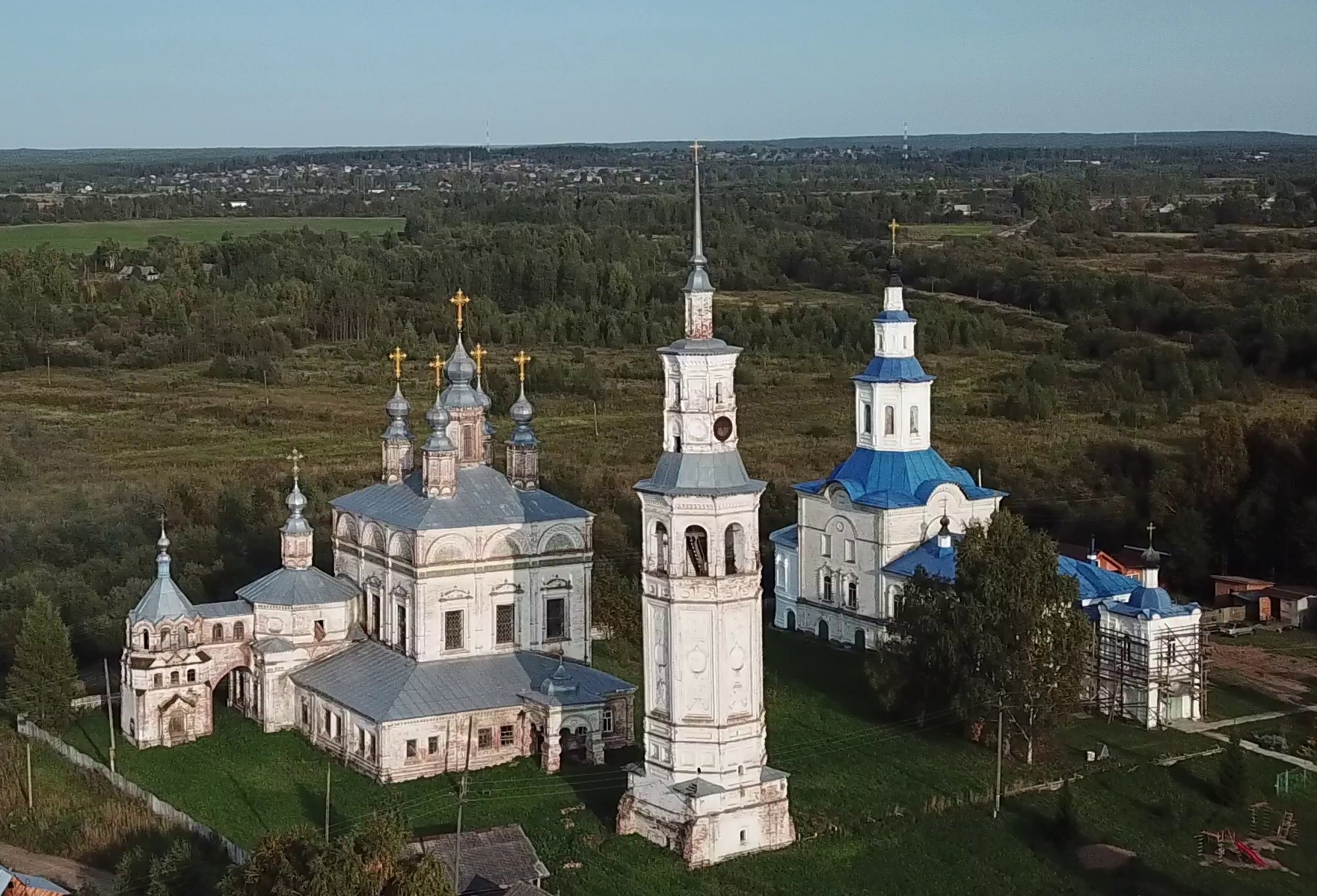
Ensemble Square 25 Octobrya (Ансамбль площади им. 25 октября). A collection of wonderful examples of the northern baroque style. You can climb the bell tower, which offers a great view. The best panoramic view of the ensemble itself is from the right bank of the Lala — from the bridge. As expected in the north, the ensemble consists of two churches: a large, cool, summer church and a smaller, warm, winter church, as well as a bell tower.
1 Cathedral of the Resurrection (Воскресенский собор). Built in 1698–1716, this cathedral is the largest church in Lalsk. It is a five-domed temple square, but its five cupolas are not the same, as is often the case in mid-latitudes. The middle is larger, the other four are smaller, but all the chapels are small, which is typical of the north and especially for Veliky Ustyug. The cathedral is decorated with an arcade of Ustyug ceramic tiles. 2 Church of the Ascension (Благовещенская церковь). 1732–1762. A one-domed church, similar in style to the "boat churches" of Totma. 3 Bell Tower (Колокольня). The bell tower was built in 1743 and fits well with the ensemble. Ensemble Square Lunacharskovo The best view of the ensemble is not from the square, but from the other side of the Lala, across the bridge. Both churches were ruined beyond recognition in Soviet times, and now barely look like churches at all.
4 Church of the Epiphany (Богоявленская церковь) (the church closer to the river). Built from 1711 to 1715, this church has been mutilated beyond recognition and is no longer functioning as a church. 5 Church of the Savior (Спасская церковь). Built in 1787, this church was used was used as a dormitory and now more resembles an apartment building than a place of worship. Only the lone tower (missing its dome) still reminds of the building's former purpose. 6 Orphanage and Church of St. John the Baptist (Воспитательный дом с церковью Иоанна Предтечи) (the church on Lunacharsky Square further from the river). 1714. The building as
Do
Regional Museum of Local History (Районный историко-краеведческий музей), ул. Ленина, 40 (on the main street in Pryashnkiov's Manor). M-F 09:00-17:00, Sa 09:00-16:00 (daily lunch break 12:00-13:00). The museum covers the history of Lalsk and local arts and crafts. Nothing particularly unique is on display, but since the museum doesn't receive visitors every day, the staff will be excited to meet you and tell you about Lalsk, and a visit to the museum may well give you your best impression of the town.
Buy
In the Regional History Museum, you can buy souvenirs made from birch bark and Dymkovo toys.
Sleep
There are no hotels in Lalsk (with perhaps one exception/option below), but you can overnight in Luza:
1 Hotel "Shakira" (Гостиница «Шакира»), г. Луза, ул. Энергетиков, 3 (in front of the Luza lumber mill in the southern part of town; beyond the area with five-story buildings), ☏ +7 83346 5-43-25. The rooms lack amenities, but are perfectly fine. Fun name! 2 Hotel "Prival" (Гостиница «Привал»), г. Луза, ул. Железнодорожников, 4а (near the station), ☏ +7 83346 5-11-71. There's an eatery on the first floor. It appears one hotel room has cropped up in Lalsk:
3 Lalsk-Agro (Лальск-Агро), г. Лальск, ул. Ленина, 2б, ☏ +7 83346 5-67-32, +7 922 956-91-84. A room with two comfortable couch-beds, a kitchen, and bathroom. Hot water. (updated Feb 2017)
Go next
In the villages around Luza, at least a dozen old churches have survived. Most of them are abandoned and in ruins, and given the distances and poor road quality around here, virtually everything (including Lalsk itself) is fairly hard to get to. Nevertheless, amateurs and connoisseurs alike are unlikely to consider the trip complete without visiting the Church of the Intercession on the Luza — an outstanding monument of northern architecture.
1 Church of the Intercession on the Luza (Церковь Покрова на Лузе). An inactive, architecturally noteworthy Orthodox church dating back to 1729. It is on the left bank of the Luza River in the woods between Luza and Lalsk. It is a two-story structure typical of the Russian North, connecting winter and summer churches. The church has singular features that not found elsewhere in Russian architecture of the 18th century. The altar of the lower church consists of two semicircles; however, the upper church's altar is five-faced. The octagonal tower of the church is larger and longer than usual, and the bell tower attached to the church at the en
Overview adapted from Wikipedia, travel guide fromWikivoyage (CC BY-SA). Photography via Wikimedia Commons.