
Kinmen County
Taiwan · Our home · Asia
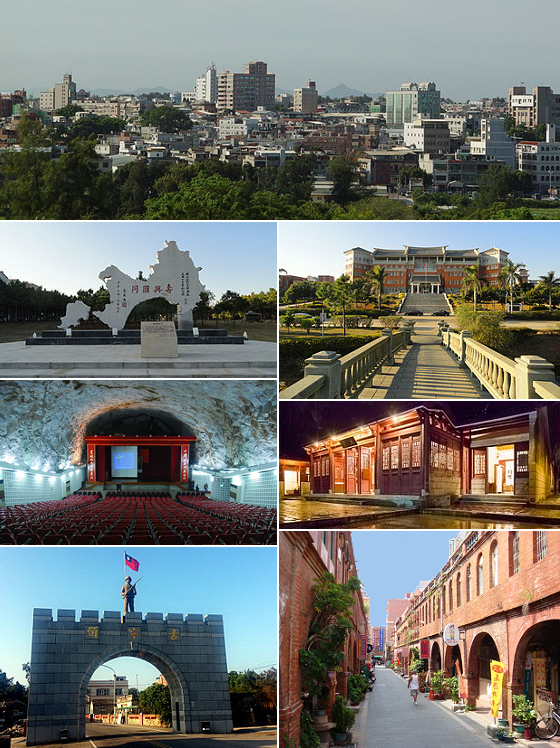
About Kinmen County
Kinmen is a county comprising a number of outlying islands near the People's Republic of China (PRC) but controlled by the Taiwan-based Republic of China (ROC) government.
All the islands of Kinmen county are within just a few kilometers of Mainland China, with the Xiamen city skyline clearly visible in the distance from many areas. Despite, and because of, its status as the front line in the semi-dormant China-Taiwan conflict, Kinmen is highly tourist-oriented, with the main themes being military history, historic architecture, and its signature gaoliang (kaoliang) grain alcohol.
About a quarter of the county, including inhabited areas, is covered by various units of Kinmen National Park, which is largely concerned with preserving historic architecture and former military sites, as well as natural areas.
Kinmen County travel guide
Understand
The main islands in the county are Greater Kinmen and Lesser Kinmen (Lieyu/Liehyu). Administratively, Kinmen is split into six townships, four of which are on Greater Kinmen. Another has Lesser Kinmen plus its neighbouring small islands, and the sixth is a couple of more remote small islands that aren't open to visitors. The islands are largely rural, made up of a mix of small towns, farmland, and historical sites. The economy of Kinmen is now based mostly on tourism and the famous Kaoliang liquor. Dried meat from Kinmen is also sold on Taiwan. Kinmen and Matsu remain sensitive areas and both the PRC and the ROC maintain substantial military forces in the area. Travellers should exercise caution, avoid political discussions, and avoid photographing military installations or even pieces of infrastructure (bridges; dams; etc.) which might be military targets. Although administered by the Taiwanese government, Kinmen and Matsu are officially considered to be parts of Fujian province, not of Taiwan, by both the PRC and ROC governments. Unlike the main island of Taiwan, they were never colonized by Japan (except for an 8-year occupation related to World War II), instead being governed by the Qing dynasty, and then the Mainland-based Republic of China, during Taiwan's Japanese period. Local residents often identify as "Kinmenese" or "Chinese" and not "Taiwanese". Politically, Kinmen is a KMT stronghold, with most residents being firmly opposed to formal Taiwan independence. The DPP has made inroads among the younger generation, but most of these Kinmenese end up permanently settling in Taiwan and never go back to Kinmen.
History In 1949, the Communists won the Chinese civil war, defeating the Nationalists (Kuomintang) who had governed (most of) China from the 1911 revolution until 1949. Since then, there has been a Communist government in most of China (the People's Republic of China or PRC) while the Nationalists held onto Taiwan, which is still officially call
Getting there
By plane
1 Kinmen airport (KNH IATA). Mandarin Airlines and Uni Air fly to Kinmen from Taipei, Taichung, Chiayi, Tainan, Kaohsiung, and Magong/Penghu several times a day. One-way tickets cost a little over NT$2000. This is the only way to get to Kinmen directly from Taiwan, unless you have your own boat. (updated Oct 2021)
By ferry There are ferries from the Xiamen in mainland China to 2 Shuitou Pier on the main Kinmen island. There are multiple daily ferries running between 09:00 and 17:30 each way, taking about 30 min in each direction. There is also a ferry from Quanzhou, but it is less frequent than the ferry from Xiamen, with only one ferry per day, taking about 1 h in each direction. There are no public ferries to Kinmen from Taiwan or any other islands under the Taiwan government's control. Before the COVID-19 pandemic, it was possible to take a ferry from Taiwan to Xiamen (in Mainland China), then take the Xiamen-Kinmen ferry to get to Kinmen. This assumes that you have a visa or visa-free entry eligibility for both China and Taiwan. Since Kinmen is under Taiwanese control, going there from mainland China counts as an exit. Thus, holders of single-entry visas cannot do short trips to from Xiamen to Kinmen and return. So make sure to clarify your visa situation before hopping on a ferry! If you are arriving by ferry, the ferry terminal has a tourist information desk that can help find you an inn. There are also money exchange counters, but they will only exchange RMB to NT$; they will not exchange other currencies. There is also an ATM just outside the ferry terminal (cross the road) that accepts Visa and Mastercard. A UnionPay ATM is in the departure area, where you also find a stall to change RMB to NT$. At the tourist services counters besides Joane Ranch Restaurant, you can rent portable WiFi (NT$250 per day) or get an unlimited data SIM Card (starting from NT$400 for 5 days). Cash only, no cards.
Getting around
By taxi There are taxis on the island, though you need pretty good Mandarin or Minnan skills to negotiate a rate with the driver. They are also concentrated mostly in the city center, so you can't count on finding one just anywhere. If you can speak Mandarin or Minnan, most of the drivers are quite friendly, so one shouldn't worry about bargaining super hard. Most of them aren't looking to rip you off. Taxis from the Shuitou wharf to Jincheng city's downtown are NT$250 flat rate, and roughly NT$200 to return to the wharf. There are a few buses that run around, but they are not frequent and bus stops aren't particularly convenient.
Your own vehicle Roads in Kinmen are all paved, there are good maps at every village and in every hotel, and navigation apps are mostly accurate. Official road signs are written in both Chinese and English, and are fairly well-placed, but the road network is very extensive and haphazardly laid out, so expect to miss some turns and have to reroute or backtrack. As of July 2022, there also seem to be a lot of road closures that mapping apps don't know about. Some of the "roads" on the mapping apps look more like bicycle paths in real life, but there don't seem to be any strict rules about which vehicles can go where, and locals would presume that scooters (at the very least) are allowed to use them. Beware of high winds, which can strike any time of the year.
By scooter It's easiest to just rent your own scooter. Your accommodations may be able to arrange this for you, or you can get a 150 cc for about NT$550 per 24 hours at a rental shop. There's one in the airport. There is also a rental place in downtown Jincheng near the northern entrance to Mofan St. Just as in Taiwan proper, it's illegal to ride a scooter without a scooter or motorcycle license. Though locals who know the way and aren't interested in stopping anywhere can ride a scooter from one corner of Greater Jinmen island to the opposite corner in about half an hour
See
The Wind Lion Gods of Kinmen are unique statues all over the island, you can either see the originals in the villages (this can take some patience and hunting skills) or just go to the new Wind Lion God Park near the ShangYi Airport. They began as simple stones placed at the northeast corners of settlements to ward off evil coming in with the winter seasonal winds. Over time, they developed into brightly-decorated, and slightly humorous, individual lion statues. One of the later trends is to wrap them in red cloth shawls to give them protection from the cold winds. Republic of China patriotism nostalgia. All around the island are monuments and giant red inscriptions (in Chinese) containing patriotic slogans, mostly from past decades all oriented around pride in the Nationalists' Republic of China as the rightful government of all China, rather than in any separate country of "Taiwan". These may be hard to appreciate if you don't read Chinese though.
Military history sites and museums
1 8-2-3 Artillery battle museum. Small but excel
Overview adapted from Wikipedia, travel guide fromWikivoyage (CC BY-SA). Photography via Wikimedia Commons.