
Itsukushima
Japan · Asia
About Itsukushima
Miyajima is one of the crown jewels of Japan, and certainly one of its finest views. Located off the coast of Hiroshima, in Hiroshima Prefecture, the serene beauty of the island is an essential coda to that city.
Itsukushima travel guide
Understand
Miyajima has been considered a holy place for most of Japanese history. In 806 AD, the monk Kōbō Daishi ascended Mt. Misen and established the mountain as an ascetic site for the Shingon sect of Buddhism. In the years since, the island's Buddhist temples and Shinto shrines have maintained a close relationship. In the past, women were not allowed on the island and old people were shipped elsewhere to die, so that the ritual purity of the site would not be spoiled; in fact, the island's real name is Itsukushima (Solemn/Strict Island), and Miyajima is just a popular nickname meaning "Shrine Island". These days, strict measures are taken to ensure that the island's sole town retains a classically Japanese Edo-era look. Deer wander freely through the streets and parks. There are still a few bits of concrete warren that have snuck in, but the seafront promenade is particularly attractive, especially later in the day when the rampaging tour groups head home and the stone lanterns are lit.
Miyajima Tourist Association, 1162-18 Miyajima-cho (in the ferry building), ☏ +81 829-44-2011. The association has a good English guide site.
Getting there
Miyajima can be reached by sea from Hiroshima etc. The main ferry terminal on the mainland is 1 Miyajimaguchi, which can be reached from JR Hiroshima station either by train (30 min; ¥420) or tram line #2 (70 min; ¥270). The tram line also passes by the Peace Memorial Park. From Miyajimaguchi, the JR West Miyajima Ferry and the Matsudai ferry both run to Miyajima. The trip takes 10 minutes and costs ¥200 each way; Japan Rail Pass and local JR West Pass holders can use the JR ferry for free. Not included in the ferry fare is a ¥100 visitor tax that must be paid upon entering the island. Ferries start running from around 06:25 and ramp up during the daytime, with each of the ferries running at least 4 trips per hour. Trips begin to wind down after 19:00, and the last runs of the day occur between 22:00 and 23:00. Most tour groups are gone after 17:00, so you'll have a different experience on the island if you wait them out. There are also direct ferry connections from the Motoyasubashi Pier of the Hiroshima Peace Park, run by Aqua Net. The boat is confining with small windows, which can, at times, get rather rough. It takes about 45 minutes and costs ¥2200 one-way, ¥4000 return (half-price for children). Timetables are irregular and are often influenced by the tides near Miyajima, but generally, the boats run at least once per hour from around 08:30 to around 17:30. The Setonaikai-kisen High-Speed Boat runs from Hiroshima Pier and the Grand Prince Hotel Hiroshima to Miyajima a few times per day; usually three runs in the morning and three more in the afternoon. It is around 32 minutes from Hiroshima (Ujina) Pier to Miyajima using this route, at a cost of ¥1900 for a one-way journey. A one-day free pass costs ¥3400. Connections to Matsuyama are also possible at Ujina Port. Some free tickets sold by JR West are also available. No bridges connect Miyajima to the mainland. Some ferries will carry automobiles and motorcycles, but parking on the island is expensive a
Getting around
Miyajima is small enough to cover by foot, and there are English-language signs throughout the island. Taxis can be taken from the pier to the hotels and residential areas, but not the tourist sights. The 1 Day Streetcar and Ferry Pass (¥900), available from Hiroshima Electric Railway, allows unlimited rides on the Miyajima Matsudai Steamship from Miyajima-guchi and on Hiroshima Electric Railway streetcars. It can also be purchased from tourist information centres in Hiroshima City and from tram conductors (recommended as a time-saver). The Visit Hiroshima Tourist Pass (one-day ticket \1000; two-day ticket \1; 500) allows unlimited rides on the ferry from Miyajima-guchi (JR Ferry and Miyajima Matsudai Kisen), Hiroshima Electric Railway trams and buses operated by many companies in the city centre. This ticket cannot be purchased on board trams.
See
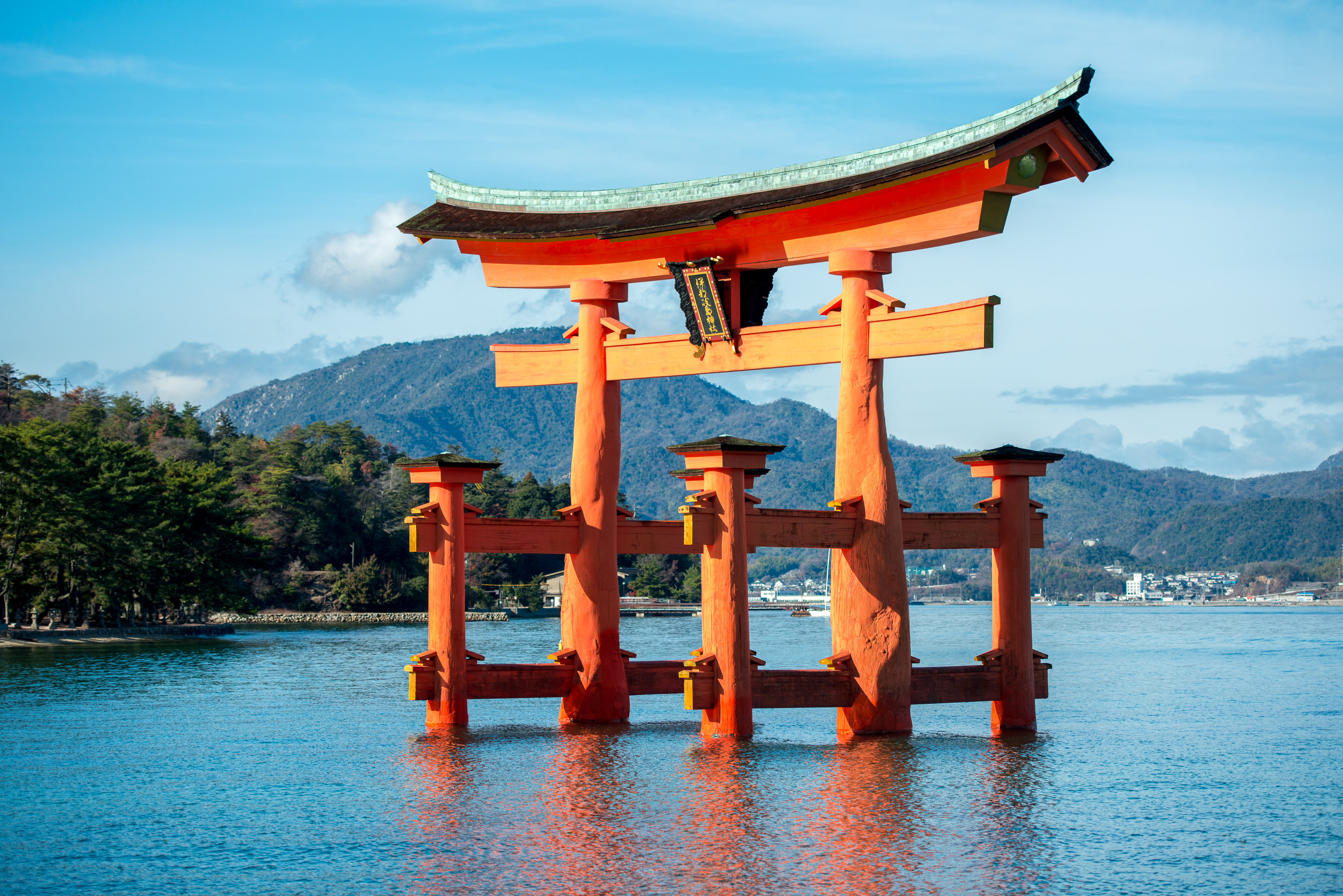
Standing in the bay in front of the shrine, the floating torii is the "gate" to Itsukushima. Whether the gate is "floating" or merely mired in mud depends on the tide. The Hiroshima tourist information office will be able to tell you the approximate time of the high tide (or you can check here), which is the best time to see the torii. If you spend a full day on the island, though, you should have the chance to see it both ways. As of May 2025, renovations are going on to repair and repaint the shrine, though these are mostly complete. The shrine is open as usual and almost entirely restored to its vermillion-lacquered glory.
1 Itsukushima Shrine, 1-1 Miyajima-Cho, ☏ +81 829-44-2020, fax: +81 829-44-0517. Mar-Oct: 06:30-18:00, Nov: 06:30-17:30, Dec: 06:30-17:00, Jan-Feb: 06:30-17:30. A UNESCO World Heritage Site, Itsukushima is a large, red-lacquered complex of halls and pathways on stilts. It was built this way so that commoners could visit without defiling the island with their footprints. Weddings are occasionally held at the shrine, but that doesn't bar visitors, and the priest's ceremonial dance is a memorable sight. ¥300 for temple entry, ¥500 for entry plus Treasure Hall. (updated Feb 2023) 2 Senjokaku, 1-1 Miyajima-cho. 08:30-16:30. This huge wooden pavilion is called the 'Sentamikaku' because it is the size of 857 tatami mats. There is actually nothing but empty space in this huge wooden building. It was started by Toyotomi Hideyoshi in 1587, but left incomplete after his death. There's also a picturesque 5-story pagoda (Gojuto) next door, though as of May 2025 this is entirely covered by scaffolding for restoration, and plenty of cherry trees if you are visiting in sakura season. ¥100. (updated May 2025) 3 Miyao Castle (5 min from Miyajima pier). A hill fort built in the early 16th century, it was a key focus of the 1555 Battle of Miyajima as part of the Mōri army’s offensive against Sue Harukata. It appears to have declined after
Do
1 Mt. Misen (530 meters). If you have energy to spare, Mt. Misen offers gorgeous views of the island and sea. The hike takes about an hour, depending on rest stops along the way. Look for the signs for the ropeway, and when you reach it, just keep going. There is a less used, slightly more strenuous (and more rewarding) route called the Omoto Pass that begins in the mossy park near the aquarium. Those with less energy (or inclination) can cheat and take the Miyajima ropeway to an observatory near the top and hike from there (¥1100 one way; ¥2000 round trip). The ropeway closes at 17:00 (last car down 17:30). It is a 30-minute walk from the end of the ropeway to Mt Misen, you have to climb about 150 height meters after going down the first ten minutes. (updated Feb 2023) 2 Momijidani Park. The ropeway station is in the middle of Momijidani Park, but the park is worth a stroll even if you're not headed up. Known for its autumn colors, there are quite a few
Overview adapted from Wikipedia, travel guide fromWikivoyage (CC BY-SA). Photography via Wikimedia Commons.