
Huatulco
Mexico · Americas
About Huatulco
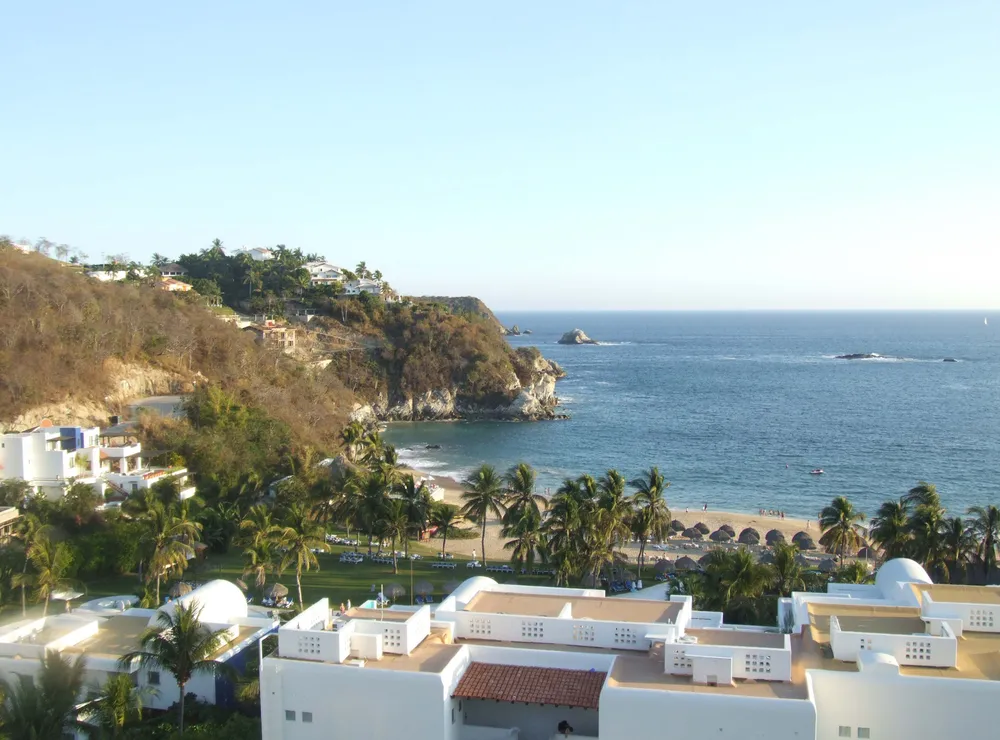
Bahías de Huatulco, is a destination resort area on Mexico's Pacific Coast in its most southern state of Oaxaca. More commonly known to outsiders as just Huatulco, the area is locally referred to as "Bahias" to distinguish it from the original, further-inland town of Santa María Huatulco. Huatulco's tourism industry is centered around its nine bays, four of which have been designated as ecological preserves where no development is permitted. The bays of Huatulco and adjacent dry tropical forest are a designated UNESCO World Biosphere Reserve. Because of the sheltered nature of Huatulco's bays, its white sand beaches are a great place for wading or swimming in calm waters, and it's also the main place along the Oaxaca coast for snorkeling, though most of the coral died in the marine heat wave of 2023.
Huatulco travel guide
Understand
The name Huatulco historically refers to the lively (but decidedly non-touristy) town of Santa María Huatulco, located in the foothills of the Sierra Madre del Sur a number of kilometers inland from the beaches. However, the Huatulco tourist area is centered on the small towns of La Crucecita, Santa Cruz, Chahué, and Tangolunda, officially considered outlying villages of the Santa María Huatulco municipality, which are gradually merging into one bigger population center. The area is a FONATUR ('Fondo Nacional de Fomento al Turismo') project, developed deliberately from the ground up as a resort area within the last few decades, and has been a major success in that regard. FONATUR is also responsible for the resorts in Cancun, Ixtapa/Zihuatanejo, Los Cabos and Loreto Bay. Compared to nearby backpacker haven Mazunte or small beach town Zipolite, Huatulco's vibe is more about Mexican families on vacation. As of 2023, FONTATUR's role in managing the development and tourism infrastructure of Huatualco has been reduced with responsibilities turned over to the state of Oaxaca. Approximately 1/3 of the land area of Huatulco is part of the Huatulco National Park (Parque Nacional Huatulco), managed by CONANP. The national park is charged with preserving the ecosystems of the region, especially lowland tropical deciduous forest, coral reefs, mangroves and flooded forests. Huatulco National Park includes more than 6,000 hectares of land area and more than 5,000 hectares of marine environment in the nine bays of Huatulco. The park is home to a great diversity of flora and fauna species; many are endemic to the region and at risk of extinction. In 2023, two new national parks were declared using some of the existing parkland of Huatulco National Park and adding some new protected areas under the management of CONANP. The new parks have no infrastructure and are yet to be developed, but as of 2024 are designated as Huatulco II National Park and Ricardo Flores Magón National Park.
Getting there
Huatulco is a 10-hour drive or a 1-hour flight from Mexico City, or a 6-hour drive or very short flight from the city of Oaxaca.
By air 1 Bahías de Huatulco International Airport (HUX IATA). Has flights from Mexico City and Oaxaca City. There is also a daily flight on Aeortucan from Huatulco to Puerto Escondido. Also there are numerous charter flights in the winter months from major cities in the US and Canada, and the number of charter flights is growing every year as Huatulco grows in popularity. (updated Aug 2019) The Huatulco International Airport is small but very pretty with its large open air palapa buildings. It is a 10- to 20-minute drive to the areas of La Crucecita, Santa Cruz and Tangolunda, where the majority of the hotels and other types of accommodations are located. If you have an air/hotel package, your bus transfer may be included; if not, you can take an "authorized taxi" from the airport or purchase a ticket (one way or round trip) on an "authorized shuttle" at a stand in the airport arrival area, or prearranged shuttle transport. The "authorized" transportation from the airport are priced higher than other taxis in the area, so be prepared. An alternative is to walk a short distance, about 500 meters, out to the main road and catch a much cheaper non-airport taxi for a few hundred pesos (which won't be air-conditioned; except maybe for an extra fee), or even a local bus for just M$20 as of 2024 (the latter will not have room for your baggage; so it's best if you are traveling light). White "Rapidos de Pochutla" vans running between Puchutla and La Crucecita also pass outside the airport, and may be willing to put your lugging in the back compartment. They probably charge a similar amount to the bus. If you have a farther distance to travel (Puerto Escondido; Puerto Angel; San Augustinillo; Mazunte; etc.) then you may want to take a taxi to the bus station in La Crucecita, which is in the opposite direction, and take a first class bus from th
Getting around
The Bahías de Huatulco tourist area revolves around a few town centers:
La Crucecita is the biggest town center, where vacationers and local tourism workers mix freely. Though it's largely a normal Mexican town, it does have a lot of cute restaurants, bars, and souvenir shops, especially in the central area near the zócalo. A bit more inland, it's at least a 30-minute walk to the nearest beach (Santa Cruz). Santa Cruz Huatulco is the mega-tourist village centered around the cruise ship terminal. It has a decent beach, a big marina for boat trips, and lots of tourist-oriented businesses. Chahué is another beach village to the east of Santa Cruz Tangolunda is a beach hotel area even further to the east San Agustín is a remote village to the west of the main tourist centers on the far side of the national park, accessible only by boat or a long (but well-graded) dirt road from a junction near the airport. Known as a relatively chill and less-crowded beach hangout spot, but still crowded with restaurants, smaller accommodations, and something of a local village. Various outlying beaches are accessible beyond Santa Cruz and San Agustín by paved road (La Entrega and Maguey), dirt road (Riscalillo), hiking trail (Cacaluta; Violín; Órgano), or only by boat (Chachacual; La India; etc.)
By taxi Taxis are the most transport method for visitors, and the area is extremely easy to get around if you can afford paying M$35-100 for a ride (depending on how far you're going). Taxis are color-coded for different home base areas, but in generally any taxi will take you anywhere "especial" (paying the entire fare). It is best to verify the price before getting into a taxi. Locals do not tip taxi drivers, although tourists may be expected to. There are some signs around which have posted prices to certain beaches or towns. Another option is to rent a driver for the day if you want to go farther afield, to Puerto Escondido for example. Between the major town centers, it is possible t
See
The "Bays of Huatulco" are the main sightseeing attraction, with daily boat trips (550-600 pesos per person for a "colectivo" boat) visiting multiple sheltered beaches, letting passengers step on the beach or snorkel at certain ones, often including remote beaches in the national park without any buildings or access by road. As of April 2024, one promoter claimed that dolphins, turtles, and whales are also seen on every trip. There is also a waterfall somewhere in the area.
Do
The main activity here is hanging out on the beach. Major tourist beaches (Santa Cruz; Chahué; Tangolunda; La Entrega; Maguey; San Agustín) are lined with seafood restaurants and bars, where you can generally enjoy shade, a relatively safe place to put your belongings, and sometimes wifi, as long as you're "consuming". The water is generally calm and safe to play or swim in, with large areas of each bay roped off with buoys to protect from boat traffic (though life guards, where present, don't seem to enforce any ru
Overview adapted from Wikipedia, travel guide fromWikivoyage (CC BY-SA). Photography via Wikimedia Commons.