
Hattingen
Germany · Europe
About Hattingen
Hattingen is a city in Ruhr. It is known for its medieval core and abandoned steel mill. It has a population of about 54,000 (2020). The city focuses on tourism, with the former steel works becoming a museum and the historic old town drawing in tourists, but not yet being overrun.
Hattingen travel guide
Understand
History
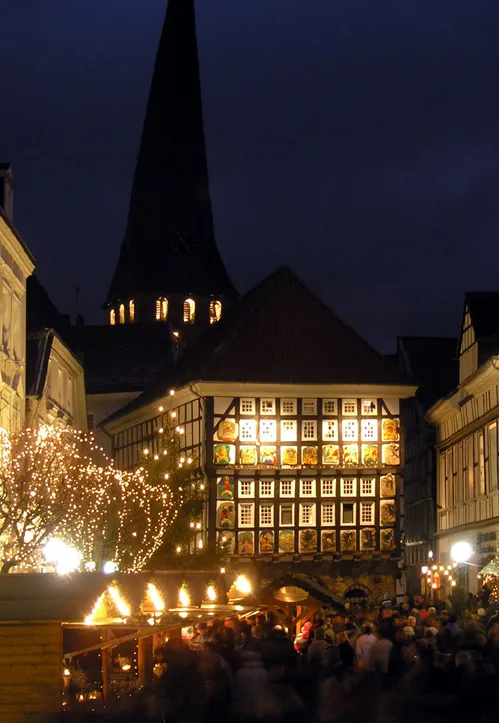
Hattingen was first mentioned in 990 as Hatneggen, followed by the founding of the town in 1396. In 1554 the town was recognised by the Hanseatic League, and its location helped the textile trade to flourish. After some run-ins with the French and Swedes, the town continued to grow steadily. Following the establishing of the Henrichshütte steelworks in 1854, Hattingen started booming rapidly. World War II meant massive support for the regime and also becoming an important air raid target. After heavy damage the historic town was rebuild but neglected in the post-war period, though public resistance meant only parts of it were demolished in the 1970s. Despite large protests, increasing competition and a bad location caused the closure of the steelworks from 1987 on, causing the loss of almost 10,000 workers and leaving a massive scar to this day. The city had managed the transition to service industry better. The historic old town was threatened with demolition in the post-war period, but this was largely prevented, besides the southern part of the core, where a large supermarket now stands. Walking around gives you a good taste of how a typical small German city centre (before bombs and concrete boxes) looked like. Several festivals throughout the year invite locals and visitors alike, with the historic Christmas market from the end of November to Christmas as the highlight, drawing people from near and far.
Geography Hattingen is a collection of settlements in a hilly area, with the Ruhr River running through the north of it, near the city centre. The centre of the historic core is St Georg's Church. Heggerstraße is the main shopping street and slowly rises up in elevation from the plateau of Hattingen Mitte as you go north. In clockwise-order the other smaller settlements are:
Welper, a quiet garden suburb built for the nearby steelworks. Stores are on Thingstr. and Marxstr., the public pool sits behind the high school.
Blankenstein, once an ind
Getting there
By plane The nearest airports are Düsseldorf and Dortmund:
Düsseldorf Airport is 40 km away. DUS is the nations fourth-busiest airport, seeing flights ranging from short domestic hops to long haul international flights. Public transport takes about 1:15h to Hattingen. Dortmund Airport is about 30 km away. Dortmund (DTM) is a typical small European bare bones budget airport. Public transport takes between 1:30 - 2:00 hours to Hattingen. Cologne / Bonn Airport, situated a little further at 60 km away, offers flights throughout Europe, northern Africa and even Iran and Iraq. Traveling by public transport via Düsseldorf takes a little over 2 hours, by car depending on traffic 1-1.5 hours. Flights operate 24 hours.
By train and public transport 1 Hattingen Mitte (Busbahnhof/ ZOB). Central bus/tram/train/taxi station. If you arrive by those in Hattingen, it'll likely be here. (updated Nov 2021) Long-distance IC and ICE trains stop at Essen, which is an important hub station in the German rail system, and at Bochum. Essen also sees daily Eurostar service to Brussels and Paris. From Essen, take local S-Bahn train S3, daily every ½ hour, roughly 05:00-24:00. Hattingen Mitte has a lift, Hattingen (Ruhr) station is on the surface and has platforms accessible without aid. From Bochum, take express bus SB37 (M-S ~ 06:00-22:30; Su 11:30-22:30; hourly) or Tram 308, daily at least every ½ hour, both cost €7.40 / trip for adults per 2024 fares, take ½ hrs and use low-floor vehicles. The bus station serves local and regional buses. See the website of regional transport authority VRR for specific schedules, fares and further information. Coaches on booked trips will drop you off at the car park next to a large World War II bunker across from Reschop-Carree centre.
By car Autobahn A43: Exit 21 Witten-Herbede, follow signs Hattingen, keep following main road past Blankenstein, turn off short dual-carriageway, left, at second light (large building straight ahead) left, up th
Getting around
The historic centre is small enough to be explored on foot. If you have mobility issues be careful when walking on the cobblestone in some alleys. Low-floor buses and trams serve Hattingen and cost €3.60 per ride or €7.40 to Essen and Bochum per VRR fares in 2025. Services operates roughly 05:00 to 00:00 during the week, with shorter hours on weekends. See VER for an interactive plan of the local network.. Tickets can be bought from the three ticket machines at Hattingen Mitte (at the bus station; the tram 308 platform and in the underground S-Bahn station) that take cash and cards, at the information office, at some select tobacco-lottery-newspaper shops and from bus and tram drivers (only single and bike tickets; preferably with coins and small banknotes).
An information office for local public transport shared between Bogestra and VER is next to the bus station Hattingen Mitte (open M-F 09:30-17:30; Sa 10:00-15:00). Night bus route NE4 runs from Bochum via Blankenstein, Hattingen (mirroring most of day time route 350) and down to Schwelm, running on Friday, Saturday and holiday nights. Taxis are available at the stand under the pedestrian bridge at Hattingen Mitte station or to be called. Several small operators exist, fares in 2025 are €9.50 base including the first 2km plus €2.40 for every additional km. A public bike-share system is run under the Metropolradruhr brand by nextbike. The system has been rolled out in the major Ruhr cities and keeps expanding. Check the app for the handful of docking stations. Sign up through the nextbike app. Rates start at €1.00 / 15 minutes, many discounts for students, residents and transport pass holders are available. Cheap parking is available in garages and car parks surrounding the town centre.
Altstadt-Parkhaus, Augustastr., Multistorey car park at north side of the old town centre, access from east via Schulstraße only, max. height 1.90 m (6.2 ft), uses licence plate scanners, pay at machine or online with credit
See
The main attraction of Hattingen is its medieval city centre. Despite wars and post-war neglect you can still experience the stereotypical alleys surrounded by timber-frame houses here. During Christmas season the city is especially charming. The other major attraction is the old blast furnace of the local closed steelworks which has been turned into a museum and mostly left in its original state but also houses exhibitions and an annual meet up for Mercedes fans in summer. Both the city and blast furnace can be experienced on your own or with a tour guide in a couple of hours.
City Centre The 1 Historic Town Centre features over 150 historic buildings
2 Old Town Hall (Altes Rathaus), Untermarkt 9. Medieval town hall build in 1576, used to govern the town until 1910, nowadays open as art exhibition. During the Christmas market, the windows get turned into a calender. (updated Feb 2024) 3 Flatiron House (Bügeleisenhaus), Haldenplatz 1. closed for renovations since 2021. Flatiron sh
Overview adapted from Wikipedia, travel guide fromWikivoyage (CC BY-SA). Photography via Wikimedia Commons.