
Goiás
Brazil · Americas
About Goiás
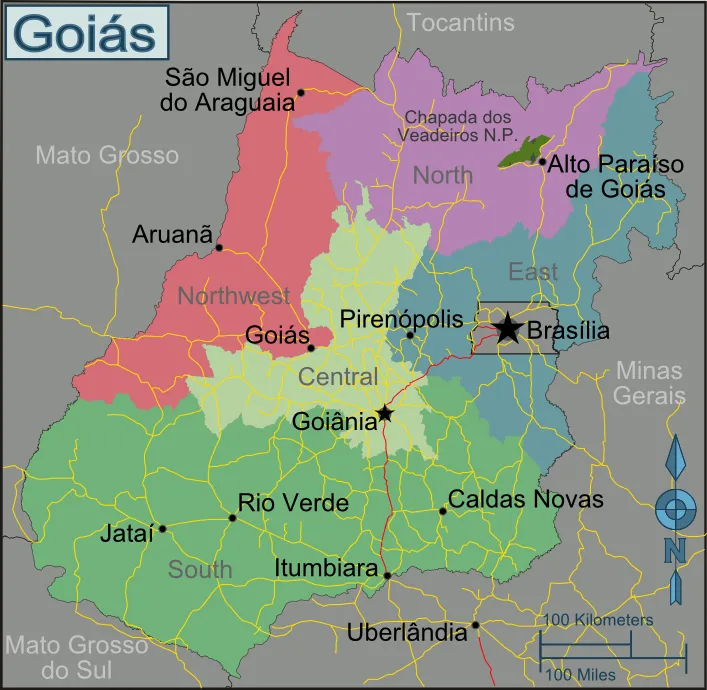
Goias (Portuguese: Goiás) is a state of Brazil in the Central West region of the country.
Goiás travel guide
Understand
The name Goiás (formerly; Goyaz) comes from the name of an indigenous community. The original word seems to have been guaiá, meaning "the same person" or "people of the same origin." The most central of the Brazilian states and the most populous of the region, Goiás is characterized by a landscape of plateaus. In the height of the drought season, from June to September, the lack of rain makes the level of the Araguaia River go down and exposes almost 2 km of beaches, making it the main attraction of the state.
Getting there
By plane The largest airport in the state is the Santa Genoveva International Airport GYN IATA, in Goiânia, which has domestic and international flights. Depending on where you are going, it is more practical to fly to Brasilia. Nelson Ribeiro Guimarães Airport (CLV IATA) in Caldas Novas has local flights.
By car The State of Goiás is located at an important national road junction. The national and state road network is present throughout the state, with more than 92% of paved roads.
By bus Almost all cities have a bus terminal with buses to various cities in the country. Consult the coverage areas of the bus companies. The busiest bus terminal in the state is in Goiânia.
See
Museums, bars, restaurants, cafes, nightclubs, concerts, theaters and nightlife in general in Goiânia. Hot springs in Lagoa Santa, Caldas Novas, Rio Quente and Jataí. Buildings from the Colonial and Imperial eras of Brazil in Cidade de Goiás, Pirenópolis, Corumbá de Goiás, Niquelândia, Pilar de Goiás and others. Waterfalls in Cocalzinho, Jataí, Cavalcante, Corumbá de Goiás, Alto Paraíso and Chapada dos Veadeiros National Park.
Do
Trails and eco-adventure in the Chapada dos Veadeiros and Alto Paraíso National Park. Beaches and water sports in the cities of Araguaia, Aruanã and Luiz Alves, and Lago da Serra da Mesa, Niquelândia and Uruaçu. Cultural festivals in Goiânia, Cidade de Goiás, Pirenópolis and many others.
Buy
It is common in the cities of Goiás to have a good number of souvenir shops. Many of these souvenirs are very amusing and resemble items from the state, such as pequi, farms, kitchen utensils from Goiás. In medium-sized cities such as Anápolis, Jataí, Rio Verde, Itumbiara and Luziânia there are good malls with big brands. In Goiânia, trade is quite diversified. You can buy everything. In addition, the capital of Goiás is known for its low prices, especially for clothing. Therefore, many retailers from the North region come to shop in the city.
Eat
Pamonha - Brazilian local delicacy. It can be savoury or sweet; à moda (a lot of possibilities; most common is savoury paste with sausage and cheese); "Romeu and Julieta" (guava and cheese). Pequi - local fruit. Appreciated by locals, especially with rice or chicken. It has a peculiar smell. Please don't bite, there are lots of thorns. You have to just gnaw. The cuisine of Goiás is very diverse, with its main dishes being fish on the tile, suã (pork meat) with rice, rice with pequi, and also the everyday Brazilian dishes such as rice and beans; in addition to pamonha, which is used as the main dish at meals; the fruits are the jaboticaba, the guabiroba, the jatobá, among many others from the cerrado. Mixtures, the name given to vegetables such as milkweed and taioba, also stand out, in addition to the introduction of guariroba, one of the main ingredients in casserole, as a vegetable in the almost daily diet. The greengrocer, the name given to homemade biscuits, is also diversified: breaker, mané pelado (cassava cake baked in banana leaves), cheese biscuit (which was invented in Goiás), lie (fried manioc biscuit), peta, the almost forgotten brevidade (povilho beaten with eggs and sugar), the dulce de leche pastry and the sweet rice cake (the latter two are typical greengrocers in the City of Goiás). The variety of sweets is extremely rich: marmalade in a box (in the region of Luziânia), “Moça-de-Engenho” or “Moça Branca” (molasses beaten and framed in the form of a sculpture),milk jam (mainly with grated papaya sticks or grated cider), egg jam (ambrosia made directly in molasses), candied fruit jam (very rich in Pirenópolis), grated cider jam, fruit peel (orange; lemon), among many others. Seasoned brown sugar (with milk; orange peel; cider or peanuts). The seasonings are very diverse, with a cuisine rich in spices such as saffron and ginger. Pequi, for example, in the old villages of Meia Ponte (today Pirenópolis) and Vila Boa, still in the beginning of the 18th
Drink & nightlife
Liqueurs of different flavors (jabuticaba; chocolate; vanilla; cupuaçu; etc.) Regional juices (tomato; jabuticaba; seriguela; cupuaçu; açaí; oiti; etc.) Cachaça (aged or distilled) Beer (light or dark) Cozumel (a drink made with light beer; salt and lemon)
Overview adapted from Wikipedia, travel guide fromWikivoyage (CC BY-SA). Photography via Wikimedia Commons.