
Frigento
Italy · Europe
About Frigento
Frigento is a town in Avellino province in the region of Campania, Italy, a historic village of Irpinia that stands out for its numerous cultural, artistic and natural resources. It is a popular destination for those in search of health and tranquillity. Frigento is also one of the "most beautiful villages in Italy".
Frigento travel guide
Understand
Frigento is in central Irpinia, on the top of a large hill at a height of 911 m a.s.l. Frigento dominates from above the wide Ufita valley to the north and the Fredane basin to the south. Its territory extends over about 40 km2 (15 sq mi). The town is called the Balcony of Irpinia, for its panorama from which you can see 5 regions and 11 provinces. It is about 40 km from Avellino and about 100 km from Naples.
History The territory of Frigento has numerous findings from the Palaeolithic era, mainly made of flint or "Frigento stone", made up, among other things, of siliceous schists, silicate red pelites and silicate marls. Animal fossil remains, associated with human artifacts, testify to an ancient frequentation of the area. The town of Frigento emerged to the honors of history in 441; in that year at the behest of Pope Leo the Great it became the seat of the diocese of the deserving bishop Marcian (who later became the patron saint), who chose this long as a hermitage and place of prayer. With the advent of the Lombards, thanks to its favorable geographical position, Frigento became a strategic place to defend the borders of the Duchy of Benevento until, in 988, an earthquake destroyed it. Slowly rebuilt, the village was for centuries under the dominion of the powerful feudal lords of nearby Gesualdo who maintained the regency until the end of their lineage. Subsequently the fiefdom was ceded to the Filangieri family, then passed to the Caracciolo di Avellino who maintained the dominion until the end of the feudal rights. Over the centuries, the history of Frigento was linked to the presence of the bishop's seat which remained a religious and also economic point of reference for the community until the definitive suppression ordered in 1818. During the Kingdom of the Two Sicilies it was the seat of institutional offices and the capital of the district of the same name belonging to the district of Sant'Angelo de 'Lombardi, which also included the nearby towns
Getting there
By plane The Naples-Capodichino airport is 90 km away. From the airport you can get to Frigento by car or by bus operated by Air Autotrasporti Irpini: AIR Capodichino bus stop
By car A16 motorway (Naples-Canosa): exit at Grottaminarda, follow the signs for Frigento and continue for 10 km. Strada Statale 400 (Ofantina): exit at Paternopoli, follow the signs for Frigento for 10 km. Strada Statale 90 from Puglie: at the Passo di Mirabella Eclano exit, take the SS 303 and continue following the signs for Frigento for 8 km.
By train Ariano Irpino, 25 km from Frigento. Benevento station, 40 km from Frigento. Naples Central Station, 90 km from Frigento. From Naples station you can arrive by car or by bus.
By bus Daily trips from Avellino and Naples via Grottaminarda operated by Air Autotrasporti Irpini. Rides from Rome operated by Marozzi In addition to extra-urban transport, Air Autotrasporti Irpini connects Frigento with the neighbouring municipalities.
See
In the historic centre, among the narrow streets around the former cathedral, the noble buildings with splendid portals worked in local stone stand out.
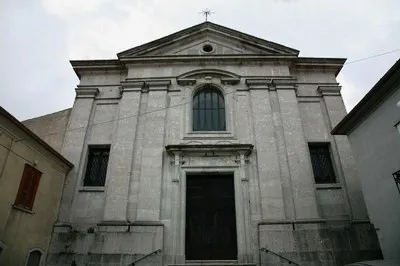
1 Santa Maria Assunta in Cielo Church. Imposing and austere former cathedral at the top of the Frigento hill. It is the oldest place of worship in the country. Interesting is the archaeological museum located in the hypogeum of the monumental complex with a valuable collection of objects from the Roman era. 2 Ruins of the medieval castle (5 km from the town in the district of S.Angelo al Pesco). Ruins of an ancient defence manor built in the Lombard period. 3 Panoramica Limiti Urban Park. The park includes the top of the historic centre of Frigento and the entire wooded area which forms an important part of the naturalistic heritage of the municipality. In fact, it is possible to find many plant and animal species. The Urban Park represents an ideal path for nature lovers and for those who want to enjoy a landscape that embraces five regions (Campania; Puglia; Basilicata; Molise and Abruzzo). 4 Roman cisterns, Via S. Giovanni, 16-25. Located at the highest point of Frigento, this archaeological area represents, for the village, the most important evidence found to date. The "Cisterns" are made up of four tunnels, located at the top of the hill (911 m asl) and have constituted a water resource of considerable importance for the development of the settlement over several centuries. 5 Palazzo De Leo (The House of Culture). Palazzo De Leo is an historic building in the historic centre of Frigento and was the birthplace and home of the canon and scholar Marciano De Leo (1751-1819). Today we can find the Civic Library, the Civic and Archaeological Museum of the Civilization and Territory of Frigento and the "Pina Famiglietti" Civic Art Collection in the historic building. (updated May 2022) 6 Madonna del Buon Consiglio Sanctuary, Via Piano della Croce (in the hamlet of Pagliara). A pleasant and seraphic place of wors
Do
Events and festivals The mysteries of Frigento (Church of S. Maria Assunta), during the Easter period Madonna del Buon Consiglio feast and fair (Piano della Croce). 9 and 10 May Festival and fair of the patron saint San Marciano (historical centre). June 14 Cicerchiamo. August. Cicerchiamo is an event promoted by Slow Food which generally takes place in August and is an opportunity to taste delicacies based on cicerchia, a legume typical of local biodiversity and particularly rich in proteins. Last week of July Pizzilli e Tammorre feast (historical centre) First or second week of August Grano and Trebbiatura feast (Pila ai Piani - Tre Masserie district). First weekend of August Accordion feast (Piano della Croce). 11-13 August Feast in honour of the Assumption, Piano della Croce and historic centre. August 15 The tirata of Carri Covoni (historical centre), August 16 San Rocco feast (historical centre). August 16
Buy
There are several local producers of food (olive oil; wine; cheese; cold cuts; chocolate; pasta; honey; wheat; flour; vegetables) and manufactured products.
Eat
Budget 1 Memories cafe, Largo S. Marciano, 28, ☏ +39 340 8543420. (updated May 2022) 2 Caffè Vittoria, Vico I Roma, ☏ +39 0825 444056. (updated May 2022) 3 Bar Cancelliere, Via Pagliara, 114, ☏ +39 349 6636975. (updated May 2022) 4 Green bar, Piano della Croce street. (updated May 2022) 5 Bar Pasticceria G&G, Via Pagliara 91. (updated May 2022) 6 Bar pasticceria Dolci Sospetti, Via Pacchiana. (updated May 2022)
Mid-range 7 Trattoria braceria da Balú, Via Piano della Croce, 11, ☏ +39 340 581 0686. (updated May 2022) 8 Agriturismo Colle Irpino, Via Pagliara, 170, ☏ +39 366 7342508. (updated May 2022) 9 Agriturismo Fontana Madonna, Via Fontana Madonna, ☏ +39 0825 444647, [email protected]. (updated May 2022) 10 L'Anphora, ☏ +39 333 3131637. (updated May 2022) 11 Il Fato, Via Pannizza, 25, ☏ +39 0825 444399. (updated May 2022)
Drink & nightlife
Aglianico wine (red) and Coda di volpe wine (white)
Sleep
1 Borgo San Rocco 37, via San Rocco 3
Overview adapted from Wikipedia, travel guide fromWikivoyage (CC BY-SA). Photography via Wikimedia Commons.