
Downtown Los Angeles
United States · Americas
About Downtown Los Angeles
Los Angeles is a city of diverse cultures, and many of them are showcased in and around the city's Downtown. While Downtown L.A. has been considered primarily a business and manufacturing hub for the last several decades, its long-heralded revival has really gained some traction as new restaurants, retail chains, boutiques, and trendy hotels open at a rapid pace. Some highlights for the visitor in Downtown include Grand Central Market, the Museum of Contemporary Art, the Walt Disney Concert Hall, Olvera Street, Chinatown, Little Tokyo, and some unique and stunning examples of American and international architecture sprinkled throughout.
Downtown Los Angeles travel guide
Understand
Bounded by a rough triangle formed by the Santa Monica Freeway (I-10) on the south, the Harbor Freeway (CA-110) on the west, and the Los Angeles River on the east, the Downtown area encompasses several neighborhoods that are remarkably varied in character. The Historic Core lies east of Hill Street and west of Main Street between 3rd and 9th Streets, and was the undisputed center of the city for the first half of the 20th century, with the old theatres along Broadway and the old banks along Spring Street. Following the white flight to the suburbs after World War II, the district became a vibrant center of Latino culture. Today, while the area is a little sketchy, a significant amount of redevelopment has occurred here and the neighborhood has many superb examples of early 20th century architecture, including a high concentration of movie palaces along Broadway. South of Pershing Square, the Historic Core overlaps with the Jewelry District, noted for its many jewelry stores. To the north of the Historic Core is the Civic Center complex, which stretches west along Grand Park between 1st Street and the Hollywood Freeway (US 101). To the west of the Historic Core, sitting between 1st and 8th Streets, are overlapping Bunker Hill and the Financial District, an area that was leveled in the 1960s for the many skyscrapers and plazas that were built here. Because of the numerous office buildings, this area can feel rather sterile in character, but it does hold the grand public library, a pair of major contemporary art museums and the Music Center, which includes Walt Disney Concert Hall. South of this is the rapidly gentrifying southwest corner of Downtown, labeled by developers "South Park," home to the convention center, L.A. Live, and the Crypto.com Arena, as well as many new hotels and high-end residential developments. The southeast side of Downtown is more gritty industrial in character. Infamous Skid Row sits east of Main Street and west of Alameda Street between 3rd a
Getting there
Downtown LA is simultaneously the hub of the freeway network, road network, commuter rail network, subway / light rail network, and bus network in the region, and thus very easily accessible. Parking lots are also plentiful, though rising steadily in price.
By car Downtown LA can be accessed directly via the Pasadena Freeway (SR-110), the Santa Monica Freeway (I-10), and the Santa Ana Freeway (I-5 and US-101). Just outside Downtown LA, these freeways connect to the Golden State Freeway (I-5), the Hollywood Freeway (US-101), the San Bernardino Freeway (I-10), the Harbor Freeway (I-110), and the Pomona Freeway (SR-60). Drive your car to a parking lot and go by foot from there. Downtown isn't that big and quite walkable, and there are plenty of Metro buses and DASH shuttles (see below) to shorten the walk. Some people are partial to parking at any one of the lots around the Music Center or Civic Center, in roughly the area bounded by Grand to Spring and Temple to 2nd. Pershing Square has good parking central to many attractions. On the south side of Downtown, the Convention Center has a large parking garage, although it is near the Staples Center and spaces will be in high demand on game days.
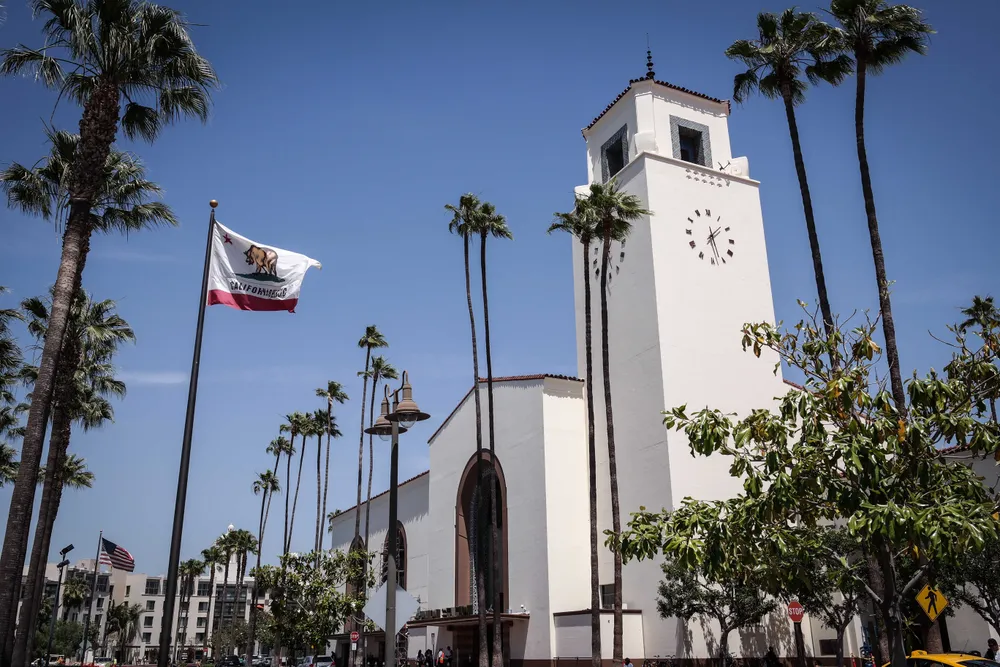
By train Union Station, the main train station for Los Angeles, is located on the edge of downtown, with transfers available to the B and D line subways, Metro, or DASH buses. Four Amtrak lines terminate here, providing direct service from as far as Seattle, New Orleans, and Chicago. Union Station is also the hub of the Metrolink interurban heavy rail system, linking Los Angeles with the Inland Empire, Orange County, Ventura County, and the Antelope, San Fernando, and San Gabriel Valleys.
By commuter rail
If your point of origin is within the urban and suburban areas of Los Angeles, Ventura, San Bernardino, Riverside, Orange, or San Diego Counties, you may be able to avail of the growing commuter rail network known as Metrolink to visit Downtown LA. Six of the seven
Getting around
Downtown is one of the few areas of L.A. that one can reasonably cover on foot.
By public transit Metro is the most extensive transit system in the region, operating buses, subway, and light rail across Los Angeles County. All major streets have at least one (and in some cases; several) bus lines running daily. Additionally, Downtown LA is served by four Metro Rail lines; see the Get in section above for details on individual lines and stations. In addition to Metro is DASH, a shuttle service run by the L.A. Department of Transportation, which is handy for when your feet get tired or to better expand your travel area. It has several convenient routes that whisk you to almost all of the worthwhile spots Downtown. DASH buses run every 5-10 minutes weekdays 6AM-9:00PM, and every 10-15 minutes 9am to 6pm on the weekends. A ride costs 50 cents (25 cents for seniors) and pamphlets are available from most Metro stations (Union Station; 7th/Olive) and convenience stores Downtown. Click here for more information on Downtown DASH routes, including real-time bus tracking
By bicycle Metro operates a bike share system, with numerous stations scattered across the Downtown area. Single trips are $3.50 for 30 minutes of use (credit or debit card required), or you can load a monthly pass onto a TAP card for $20 which gives you free rides shorter than 30 minutes and $1.75 for every thirty minutes after that.
See
1 Chinatown. Centered along North Broadway north of Cesar Chavez Avenue, Los Angeles' Chinatown is unlike those of many other cities in that it has a much more modern appearance, with a mixture of traditional Chinese and modern architecture along wide, busy streets. North Broadway is lined with shops, restaurants, and institutions serving the local Chinese-American population, as well as several urban malls and plazas leading off the street which hold many small shops, restaurants, and stalls. 2 Chinatown Gate. An impressive arch which spans over North Broadway near the intersection of Cesar Chavez Avenue, with two striking golden dragons regarding an orb-like lantern. (updated Aug 2016) 3 Chinatown Central Plaza. A pedestrian mall off Broadway north of College Street that's the historic center of the neighborhood, with lots of touristy shops housed in traditional pagoda architecture with Chinese lanterns strung over the alleyways. A couple of highlights for visitors are an elaborate wishing fountain and a statue of Bruce Lee in combat stance. (updated Aug 2016) 4 Saigon Plaza. An open-air bazaar off Broadway between College and Alpine Streets with stalls selling bargain goods (be sure to haggle!). (updated Aug 2016) 5 Los Angeles State Historic Park, 1245 N Spring St (Metro Gold Line: Chinatown station), ☏ +1-323-441-8819. Daily 8AM-sunset. Also known locally as the Cornfield, this expansive public park on the north side of Chinatown opened after an extensive overhaul. The site has a long history, having been used as agricultural land near the origin
Overview adapted from Wikipedia, travel guide fromWikivoyage (CC BY-SA). Photography via Wikimedia Commons.