
Dinosaur National Monument
United States · Americas
About Dinosaur National Monument
Dinosaur National Monument is a United States national monument spanning from Northwestern Colorado into Northeastern Utah.
Dinosaur National Monument travel guide
Understand
The monument was created in 1915 to protect an extensive deposit of fossilized dinosaur skeletons as well as pictographs dating back 10,000 years. The monument is divided into two districts, the Canyon Area on the east side and the Dinosaur Quarry on the west side. Each district has its own visitor center. Pets are allowed inside the monument but must be on a leash no longer than 6 ft (1.8 m). Pets are not allowed inside any buildings or on any hiking trails.
History Dinosaur National Monument's cultural history dates back 10,000 years. The Yampa and Green Rivers have provided water for survival in an arid country. Indian rock art in the form of petroglyphs and pictographs provide evidence that many people have come before modern travellers. The Fremont Indians lived in the canyons in Dinosaur National Monument 800–1,200 years ago. Following the Fremont were the Ute and Shoshone, who are still live in the area. Early settlers left their mark on the landscape with their homesteads. Those who had access to the rivers and a constant flow of water survived, while others dried up with drought and moved away. Now, many of the remains of homesteads are found alongside the Indian art work of the past. The park's value as a site for dinosaur remains was established when paleontologist Earl Douglass first came to Utah looking for mammal fossils. He returned in 1909 and discovered an immense deposit of dinosaur bones, now protected at Dinosaur National Monument. Although made famous by dinosaurs, Douglass died preferring his beloved mammal fossils over dinosaurs.
Landscape This part of Utah and Colorado is rocky-desert, with sinuous canyons deep-cut by rivers.
Flora and fauna
Climate
Dinosaur's climate is semiarid with temperatures averaging between 0°F (17°C) to 30°F (1°C) in January and 50°F (10°C) to 100°F (38°C) in July. Elevations within the park vary between 4700 and 9000 feet. Winter snow makes roads at higher elevations impassable while only l
Getting there
By road Both districts of the Monument are accessed via U.S. Highway 40. From Salt Lake City, take I-80 east to US 40 east, about 4 1/4 hours and 185 mi (297 km). From Provo, take US 189 north to US 40 east, about 4 hours and 166 mi (267 km). From Denver, take I-70 west, to SR 9 north, then to US 40 west, about 5 hours and 285 mi (459 km).
Getting around
Harpers Corner Road is closed from mid-December to approximately Easter due to snow at the higher elevations. All dirt roads in the park are clay based and impassable when wet, even with four-wheel drive vehicles. These roads are Echo Park Road, Yampa Bench Road, Island Park Road and the road into Gates of Lodore. These roads are not maintained in the winter and can be impassable due to snow. The use of chains on wet clay roads renders the roads all but impassable for those who follow. Waiting for several hours will allow the roads to dry, leaving them in drivable condition for all visitors.
See
Dinosaur Quarry district
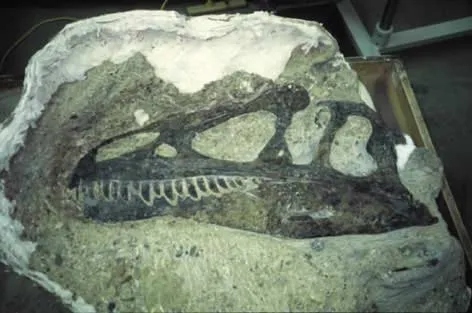
1 Quarry Exhibit Hall. The Quarry Exhibit Hall allows visitors to view the wall of approximately 1,500 dinosaur bones in a comfortable space regardless of the weather. You can see the remains of numerous different species of dinosaurs including Allosaurus, Apatosaurus, Camarasaurus, Diplodicus, and Stegosaurus along with several others. Exhibits, including an 80-foot long mural, reveal the story of these animals and many others that lived in the Morrison environment during the late Jurassic. (updated Jul 2020)
Canyon Area district 2 Canyon Visitor Center, 4545 Hwy 40 (2 miles east of Dinosaur to Harpers Corner Road; north on Harpers Corner Road; first right into the parking lot), ☏ +1 970 374-3000. October 29-May 1: Closed; May 2-Memorial Day Weekend: 8:30AM-4:30, closed M-Tu; Memorial Day Weekend-August 30: daily - 8:30AM-4:30PM; September 1-October 26: 8:30AM-4:30PM, closed M-Tu. The Canyon Visitor Center is the gateway to the monument's mountains and river canyons. Exhibits orient visitors to the monument's facilities. An Intermountain Natural History Association bookstore sells items that will further enhance your experience. Staff are available to answer questions and a park film is shown throughout the day. Restrooms and water are available during business hours. Dinosaur fossils are not found in this area. The Canyon Area is a region of deep, twisting canyons. Petroglyphs can be seen here but the district contains no dinosaur fossils. (updated Jul 2020)
Do
Hiking Each district has numerous trails of varying length and difficulty.
Dinosaur Quarry District. 6 trails ranging from 1/2 mi (0.8 km) to 3 mi (4.8 km). Canyon Area District. 4 trails ranging from 1/4 mi (0.4 km) to 8 mi (13 km), one of which is handicapped-accessible.
River rafting The Green and Yampa Rivers pass through the monument, offering Class III and Class IV rapids. Unless you are an experienced river rafter, do not attempt to raft without a professional guide.
Private boats - $15 application fee, plus $20 for a one-day permit or $185 for a multi-day permit. Commercial guide trips. See the Dinosaur NM website for a current list of authorized commercial guides.
Eat
There are no restaurants within Dinosaur National Monument. However, several picnic areas provide a relaxing atmosphere with a view. Picnic areas are located:
Near the Split Mountain boat ramp along the Tour of the Tilted Rocks self-guided auto tour near the Temporary Visitor Center. At the Josie Bassett Morris homestead at the end of the Tour of the Tilted Rocks self-guided auto tour near the Temporary Visitor Center. At Plug Hat Butte along the Harpers Corner Auto Tour road in the Canyon Area of the park. At the Canyon Overlook along the Harpers Corner Auto Tour road in the Canyon Area of the park. At the Harpers Corner Trailhead along the Harpers Corner Auto Tour road in the Canyon Area of the park. Nearby communities offer a variety of dining options.
Sleep
Lodging There is no lodging within Dinosaur National Monument. However, the nearby communities of Vernal, Dinosaur and Rangely have lodging. Obtaining lodging in the area can be difficult; it is recommended that you reserve lodging ahead of time if you plan on staying in the area overnight.
Camping
Dinosaur Quarry district 1 Green River Campground (The Green River Campground is located 5 miles from the Quarry Visitor Center near Jensen; Utah.). Open from mid-April to mid-October. 80 sites. 27 sites can be reserved in advance. Sites accommodate both tents and RVs (no hookups). Drinking water and flush toilets are available but there are no showers. The Green River Campground is located along the banks of the Green River in a grove of cottonwood trees at an elevation of 4795 feet. The highly eroded Split Mountain towers to the north of the campground. The famous dinosaur quarry, where you can see 150 million year old dinosaur bones still encased in the rock is approximately five miles from the campground. Also nearby is the Split Mountain Boat Ramp where
Overview adapted from Wikipedia, travel guide fromWikivoyage (CC BY-SA). Photography via Wikimedia Commons.