
Dijon
France · Europe
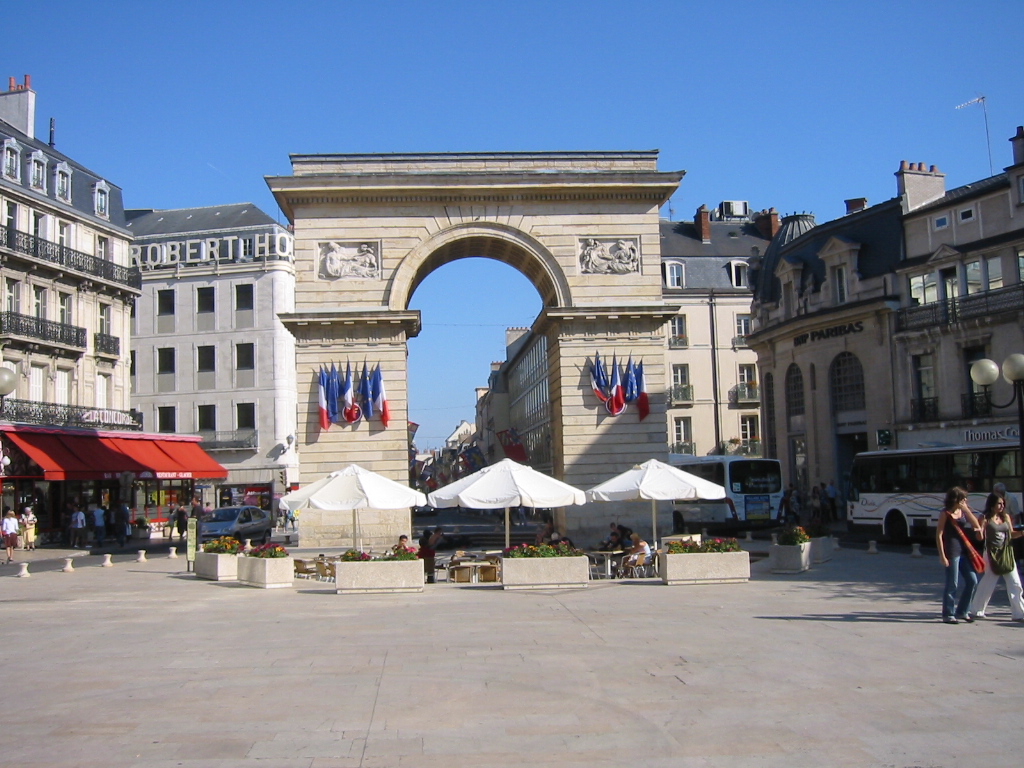
About Dijon
Dijon is the largest city in the eastern French region of Bourgogne-Franche-Comté. Dijon is best known for its mustard (named after the town), which is no longer produced in its metropolitan area. The main city of Côte-d'Or department is one of the most beautiful cities in France, and its historic buildings and byways were not heavily damaged by bombing in World War II and are largely intact.
Dijon travel guide
Understand
The surroundings is also an important wine production region, and Dijon has historically been the centre for regulatory bodies for wine production (some wine classification systems were invented here) and therefore the historical centre of Dijon forms part of the UNESCO World Heritage site "Climats, terroirs of Burgundy". Dijon was for some time the capital of the Dukes of Burgundy. Burgundy was a great power during the 14th and 15th centuries, when the dukes controlled a large part of what is now northeastern France, western Germany, Belgium, and the Netherlands. The dukes were great patrons of the arts, so Dijon was a major centre of Gothic and early Renaissance music, painting, and sculpture, attracting some of the greatest and most famous artists and musicians from Flanders in particular. The music the great composers left behind can be performed anywhere, but it is particularly in the fields of sculpture and architecture that masters left a lasting mark on Dijon. Today, Dijon is a cosmopolitan city, with universities in the centre and industrial plants on the outskirts. Traffic is restricted in the centre of the city, so many parts of central Dijon are quiet and relaxing.
Tourist information There are three tourist offices [1] in the city:
At the train station (on the right when getting out of the station): April to September: Monday to Saturday 09:30 - 18:30, Sundays and public holidays 02:00 - 18:00 October to March: Monday to Saturday 09:30 - 13:00 and 14:00 - 18:00, Sundays and public holidays 10:00 - 16:00 Behind the "Palais des Ducs de Bourgogne" (11 rue des Forges): April to September: Monday to Saturday: 09:30 - 18:30, Sundays and public holidays: 10:00 - 18:00 October to March: Monday to Saturday 09:30 - 13:00 and 14:00 - 18:00, Sundays and public holidays: 10:00 - 16:00 There is another one at the well of Moses. They have free maps of the downtown area, including a map and guide for the self-guided walking tour of Dijon. The walking tour uses a sm
Getting there
By train There are two train stations in Dijon: Dijon-Ville and Dijon-Porte-Neuve. The main one by far is Dijon-Ville, the other being way smaller, without any personel and used only for some minor lines. The train à grande vitesse (TGV) speeds travellers from Paris (only 100 min) and other major French cities to Dijon. There are also regular train services to a variety of destinations, including, but not restricted to, Italy (Milan; Turin; Florence and Rome among them), Switzerland, Luxembourg and Belgium.
1 Dijon-Ville station (Gare de Dijon-Ville), Cour de la Gare, 21000 Dijon. (updated Aug 2021) From Paris (Gare de Lyon) by TGV: approx. 1 hr 40 min. Variable prices. From Paris (Bercy) by TER: approx. 3 hr. Fixed prices: €36 per adult or €18 per passenger under 26 years old for one way. From Lyon by TGV: approx. 1 hr 35 min. Variable prices. From Lyon by TER: approx. 2 hr 5 min. Fixed prices, €31.60 per adult or €15.80 per passenger under 26 years old for one way.
By plane 2 Dijon-Burgundy Airport (Aéroport Dijon-Bourgogne), 717 rue de l'Aviation, 21600 Ouches, ☏ +33 637635451. This is a former military air base known as "Base Aérienne 102" whose military function was ended in 2016 after over a century of use. It does not see any commercial flights but is able to accommodate general aviation.Its entrance is located on the commune of Ouges, mainly accessible by road. Dispite a bus stop for an Express Divia bus near the terminal leading to Dijon-Ville train station, the service only has 4 buses a day, from Monday to Friday only and mainly used by workers of the area. So if you can only rely on public transportation, the second nearest stop of a main Divia bus line is 1.1 km (~14 min) away by walk toward the north-west direction of the road. (updated Aug 2021) There are a few TGV high-speed trains directly from the center of Dijon to Paris CDG airport. If your arrival is at Paris Gare de Lyon, which there are frequent TGV trains to Dijon, you can either:
Getting around
Walk For most purposes, walking is the best way to get around the center of the city. A comprehensive network of buses covers farther local destinations.
By bicycle If you want to get a bit outside of the downtown (like to get to the well of Moses) it's often easier and faster to use a bicycle.
DiviaVélodi (and DiviaVélo), ☏ +33 380112929. Similar to the Vélib service in Paris, DiviaVélodi is a bike loan and DiviaVélo is a bike rent service more suited for the inhabitants and long stays. There is bike stands throughout the city, allowing you to pick a bike and then leave it in another stand. You have to pay at a stand (with credit card; you must have at least €200 on your credit card account as that amount will be charged unless you return the bike in time) (updated Aug 2021) La Bécane à Jules, 17 rue de l'Île, ☏ +33 3 80 49 18 06. Simpler and cheaper is the bike rental offered by this non-profit association who is a self-repair bicycle workshop, but they also rent bikes to non-members. It's €6.50 for the day or €11 for a week-end. €6.50 per day.
Public transport
Buses and trams in Dijon are operated by Divia. As of August 2021, a one-hour ticket costs €1.40 (plus 30 cents for a reloadable card or if you buy it to a bus driver), €14 for a "10+1" tickets recharge, €4.20 for a 24-hour ticket, €7.35 for a 48-hour ticket, and €9.45 for a 72-hour ticket. There is also city bus which is free of cost which will take you around the city. The city offers the Diviacity, a free, frequent shuttle bus for visitors that connects many of the downtown destinations in a loop, along with several parking areas. The shuttle is a minibus that is often congested with locals. If you arrive by train, the orientation maps can be a bit misleading: maps are oriented with west, rather than north, in the upward position.
See
There is a self-guided walk in the city, called Parcours de la chouette, shown by owl arrows and numbered owl plates in the ground. There are 22 stops of interest. The book with the description of stops is available at the tourist office for €2.50, there is also an app on the Google Play store for €2.99 or on the App Store for €1.99. But it's not mandatory.
Landmarks
La Chouette (The Owl). The icon of Dijon, sculpted on the side of the Notre-Dame church in 15th century. Story says it can grant you a wish when you touch it with your left hand. There is a dragon hiding in the church window to the left of the owl, which supposedly eats your wish if you touch the owl passing from the wrong direction. 1 Place François Rude (Place du Bareuzai). A central place with beautiful traditional houses, a fountain with a sculpture, with an old carousel, and a lot of cafés and bars. Popular among locals on summer days.
Buildings and structures 2 Ducal Palace (Palais des Ducs et des États de Bourgogne). A beautiful building, former main residency of the Dukes of Burgundy. Nowadays, the building is split between the roles for town hall on its western and
Overview adapted from Wikipedia, travel guide fromWikivoyage (CC BY-SA). Photography via Wikimedia Commons.