
Chapel Hill
United States · Americas
About Chapel Hill
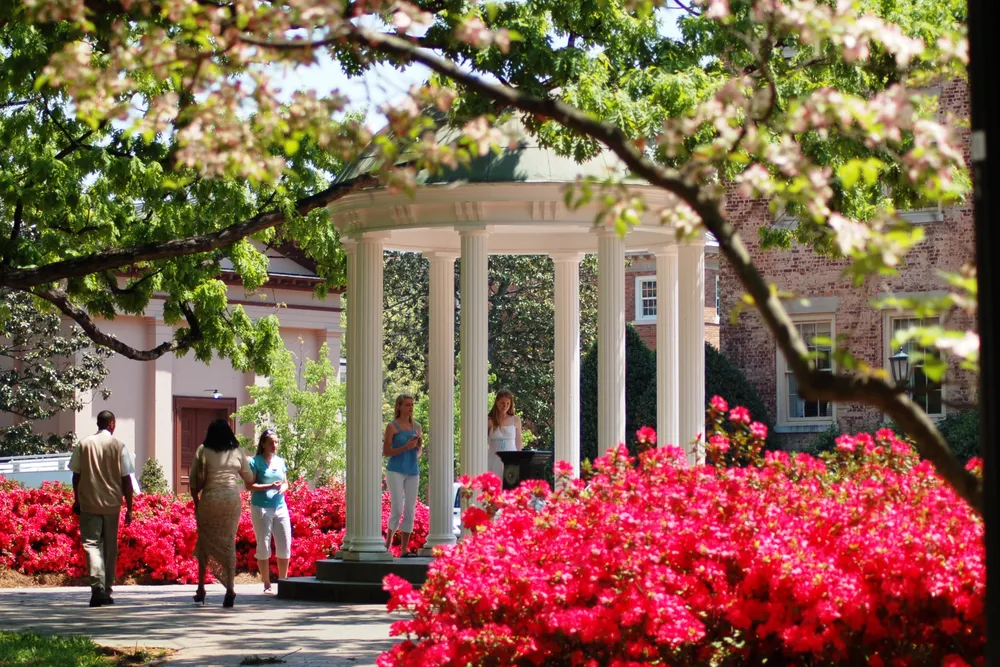
Scenic and regularly decked out in "Carolina blue", Chapel Hill is a lovely college town in North Carolina that makes up the westernmost point of the Research Triangle. The town is the smallest of the Triangle's three cities, with an influence and pull that belies its size. Based around the University of North Carolina at Chapel Hill, the town caters heavily to the local student population, with plenty of bars and restaurants near the university's beautiful campus. Immediately to the west of Chapel Hill is the adjacent town of Carrboro, an old mill town now known for its local shops, restaurants and nightlife.
Chapel Hill travel guide
Understand
The town began as a small village of a thousand people consisting of mostly Scottish and English immigrants arriving in the area during the 1700s; the village took its name from the New Hope Chapel, which happened to be situated on a hill (the Carolina Inn of Chapel Hill now stands where the chapel once was). The town was founded in 1819 to support the University of North Carolina (UNC) at Chapel Hill and later was incorporated in 1851. The adjacent town of Carrboro was settled in the 1880s around a spur rail line built to serve the university; the town is named for Julian Carr, who purchased a local cotton mill and installed electricity in the town. Today, Carrboro is where many UNC students live, owing to its cheaper rents, and is home to the Weaver Street Market (a local co-op), a popular farmers' market, plenty of bars and restaurants, and a bunch of festivals. Like much of the rest of the Piedmont, the landscape is hilly and heavily wooded, becoming very lush and green in the summer months. Politically, Chapel Hill is liberal compared to much of North Carolina. Although legend says that the town became liberal when a Union general married former UNC President Swain’s daughter, Chapel Hill’s liberal politics are similar to many US college towns and are bolstered by nearby Carrboro, which is known for being a bastion of liberalism in the state. It is not uncommon to see a protest in Chapel Hill and/or on the university campus for various liberal causes, with the traditional locus of this being the square in front of the post office on Franklin Street across from the campus.
Visitor information 1 Chapel Hill/Orange County Visitors Center, 308 West Franklin St, ☏ +1 919-968-2060. M-F 8:30AM-5PM, Sa 10AM-2PM. Has information and brochures on the area, and a small selection of free postcards.
Getting there
By car Interstate 40 passes along the north and east side of Chapel Hill, with three exits: NC 86 (Exit 266), US 15/501 (Exit 270), and NC 54 (Exit 273). From the west, NC 86 (which becomes Martin Luther King Jr. Blvd in Chapel Hill) is the best exit. Be warned that Martin Luther King Jr. Blvd is a notorious speed trap through Chapel Hill, where the speed limit is only 35 mph (56 km/h) despite the road being designed to handle much faster speeds. From the east (say; Raleigh or the Research Triangle Park), NC 54 (which becomes Raleigh Road) is a good option. Coming from Durham, US 15/501 is the most direct route.
By plane The nearest commercial airport is Raleigh-Durham International Airport (RDU IATA), a 20-minute drive to the east in Morrisville, just off I-40. RDU has two terminals; Terminal 1 services budget carrier Southwest, while the more modern and architecturally impressive Terminal 2 services American Airlines/American Eagle, Delta, Frontier, JetBlue, and United. Both terminals have restaurants, newsstands and smaller versions of North Carolinian stores such as A Southern Season and the ACC Store. RDU also has rental car services and overnight car parking. If taking public transit, Triangle Transit route #100 takes you from the airport to the Regional Transit Center, where you can then transfer to #800 or #805 to Chapel Hill.
By train The nearest Amtrak stop is in Durham, which is served by the New York City-Charlotte Carolinian line and the Raleigh-Charlotte Piedmont line. The station is across the train tracks from the Durham Station Transportation Center, where you can take Triangle Transit #400 or #405 to Chapel Hill.
By bus GoTriangle, ☏ +1 919-549-9999. Routes between Chapel Hill and Durham (routes #400 and #405), and the Research Triangle Park and Regional Transit Center (#800 and #805), where you can transfer to Raleigh and RDU. There is also direct service to and from Raleigh during commuter hours (route CRX). Stops are marked by signs
Getting around
The UNC campus and the downtown area are very pleasantly walkable, but going further afield largely requires transportation by car. Anything outside the immediate Franklin Street downtown area can be frustrating on foot, with long distances and fast-moving car traffic. Grocery stores are a fairly long walk from downtown Chapel Hill, although downtown Carrboro is served by the Weaver Street Market and a Harris Teeter. Limited public transit service around town is provided by the fare-free Chapel Hill Transit bus system. Curb parking in the downtown area is available but often full, especially while school is in session, making it hard to find a spot. Paid lots and garages are available along Rosemary Street, just north of Franklin Street. Outside of the downtown area, parking is very easy to find.
By bus Chapel Hill Transit, ☏ +1 919-969-4900, [email protected]. Routes go through Chapel Hill, Carrboro and the UNC campus. Buses run on weekdays, with limited service on Saturdays and virtually no service on Sundays save for two routes circulating around the UNC campus. Service tends to be less reliable at night, on weekends and times when there is a football or men’s basketball game. For those particular home games, many Chapel Hill Transit buses are used for the Tar Heel Express, a park-and-ride service to UNC football and men's basketball games. Fares are free, except the Tar Heel Express (though pay attention—Chapel Hill Transit buses are blue and routes are labeled with letters; the green buses; including most bus routes labeled with numbers and the CRX to Raleigh; belong to Triangle Transit; the Research Triangle regional transit system; which is not free). (updated Oct 2017)
By bike Chapel Hill is a great location for recreational biking, with local mountain biking trails and scenic road riding through local farmland. Commuting by bike is popular in the Chapel Hill-Carrboro area. The Carrboro area is somewhat bike-friendly, while Chapel Hill is
See
University of North Carolina at Chapel Hill. Often considered one of the best public schools in the United States, UNC is also one of three schools that claim to be the oldest public university in the US. While it was the second public university to receive a state charter (in 1789), after the University of Georgia, it was the first public university to start classes (in 1795) and graduate students (1798). The campus is divided into three sections: North (between Franklin Street and South Road), Middle (between South Road and the UNC Hospital and Manning Drive) and South (from Manning Drive south; including the UNC Hospital). The North campus, the oldest, is quite scenic, with plenty of brick buildings and beautifully landscaped. The main quad runs north-south through the North campus and is lined with lovely academic buildings, and is home to the 1 Old Well, a small rotunda modeled after the Temple of Love of the Palace of Versailles, and 2 Old East, built in 1793 and the oldest building on the campus (now a highly in-demand residence hall). 3 The Pit. The center of activity on campus is a small plaza between the bookstore, the student union, a dining hal
Overview adapted from Wikipedia, travel guide fromWikivoyage (CC BY-SA). Photography via Wikimedia Commons.