
Bora Bora
France · Europe
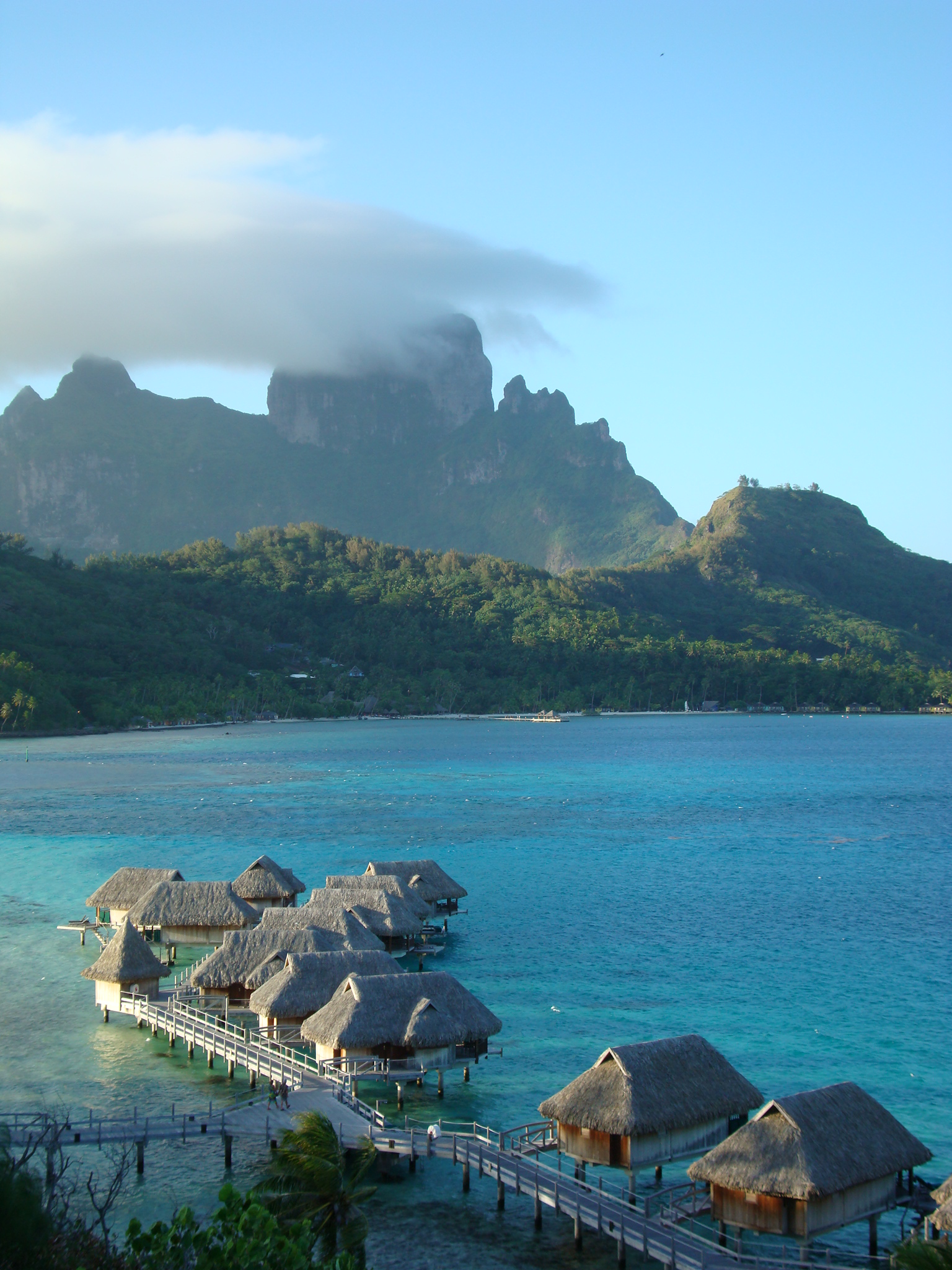
About Bora Bora
Bora Bora is a volcanic island in the Society Islands archipelago of French Polynesia. The Polynesian island in the South Pacific is ranked at the top of the list when it comes to most remarkably beautiful in the world. The best time to visit is May.
Bora Bora travel guide
Understand
It is perfectly possible to spoil yourself in one of the incredibly luxurious high-class resorts and spend the savings of a lifetime in a few days. Nonetheless, a bit of planning ahead can allow enjoyment of the majestic scenery with a tighter budget. Bora Bora is a very pricey destination. Everything (catering and activities) ranges from "expensive" to "indescribably expensive". Bora Bora is an island in the Leeward group of the Society Islands of French Polynesia. The island, which is about 230 km (140 mi) northwest of Papeete, is surrounded by a lagoon and a barrier reef. In the center of the island are the remnants of an extinct volcano rising to two peaks, Mount Pahia and Mount Otemanu, the highest point at 727 m (2; 385 ft). The original name of the island in the Tahitian language might be better rendered as Pora Pora, meaning "First Born"; an early transcription found in 18th- and 19th century accounts is Bolabolla or Bollabolla. The major settlement, Vaitape, is on the western side of the island, opposite the main channel into the lagoon. The products of the island are mostly limited to what can be obtained from the sea and coconut trees, which were historically of economic importance for copra. During the 2017 census, the population on the island was about 10,600 people, up from 8,880 in 2007.
History The history of Bora Bora shows that the island’s first settlers back in the 4th century were Tongan people. The first European explorers who visited the island were led by James Cook. However, prior to this, the island of Bora Bora was already sighted by other explorers. In 1842 the island became a French colony under the governance of Admiral Abel Aubert Dupetit Thouars. During World War II, the United States made Bora Bora a base for military supply, oil depot, air strip and seaplane base. They constructed defensive fortifications around the island. Luckily though, no combat took place here and the presence of American troops seemed to be accepted by the o
Getting there
By plane Take an international flight to Tahiti, and then a less than an hour flight to Bora Bora. Air Tahiti flies several times a day from Tahiti. Flights are quite often full, so it is not a bad idea to make a reservation. Air Tahiti operates flights from
Papeete/Tahiti: 4 direct flights per day, flight time 50 min, Moorea: daily, flight time 50 min, Huahine: daily except Wednesday, flight time 25 min Maupiti: Sunday, flight time 15 min Raiatea: daily, flight time 20 min The airport is on a small motu (islet) north of the main island. Transfer to the main island or to accommodations located on other motus is done by boat. The major accommodations have counters at the airport. For the accommodations located on the main island, you will need to take the (free) ferry to Vaitape. From there, small buses will usually pick you up. Air Tahiti operates a free shuttle boat transfer from the airport to the main village, Vaitape, by "Bora Bora Navette".
Getting around
Vaitape is the arrival point of the ferry from the airport, and is the only town of any size of the island. At the southern tip of the main island, Matira has the largest beach, and several hotels and restaurants. The central part of the island is extremely mountainous, tough to access and not inhabited (and furthermore devoid of roads). The way you get around depends greatly on your accommodation and its location. Several resorts are on motus and not on the main island, hence the need of boat transportation to get anywhere. Boat transfers from those motus resorts to the main island or between the resorts and the airport are usually provided. Accommodations on the island generally also provide a transfer to and the airport ferry quay. On the main island, there is only one sealed road. Public transport on the island is limited, consisting of a single bus that goes halfway around the island and back approximately every hour. Taxis are also available. Operators of activities and restaurants sometimes (but not always) provide a transfer to and from the accommodations: be sure to ask when booking.
By car or bike Renting a bicycle, moped or a car can be an option if you plan to have your freedom on the main island. The road around the island is 31 km long, and can be driven comfortably in an hour – two hours with stops. Europcar and Avis rent vehicles on the island: an economy car will cost 12,000 F (francs) for 24 hours, while a two-seat electric Renault Twizy can be had for 4 hours for 8,000 F (Jan 2019). A scooter will cost 5,500 F for 4 hours, or 6,800 F for 24 hours.
See
The island of Bora Bora is a volcanic caldera. This geography has produced a lagoon, well protected from waters by the surrounding motus (islets). The lagoon, and the tropical underwater life, including sharks and rays, provide fantastic opportunities for many forms of water-based recreation, ranging from swimming, through snorkelling and to scuba and other options if you want to immerse yourself in this unique environment. In addition to the sights under the surface of the lagoon, the dominating and unusually shaped peak of Mount Otemanu which reaches 728 m above sea level, and its smaller neighbour Mount Pahia are also worthy attractions. The combination of the beautiful lagoon and these impressive peaks provide an almost endless supply of opportunities to take travel photos which will leave your friend back home cursing you for sharing them. Very few go to Bora Bora for the historic relics. However, if you have seen enough of the lagoon, you might want to take a peek at the few World War II remains and the archaeological Polynesian relics in one of the tours of the island.
1 Bora Bora Lagoonarium. A certified diver acts as underwater guide as you swim and come face to face with the turtles, sharks, sting rays and numerous other fish which call the lagoonarium their home. As the "...rium" name implies, this commercial aquarium is a captive, enclosed zoo-like environment, preventing free movement beyond the confines of the establishment. For those that are not into diving, there is a little submarine. Numerous visitors that have voted this as a favorite. (updated May 2020)
Do
There are comparatively more activities in Bora Bora to keep you occupied than in other islands of French Polynesia. Being practical while lazing under the sun in a white sand beach, a good book will be in every case a very useful item to bring. It sometimes rains in Bora Bora (and sometimes even a lot). The vast majority of the activities take place outdoors, and there are no cinemas, libraries or museums to visit, so even if large resorts do lend books and games, bring some good reading with you. There are many activities that are cost-free, like swimming in the lagoons and enjoying the famous sunset. Most destinations are aquatic oriented, that may also include scuba diving and snorkeling. Besides the water activities there are many other activities like parasailing, deep sea fishing which is one of its kind in the world si
Overview adapted from Wikipedia, travel guide fromWikivoyage (CC BY-SA). Photography via Wikimedia Commons.