
Berlin-Tegel Airport
Germany · Europe
About Berlin-Tegel Airport
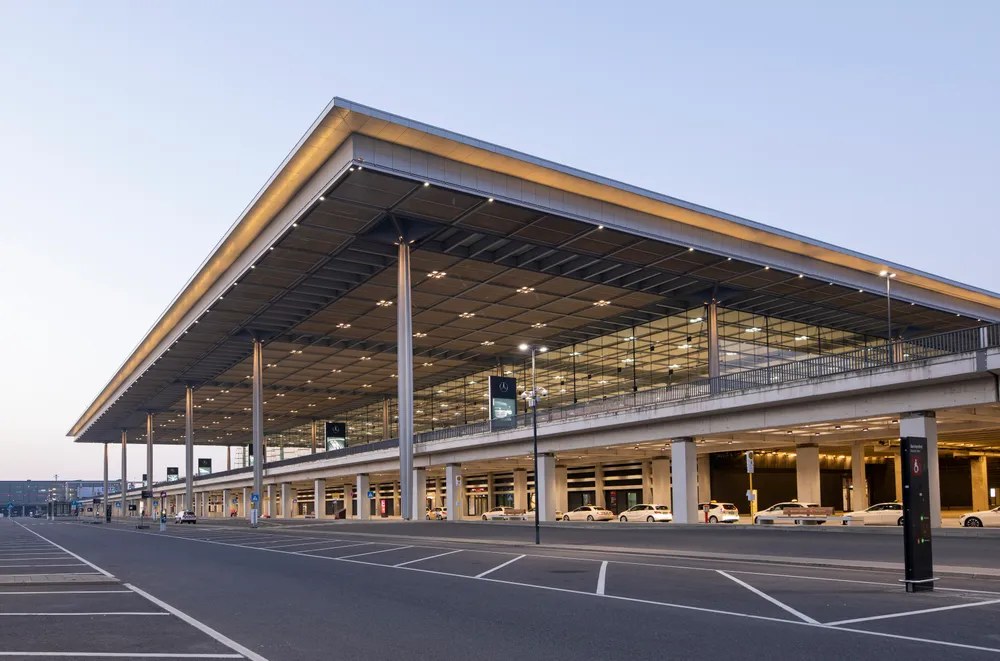
Berlin Brandenburg Airport, commonly referred to by its IATA code, BER IATA, or Flughafen BER, is the sole international airport of Berlin, the capital of Germany. It is located in Schönefeld in the namesake state of Brandenburg just south of Berlin. It opened in late 2020 and is the third busiest airport in the country after Frankfurt and Munich. It sees frequent flights from all major European and several leisure destinations as well as domestic services, but few long-haul flights. Berlin used to be served by Tegel Airport, which closed in 2020, and Schönefeld Airport, which was incorporated into BER.
Berlin-Tegel Airport travel guide
Understand
Due to Berlin's division during the Cold War, the city had no fewer than four airports. The American, British and French sectors of democratic West Berlin respectively controlled Tempelhof, Gatow and Tegel, while the Soviets held Schönefeld, just outside East Berlin, capital of the communist-aligned GDR. While this situation served the needs of the Cold War protagonists, it became apparent in the early 1990s that a pretty drastic change would have to be made to accommodate the newly re-emerged capital of reunified Germany. Gatow was closed in 1995, and Tempelhof followed in 2008; this left Tegel and Schönefeld as the city's primary and secondary airports, respectively. It was planned that Schönefeld would be extended and converted into a new single airport for all of Berlin, with Tegel closing. While this may have been a good idea in theory, making it a reality turned into the biggest slow-moving plane-wreck in the history of reunified Germany, in full view of the public. First, the airport's owners (the states of Brandenburg and Berlin, and the federal government) decided to shelve the expansion plans for Schönefeld that had been drawn up under the GDR but had never been put into practice. They also opted to ignore a private company's proposal to build the entire project for two billion euros. After all, the governments obviously knew what they were doing. Having broken ground in 2006, the project ostensibly advanced quickly, with the grand opening set for 2011. But the discovery of a design fault in the fire prevention system led to last-minute embarrassment. Picture the scene: they had planned the biggest party of the year, ordered crateloads of champagne, and sent out invites to celebrities near and far. Their biggest airline partner, Air Berlin, had already sold thousands of tickets for flights from their "new home". And then they learnt of a deadly health and safety defect, and were forced to cancel. Yikes. But no matter: surely this issue could be easily fix
Getting around
Terminals 1 and 2 are beside each other and connected after security. There are straight forward paths within the airport due to its geometric shape, however walking times can reach up to 15 minutes especially if you need to walk between the pier buildings containing the A and B gates with higher numbers. Automated walkways are only provided within the Terminal 1 main building, however assistance for the elderly or people with handicaps is available on request.
Buy
A selection of stores selling souvenirs, newspapers, clothing and the usual travel necessities, however there are fewer stores than at other major international airports. Most outlets are located around Terminal 1's central marketplace Terminal 1, after security but before passport control (for those leaving the Schengen Area).
Heinemann Duty Free & Travel Value (several locations throughout all terminals, the largest is at Terminal 1's marketplace). (updated Jun 2022) Ampelmann (central area of Terminal 1). Large selection of Berlin souvenirs featuring the famous Ampelmann figure from the city's pedestrian traffic lights. (updated Jun 2022) Picard (central area of Terminal 1). Branch of the upscale German leather goods store, especially handbags. (updated Jun 2022) Lamy (near Gate C1). Outlet of the upscale German pen brand. (updated Jun 2022) Gant (central area of Terminal 1). Upscale US clothing brand. (updated Jun 2022) Swatch (central area of Terminal 1). watches (updated Jun 2022) Marc O'Polo (central area of Terminal 1.). Mid-priced leisure fashion brand. (updated Jun 2022) Lego (central area of Terminal 1). Branch of the Danish building-block maker. (updated Jun 2022) Relay. Several newspaper kiosks throughout both terminals. The outlet adjacent to arrivals exit 1 also has a small post office (updated Aug 2022) Metropolitan Pharmacy (central area of Terminal 1 and central arrivals area). (updated Jun 2022) REWE (Level U1, near the railway station entrance). 05:00-00:00 daily. Branch of the ubiquitous German supermarket chain. (updated Jun 2022)
Sleep
There is a hotel directly in front of Terminal 1 (with another one under construction as of 2022) with a few more in the nearby areas, some of which offer airport shuttles, but all can be reached by a few minutes on public transport. All terminals are open 24/7 on the landside area, however seating and quiet corners are very sparse making an overnight stay uncomfortable.
Steigenberger Airport Hotel Berlin. part of an upscale hotel chain, located on the main square right in front of Terminal 1. (updated Jun 2022) B&B Hotel Berlin Airport. Located near the highway at the border of the airport grounds. (updated Jun 2022) InterCity Berlin Airport BER Terminal 1+2. midscale hotel, directly in front of Terminal 1 (updated Aug 2022) InterCity Hotel Berlin Airport Area North. Midscale business hotel, next to the old Schönefeld Airport. Within walking distance of Schönefeld (bei Berlin) railway station. (updated Jun 2022) Holiday Inn Berlin Airport Conference Centre. Leisure and business hotel in the village of Schönefeld, north of Schönefeld (bei Berlin) railway station. (updated Jun 2022)
Overview adapted from Wikipedia, travel guide fromWikivoyage (CC BY-SA). Photography via Wikimedia Commons.