
Avilés
Spain · Europe
About Avilés
Avilés is a post-industrial city in Asturias in northwest Spain. With a population of 76,000 in 2024, it's best known for the Oscar Niemeyer International Cultural Centre.
Avilés travel guide
Understand
The northwest coast of Spain is indented by rías, river valleys flooded by a combination of sea-level rise and landmass sink. They're deep and sheltered, so they attracted settlement and became ports. Avilés is first documented in 905 AD when it was two small towns divided by an inlet of the ría: Sabugo north side was a fishing village. South was the more prosperous La Villa, with stout walls to protect its mercantile wealth. In the 19th century the inlet was filled in to become Muelle Park, the medieval walls were taken down, and the two towns merged. Although Avilés had early industry through salt and ship-building, it was small-scale. Only in the 20th century did steel, glass and similar smokestack industries arrive; city population burgeoned but its surrounds became ugly and polluted. Towards the end of the century these industries withered, leaving a sad brownfield mess. The city perforce got into new industry such as IT, and also sought a new cultural identity. It took its cue from Bilbao's signature development of the Guggenheim art gallery: here the equivalent is the Oscar Niemeyer Cultural Centre, completed in 2011. The climate of Avilés is dominated by the restless Atlantic and Bay of Biscay. It's cool and wet, seldom below zero or warmer than 30 °C. Pack your rainwear not your beach clothes. Oficina de Turismo is in the old fish market square by the riverside, open daily 10:00-15:00. Aviles.es is the city information portal.
Getting there
By plane 1 Asturias Airport (OVD IATA) has frequent flights from Madrid, and at least daily from Barcelona, Seville and Palma de Mallorca. Other domestic flights are from the Canary Islands, Málaga and Granada. International flights are from London Gatwick, Paris Orly and Amsterdam. The airport is on the coast 15 km west of Avilés. Alsa buses run hourly 08:00-01:00 to Avilés, Oviedo and Gijón.
By road From Madrid follow A6 / AP66 (toll) past León and Oviedo. Turn west onto coastal A8 to come into Avilés.
By bus ALSA buses run hourly from Madrid Sur (some starting from MAD airport terminal 4), taking 6 hr 30 min via Madrid Moncloa, León and Oviedo - where you usually change, but three per day are direct. Buses from Oviedo to Avilés run every 30 min and take 30 min, and buses from Gijón likewise. The bus station is co-located with the railway station.
By train One train per day is direct from Madrid Chamartin, taking 4 hours via Valladolid, Palencia, León and Oviedo. Otherwise change at Oviedo, where they run every couple of hours. See Renfe for times and tickets. Cercanías (commuter) train C3 runs every 30 min from Oviedo, taking 40 min. Train C4 runs hourly from Gijón, taking 55 min. 2 Avilés station for trains and buses is on Av Telares near the river.
Getting around
Tranvia Aviles is the city bus company (deceivingly not a tram), with 8 lines around town. Alsa buses run further out, including to the airport. A dozen taxi firms ply in town.
See
A total solar eclipse on Wednesday 12 Aug 2026, starting at 20:27 and lasting two minutes. The chances of a clear sky are only 45%, and you need to find a spot with a clear view to the northwest horizon, where the sun will be setting. St Thomas of Canterbury, Plaza Merced. Daily 07:30-13:30, 17:00-20:00. Neo-gothic church completed in 1903, with striking twin towers. Free. (updated Nov 2025) Old St Thomas (100 m northwest at Plaza Carbayo 2). This was the original St Thomas, a dinky 13th century church that the fisherfolk of Sabugo outgrew. It's seldom open. (updated Nov 2025) St Nicholas of Bari (on the plaza by the town hall). M 18:00-19:30, Tu-Sa 11:00-13:00, 18:00-19:30, Su 09:30-13:00, 17:30-19:00. A late 14th century church, built in Romanesque style as part of a monastery and also known as San Francisco. (updated Nov 2025) 1 Museum of Avilés Urban History, La Ferrería 33, ☏ +34 985 565512. Tu-Sa 10:30-13:30, 16:00-20:00, Su 11:00-13:30. Three floors of exhibits on city history from 1085 to the present day. Free. (updated Nov 2025) Sala Permanente de Cómic de Avilés is a small free museum about the comic cartoon format. It's at La Ferrería 35 next to the Urban History Museum and open same hours. Palacio de Camposagrado is west side of the museum at San Bernardo 35, a square baroque building from 17th century. It now houses an art school, no public access, and in any case the interior is entirely modern. Casa Ratoncito Pérez is a bit twee but kids will love it. It's at Muralla 33 east side of Palacio de Camposagrado: open the wooden shutter to reveal the cosy residence of a mouse. St Antony of Padua is a 13th century Romanesque church east side of the museum at Alfolíes 1. It's also known as Church of the Franciscan Fathers as those monks occupied it 1919-2013. Within is the tomb of Pedro Menéndez (1519-74), who organised the Spanish treasure fleet and associated defences, secured Spanish control of Florida, and founded the city of St Augustine. The church
Do
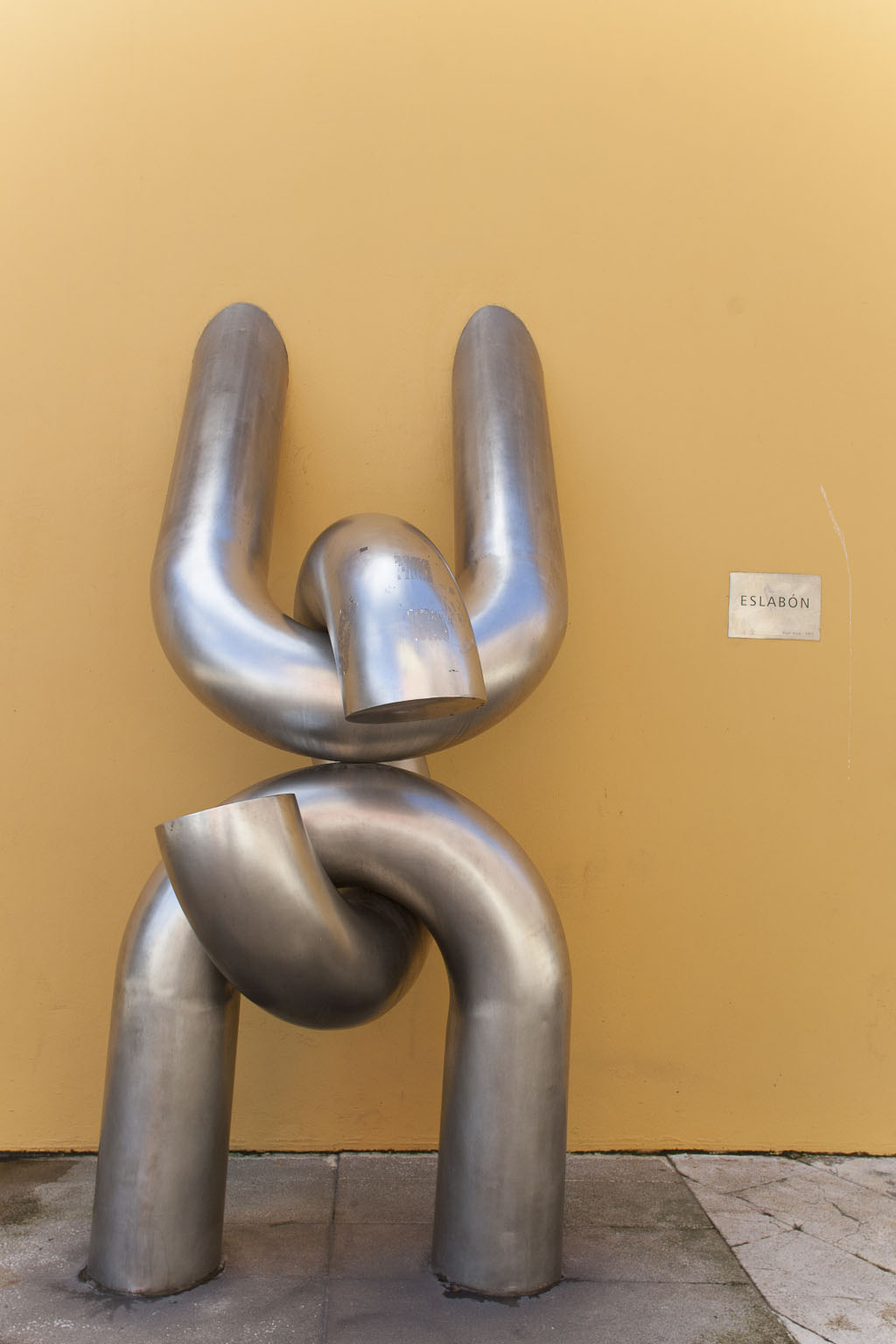
Teatro Palacio Valdés was completed in 1920 in neobaroque style. Balsera Palace now houses the Julián Orbón Music Conservatory, with regular concerts. Orbón (1925-1991) was a composer born in Aviles, working mostly in Cuba, Mexico and the US. The Palace is at Ferrería 14; it was built in 1909 as a merchant's residence in Art Nouveau style. Football: Real Avilés CF were promoted in 2025 so they now play soccer in Primera Federación, the third tier. Their Estadio Román Suárez Puerta (capacity 5400) is on José Cueto, 500 m west of city centre. Palacio de Deportes is a sports complex and athletics stadium 200 m west of the football ground. La Ruta del Acero - "the steel road" - is a walking and cycling path for 2 km along the south river bank towards Llaranes. It's dotted with sculptures symbolising Avilés' industrial heritage, and the ArcelorMittal steelworks looms large on the north bank.
Events Antroxu is roughly equivalent to Mardi Gras, a fiesta just before Lent, with various dressings-up and hurling of eggs. Descenso Internacional y Fluvial is a parade of floats and mock-boats along Calle de Galiana. Fiesta del Bollo is on Easter Sunday and Monday. Bollo is a traditional cake. Intercéltico is about the culture of all Celtic regions, second half of July. La Mar de Ruido is a rock festival in August. Feast of Saint Augustine, Avilés' patron saint, is on 28 Aug. Augustine of Hippo (354-430) was a theologian whose writings greatly influenced western Christendom. Fifty-Fifty is a jazz festival in September. Avilés Acción is a festival of short films (under 40 min) screened over a week in October. Amagüestu means in August but is nowadays in November, with the gathering and roasting of chestnuts.
Buy
El Mercado is the traditional market, on Plaza Hermanos Orbón 100 m west of Muell Park. It's open M-Sa 08:30-20:00. The flea market is Monday morning. El Atrio is a shopping centre 100 m west of El Mercado on Cámara. Lots of small supermarkets in town. Hipercor is a large shopping centre 2 km southwest on C de Grado, open M-Sa 10:00-22:00. El Cor
Overview adapted from Wikipedia, travel guide fromWikivoyage (CC BY-SA). Photography via Wikimedia Commons.