
Auschwitz
Poland · Europe
About Auschwitz
Auschwitz-Birkenau is the generic name given to the cluster of concentration, labour and extermination camps established by the Nazis during the Second World War and located near the towns of Oświęcim and Brzezinka in southern Poland, some 60 km from Kraków. The camps have become a place of pilgrimage for survivors, their families and all who wish to travel to remember the Holocaust.
Auschwitz I has a lot of exhibitions in the historical buildings - many hours are required to see it all. Auschwitz II has a bigger area, but a much smaller amount of historical information. It is possible to do justice to both camps in one very long and difficult day.
Of the over one million people sent to die in Auschwitz, fewer than 200,000 of them survived, mostly non-Jewish political prisoners.
Auschwitz travel guide
Understand
Although not the first or only Nazi concentration and extermination camp, Auschwitz-Birkenau has become a widespread symbol of terror, genocide and the Holocaust in the global consciousness. A concentration camp was established by the Nazis in the suburbs of the Polish towns of Oświęcim and Brzezinka which - like the rest of Poland - were occupied by the Germans from the beginning of the Second World War (1939) till it was liberated in 1945 near the war's end. The name of the city of Oświęcim was changed ('germanized') to Auschwitz, as well as the name of Brzezinka - Birkenau; which became the name of the camp as well. The camp was continually expanded over the next five years and ultimately consisted of three main parts: Auschwitz I, Auschwitz II-Birkenau, and Auschwitz III-Monowitz. Auschwitz-Birkenau also had over 40 sub-camps in the neighboring cities and in the surrounding area. Initially, only Poles and Jews were imprisoned, enslaved and murdered in the camp. Subsequently, Soviet prisoners of war (POWs), Romani/Sinti (Gypsies), and prisoners of other nationalities and minorities were also incarcerated, enslaved and murdered there. From 1942 onwards, the camp became the site of one of the greatest mass murders in the history of humanity, committed against the European Jews as part of Nazi high command plan for the complete destruction of that people (the Final Solution). An estimated 1.1 million people were killed or died at Auschwitz-Birkenau, the majority of whom were Jewish men, women and children deported from their homes all over occupied Europe. They were transported to Auschwitz-Birkenau in overcrowded cattle wagons, and upon arrival sent immediately to their deaths in the Birkenau gas chambers. Their bodies were afterwards cremated in industrial furnaces in the crematoria. At the end of the war, in an effort to remove the traces of the crimes they had committed, the SS began dismantling and razing the gas chambers, crematoria, and other buildings, as w
Getting there
By bus There are quite frequent and inexpensive buses from Katowice. From Kraków main bus station, bus and minibuses (14 zł each way) that depart from the basement level of the main bus station. The bus takes about one and a half hours; it is usually busy and stops locally along the way. The last bus last bus should be around 7pm to Kraków. Trains also stop running early. If you plan to stay until closing time make arrangements regarding your return beforehand.
By car Driving from Kraków takes about one hour and you have to leave the A4 motorway at the Oświęcim/Balin exit. There is a big parking lot in Auschwitz I that costs 20 zł for the whole day. 200 metres from Auschwitz II there is another parking lot that costs 40 zł per stay, but also free space for around 40 cars near the main door. As of 2017, it is possible to find legal free parking within 1 km from Auschwitz I.
By train The train station of Oświęcim is about 2 km from the museum and there are public town buses connecting them (2.70 zł). There are several local trains each day, both from Kraków and from Katowice and few going to other cities like Ostrava or Prague. The trip to or from Kraków central station in 2025/2026 timetable takes between 42 min and 1.5 hours, depending on the type of train and route. It costs between 12 and 16.50 zł - often faster trains are cheaper. The last train to Kraków leaves around 10pm, always check timetable for your day.
Organised tours Several companies provide tours from Kraków and Katowice. Prices range from 60 zł to 100 zł. They advertise heavily so you'll have no problem finding one. These tours involve a minibus pick-up from many spots in Kraków and Katowice, a lunch break, and a few hours' guided tour.
Entrance Admission is free but you absolutely need a ticket for Auschwitz I. Individual visitors have the choice to do a self-guided visit, or to join a guided tour, which you pay for. Group visitors must hire a tour guide for their visit. Since 2020 th
Getting around
The Auschwitz Memorial and Museum is easily navigated on foot. In order to acquire a proper sense of the place it is essential to visit both parts of the camp. Tours provided by the museum in various languages cost 150 zł (discounts available for students up to 26 years of age) and are recommended if you want a deeper understanding of the site, but they are unfortunately somewhat rushed, and you can get a pretty good feel by buying a guidebook and map (small simple guide costs 5 zł) and wandering around on your own. Each exhibit is described in Polish with other language translations. There are free toilets at the Auschwitz-I site, but no toilets at Auschwitz II-Birkenau.
Between camps There is a free shuttle bus between Auschwitz and Birkenau. In the summer, it runs every 10 minutes, and during winter, every 20 minutes. You can just walk the 2.2 km (1.4 miles) between the camp entrances (although it isn't a very nice walk as it is along the roads). A taxi between the sites will cost about 15 zł.
See
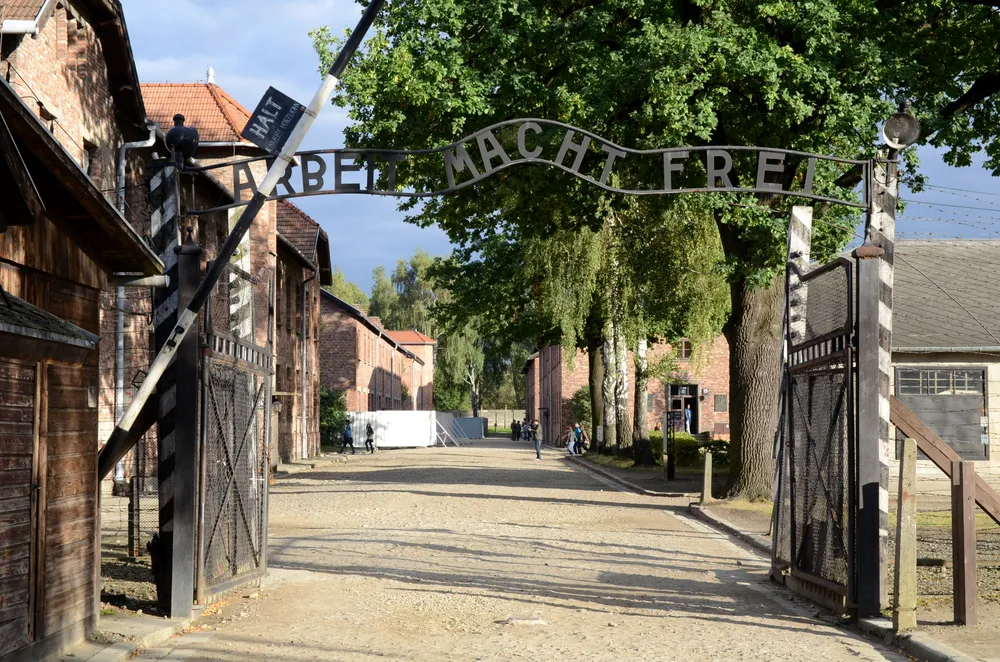
1 Auschwitz I. The first camp to be used (therefore called Stammlager; 'main camp' in German). It is in a far more complete state than Birkenau, but is also much smaller. The camp consists of former Polish military barracks, which were requisitioned by the Nazis in 1940. Near the entrance, you will see the wrought iron gate bearing the infamous and mocking camp slogan, Arbeit macht frei - "work sets you free." Inside some of them you will find information material, boards, photos and personal belongings to illustrate the life and cruelties of this camp. The only remaining gas chamber is here. As indicated in the chamber, it was reconstructed to its wartime layout after the war. Other sights include solitary confinement cells used as punishment, the death wall memorial where several thousands of people were shot by firing squad, and a reconstruction of the gallows used in 1947 to execute camp commandant Rudolf Höss, on the site of the camp's Gestapo office. 2 Main Building. The entrance to Auschwitz I has a museum with a cinema where a 15-minute film is shown, shot by Ukrainian troops the day after the camp was liberated. It's too graphic for children (if indeed you bring them to Auschwitz-Birkenau at all), and costs 3.5 zł, included in the price of a guided tour. Showings between 11:00 and 17:00, in English on the hour and Polish on the half hour. Informative and disturbing. The bookstores and public conveniences are here. Consider buying a 5 zł guidebook or 5 zł map. 3 Auschwitz II-Birkenau. The second camp, built after Operation Barbarossa to accommodate the influx of captured Slavs from the Soviet Union, and is around 3 km from Auschwitz I. You can still see the entrance gate, the railway track and ramp and a single row of preserved barracks; the rest were destroyed. Many of the fences, chimneys and watchtowers are still standing, which illustrate the camp's bewildering size. You can also see the buildings where incoming prisoners were shaved and
Overview adapted from Wikipedia, travel guide fromWikivoyage (CC BY-SA). Photography via Wikimedia Commons.