
Aranjuez
Spain · Europe
About Aranjuez
Aranjuez is an historic municipality] (population 47,000) at the confluence of the Tajo and Jarama rivers. It is about 50 km south of Madrid in Spain and difficult for Anglophones to pronounce: aɾaŋˈxweθ sounds something like a'ran'with!
Aranjuez travel guide
Understand
Nestling in the wide, flat-bottomed valley at the confluence of the Tagus (locally Tajo) and Jarama rivers, in an exquisite natural setting, the town of Aranjuez, has been declared a UNESCO Cultural Landscape World Heritage Site since 2001. The Royal Estate and Villa was once the exclusive springtime residence of royalty and its 700 families of servants. In 1747 the town started to become the modern thriving city of today, but retaining the outstanding cultural and sporting opportunities for residents and visitors in an environment of great natural interest once reserved to courtiers and their king. All so-called ribereños still strive to serve everyone as delightfully as they once served the nobility, and especially those who seek know the history, architecture, and the culture that created its incomparably sublime buildings, gardens, and landscapes - Aranjuez offers food for thought combined with serenity, comfort and fine cuisine.
Getting there
By plane The main passenger terminal is Madrid–Barajas Airport, to the west of the capital city, which links via a toll-road to the three concentric peripheral routes M-50 (outer) M-40 and M-30 (inner) autovías. There are also direct rail and metro services from Terminal 4.
By train In summer, RENFE occasionally run the Strawberry train - el tren de la fresa is a steam-train tourist service from Madrid Madrid region Cercanias C-3 service trains link Aranjuez directly to Madrid The ride takes roughly 45 min to 55 min from Atocha, Sol or Chamartin. From Atocha RENFE high-speed trains connect directly to the airport and to most Iberian cities. For Paris change from w:AVE to w:TGV at Barcelona
By car Use either M-50, M-40, or M-30 peripheral major roads around Madrid which connect to A-4 (Autovia Sur/direction Cordoba) use exit at Km 37 (under arched footbridge) to M-305 (regular road direction Aranjuez - take care of tight bend left and 2 lanes converging). This leads via La Montaña district and automotive sales zone (3 km north of city) and then directly to the royal palace (recommended: use free surface car-park on left immediately after road-width restriction or continue into monumental zone then turn right under arch by church to paid underground parking in Calle Valeras). For the south (industrial area) of town continue on A4 to next exit (or use toll road R-4).
Getting around
Walk
Aranjuez is fairly flat and accessible with many fine gardens and parks as well as those of the royal palace complex. For a swift introduction, there is the tourist chiquitren or wagon-train which optionally offers a combined ticket which includes some museum entry and riverboat services. This leaves daily, all year round, from behind the Royal Palace, through the town and around the Jardin del Principe royal gardens, and includes a recorded commentary in Spanish and English. The Jardin de la Isla is a more formal garden with some notable fountains joining the palace.
Amble around the town as well as the royal sites - the town is compact and level - ideal for walking - but, this being an historic town with lots of interesting architecture, wheelchair users may need help entering some business premises, but assistance is usually readily available on request. Tourist Walks: the tourist office offers several routes which pass by numbered information boards erected by the municipality near places of interest
Cycle Aranjuez municipality has a free cycle hire service called Aranbike, but there is a registration fee, and the process is a very clumpy operation and all in Spanish.
Doce Calles To the north, beyond the rotunda Roseñol cobbled roundabout (near the riverside tourist restaurant 'el Rana Verde) are the royal vegetable gardens (now farmland). A roundabout and rural café ('gango) serves as a hub for 12 royal rides (now mostly restricted to pedestrian and bicycle us). As well as being level, they boast elegant, tree-lined, shade and shingle surfaces. Radiating like a clock from the Doce Calles (12 ways) roundabout/kiosk-bar, some border the river, whilst others lead to a new- park - the steep slope known as talud sur de la Montaña which has an ancient water-wheel and path-extensions all bicycle or wheelchair accessible and suitable for the fitter users. Throughout its history as a royal estate from 1560, the steep-sided, fertile valley at the conflue
See
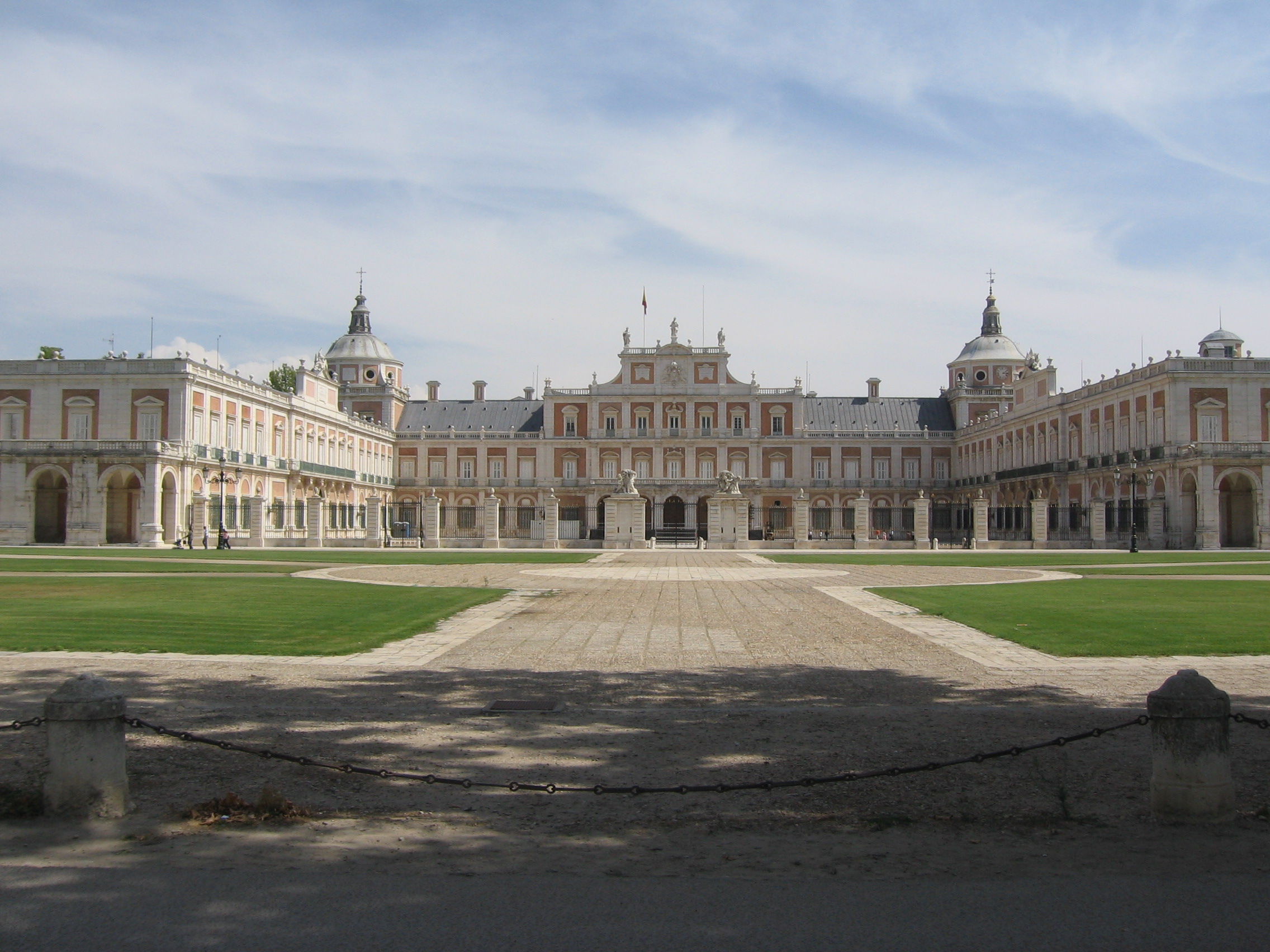
Royal Site w:Royal Palace of Aranjuez dates from the 18th century. Some of the famous rooms are: The Porcelain Study Throne Room Jardin de la Isla attached formal gardens Plaza Eliptica oval grassed park, with three radiating walkways with shady trees leading towards the festival ground near the railway station One of the exterior facades of the Palace, the Gardens surrounding the Palace Chiquitren- tourist road-train which visits: Jardin de la Isla - formal gardens adjoining the palace Jardin del Principe - an extensive riverside park with many features, including Botanical Gardens Chinese Garden Real Casa del Labrador Museo de Falúas Reales - Royal Barge Collection Within Aranjuez, there are many sculptures and architectural gems - because the town was created by royalty and only royal servants were permitted, the vernacular buildings tend to be of one design in the tightly packed centre, interspersed with noble palaces and grand military installations along the boulevards. Worth visiting are the newly restored railway station and Carlos III theatre, the Queen's stable, now adapted as the municipal cultural centre, the central Abastos market and (ruined) Carlos municipal (plague) hospital. Saturdays there is a substantial open air market for food and clothing in Calle Valeras, which faces the Royal Palace.
Mariblanca - a large sandy square properly called Plaza San Antonio after the Royal chapel at the end.
Old Town Plaza de la Constitución Town hall (casa de los empleados) Central covered market Abastos Bull Ring The first Plaza de Toros built in Spain, contains small museum Palacios Principe de La Paz -the rogue royal favourite who provoked the mutiny of Aranjuez for consorting with Napoleon - near the palace (now a 4* hotel) and also in Calle Principe - now Colegeo de la Sacrada Familia - in front of which the mutiny is re-enacted)
Nearby Heurtas y Jardines Shady tree-lined walks in what used to be the kitchen gardens and orchards Parque Talud Sur: A
Do
Feria de Aranjuez festival about first week of September includes a fun-fair (car park; M-305) sports events (Delete stadium) food and drink stalls (Mariblanca) a concert at the Royal Palace a traditional or Sacrificio Goyesque (in the Plaza de Toros) a dramatic street re-enactment of the attack and burning of Godoy's House, (now Sacrada Familia school in Avenida Principe) with fireworks and costumes inspired by Goya paintings A fun raft-race organized by the pirates of the Tajo The Motin de Aranjuez took place in March 1808 because Godoy was believed to have colluded with Napoleon to invade Spain on the pretext of attacking Portugal. Subsequently
Overview adapted from Wikipedia, travel guide fromWikivoyage (CC BY-SA). Photography via Wikimedia Commons.