
Almodóvar del Río
Spain · Europe
About Almodóvar del Río
Córdoba is a mid-sized city of 326,000 inhabitants (2018) and the capital of the province of Córdoba in the centre of Andalucia. A great cultural reference point in Europe, this ancient city has been declared a World Heritage Site and contains a mixture of the diverse cultures that have settled it throughout history. The historic quarter of Córdoba is a beautiful network of small streets, alleys, squares and whitewashed courtyards arranged around the Mezquita, which reflects the city's prominent place in the Islamic world during medieval times.
Almodóvar del Río travel guide
Understand
Very few places in the world can boast of having been the capital of a Roman province (Hispania Ulterior), the capital of an Arab State (Al-Andalus) and a Caliphate. Such splendor is palpable in the intellectual wealth of this city, that has seen the birth of figures like Seneca, Averroes, and Maimonides. Córdoba also has much to offer in terms of art, culture and leisure, thanks to a myriad of cultural events that are organized here throughout the year: Flamenco festivals, concerts, ballet and other activities. These events are complemented by a number of museums and a good nightlife scene.
1 Tourist Information Office (Punto de Información Turística), Plaza de las Tendillas, 5, ☏ +34 902 201 774, [email protected]. Daily 09:00-14:00, 17:00-19:30. 2 Tourist Information Office (Punto de Información Turística), Campo Santo de los Mártires (in front of the Alcázar), ☏ +34 902 201 774, [email protected]. Daily 09:00-14:00, 17:00-19:30.
Getting there
By carpooling In Southern Spain (Andalusia) you usually get a better price using Blablacar than travelling by train or intercity bus.
By train RENFE, Spain's high-speed rail network, offers a very fast and comfortable train service to Córdoba. From Madrid Atocha trains run hourly, most continuing to Sevilla (45 min), some to Malaga (50 min), Cadiz or Algeciras (for Morocco). Two of the Madrid services originate in Barcelona, taking about five hours via Zaragoza. As the trains are so fast and journey times are short, they only run day-time.
1 Estación de Córdoba Central, Glorieta de las Tres Culturas, ☏ +34 902 432 343. The station is modern, on Avenida de America. There are luggage lockers, wi-fi, cafés, and a tourist information centre. To get to the old town including Mezquita, turn left in the station mall as you exit the platform, then right down the verdant divided boulevard of Avenida de la Republica Argentina. 15 min brings you to a gate through the old city walls, keep straight on then bear right towards the biggest tower in view.
By bus 2 Córdoba Bus Station (Estación de Autobuses de Córdoba), Avenida de la Libertad (just across the street from the train station), ☏ +34 957 40 40 40, [email protected]. Regular buses from almost every town in Andalucia as well as from Madrid departing from the "Estación Sur" (around 6 buses per day). ALSA and Socibus both have timetable and ticket information online.
By plane 3 Córdoba Airport (ODB IATA) (6 km southwest of city centre). A very small airport with year-round service to Barcelona on Vueling and seasonal flights to Palma de Mallorca and Gran Canaria. (updated Dec 2025) The closest major airports are in Seville, Málaga and Madrid; from there a train or a bus to Córdoba takes but a few hours.
By car Distances to Cordoba: Madrid 407 km, Badajoz 278 km, Granada 166 km, Malaga 175 km
Getting around
Just about everything of interest in Córdoba is within easy walking distance (the one notable exception being the Medina Azahara), and the typical tourist can do with the standard tourist map which can be obtained from the tourist offices (one on the east side of the Mezquita; another between the Alcázar and the city walls; and yet another in the train station; to name a few). The area with by far the most to see is the Old City surrounding the Mezquita. The Old City is a tangle of medieval-style streets roughly bounded by the Guadalquivir River on the south, the area surrounding Plaza de las Tendillas on the north and the tree-lined Paseo de la Victoria on the west. This area is crammed with places to stay, eat and buy souvenirs, though many visitors may find certain areas (particularly immediately surrounding the Mezquita) too touristy, with more interesting things found wandering into the tiny streets of the Jewish Quarter to the west and north of the Mezquita. Behind the Mezquita the Roman Bridge crosses the Guadalquivir River to a museum in the old gate on the opposite side. The area immediately to the north of the Old City, roughly from the area around Plaza de las Tendillas to Avenida de America is a more modern section of town and is where the train and bus station is located as well as a major shopping area. Along Paseo de la Victoria on the west side and Avenida de America on the north are large parks that make for a pleasant stroll. With the rechargable green travel card you can use all means of public transport (regional trains; city and regional buses) for a lower price. The card can be bought in tobacco shops for €1.50 and must be charged with at least €5 (Nov 2024). There is another travel card issued by the city bus operator, but you can only use the city buses with that card.
See
The Mezquita
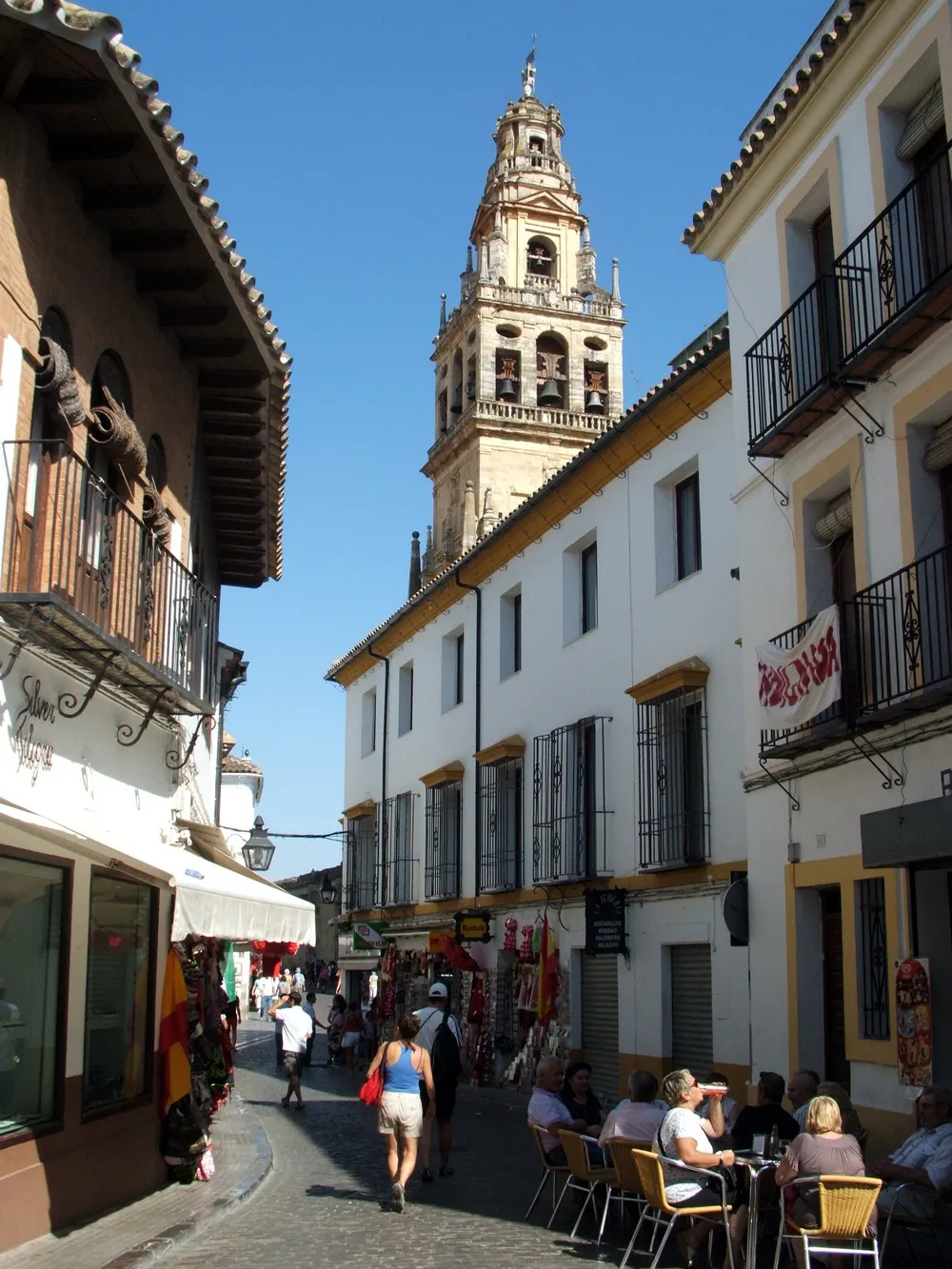
M-Sa 08:30-19:00, Su 08:30-10:30 and 14:00-19:00 (last entry 30 minutes before closing). €15 (free entry during 8:30-9:30 morning mass) Official site and tickets. Tickets also allow entry to over ten other churches in Córdoba, and times and a map of them are at the exit to the Mezquita. The biggest attraction in Córdoba and a truly must-see building, the Mezquita is a massive former mosque-turned-cathedral famed for its "forest" of columns topped with Islamic-style red and white striped arches among its other many architectural highlights and serves as a reminder of the glory and importance Córdoba held in medieval times. The building is full of history and beauty - you'll want to give yourself at least a couple of hours to do it justice. Built in 786 as a mosque, the structure was expanded several times under Córdoba's Muslim rule while still remaining largely true to the original design. Following the Christian Reconquista of Córdoba in 1236, work immediately went underway to convert the building to a church, and four centuries later a cathedral at the centre of the building was constructed, though not without controversy as it significantly altered the space. Today, despite the presence of the cathedral, most of the original mosque structure remains remarkably well-preserved. Approaching the Mezquita, the first thing you will notice is the massive bell tower on the building's north side which looms over the surrounding buildings. Built in the 1600s the tower replaced a minaret previously on the site. It is possible to go up the bell tower, but this requires a separate ticket (€4) for a strictly-enforced 30-minute slot, including climbing and descending. The tower is outside the main ticketed zone of the Mezquita, so plan on visiting before or after your ticketed entry to the Mezquita itself. Along the outside of the building the wall takes on the appearance of a fortress, with an elaborate set of Moorish-style archway and windows spaced every so
Do
May - ¡Mayo!. The best time to visit the city. 'The Month of Córdoba'.
Feria de Córdoba - Last week in May, a huge fair of drinking, dancing, eating, and not working. Flamenco and salsa music. A great time! (Late May - early June) Cruces de Mayo - 1st week of May. Very fun, a lot of public squar
Overview adapted from Wikipedia, travel guide fromWikivoyage (CC BY-SA). Photography via Wikimedia Commons.