
Aegina
Greece · Europe
About Aegina
Aegina (Greek: Αίγινα) is one of the Saronic Gulf Islands, a triangle 11 km on each side. It's the closest island to Athens, reached in barely an hour by ferry, and in 2011 had a population of 13,056. The main reasons to visit are to escape the city heat for an agreeable old port, and to see the temple of Aphaea. It feels more like a beach suburb than a Greek island, and it can get busy, but most visitors are from the city.
Aegina travel guide
Understand
In legend Aegina was a goat-nymph, though it was almighty Zeus who acted the prize goat with his predatory sex adventures. Aegina was carried off to the island that now bears her name (maybe not unwillingly) and bore Zeus a son Aeacus, who became king. Hera the wife of Zeus tended to blame the other women rather than her hubby, and wiped out the island population by plague. However Aeacus prayed to Zeus to convert the teeming ants into humans, the myrmidons, a sort-of warrior caste - honestly, how many of us would have thought of doing that? In the 7th to 5th centuries BC Aegina was a maritime trading state and its currency, embossed with a sea turtle and later a land tortoise, circulated widely in the Hellenistic world. Trade rivalry with Athens escalated into war, the island suffered a massacre in 424 BC, and this time the trick with the ants somehow couldn't be repeated. Aegina lost its importance and fell under the sway of other city-states, passing (as did Athens) into Roman, Byzantine, Venetian and Ottoman control. It has some agriculture but little industry, and has long been a holiday retreat for Athenians.
Getting there
Frequent ferries ply from Piraeus port in Athens to Aegina town. Hydrofoils for foot passengers take 40 min, single fare €14, conventional vessels for cars and motorbikes take 70 min, single fare €10. Within the Piraeus port, follow signs for "Aegina" and "Gate E8" (to be sure, check the electronic screens, as specific gate can sometimes shift e.g., to E7). In normal times hydrofoils sail hourly 07:00-17:00, some continuing from Aegina to Agistri, Poros or Methana. The ferry operators are Hellenic Seaways, Blue Star Ferries and Saronic Ferries. As of December 2025, Hellenic Seaways and Blue Star Ferries provide only hydrofoils option, while previouly mentioned Alpha Lines and ANES Ferries don't list Aegina in their schedules. 1 Aegina port is at the heart of the town. Ferries dock on the west pier, cruise ships on the east pier, and small craft use the inner harbour. There are lots of nearby cafes.
Getting around
There are five car rental agencies near the harbour, which also have motorbikes and scooters - book ahead to ensure availability. Some of their offerings are dilapidated. For a day trip, you might do better to hire a taxi. The driver knows the roads, where to park and how much time to allow to return you to the ferry pier, and will regale you with what his great-grandmother got up to during the war. Buses on the island are a limited service to enable villagers to get into town for essentials then get home. They are not well-designed for sightseeing outings, but it's possible given boundless patience. The three routes all start from the bus stand by the harbour, and take at most 30 min to the end of the line. A single ticket is €2, pay cash as you board. Destinations are only shown in Greek but if in doubt, get on and ask the driver.
- Route 1 (yellow) follows the north coast, Aegina town - Kipseli - Vathi - Souvala - Agii - Vagia, with three M-F and two Sa Su. - Route 2 (blue) runs east across the island, Aegina town - Agios Nektarios - Aphaia Temple - Agia Marina. These run M-F with three outbound buses passing the temple. Two others turn off after Agios Nektarios along the lane via Alones to Agia Marina and don't pass near the temple, but they return that way, so there are five return services. - Route 3 (orange) follows the coast southwards, Aegina town - Faros - Marathonas - Aeginitissa - Perdika, with three M-F and two Sa Su.
See
1 Temple of Apollo (Archaeology Museum) (500 m north of harbour). F-M, W 10:00-17:30. Small museum and remains of a citadel on Kolona headland, you mostly come for the view. "Kolona" refers to the column, still standing, which was a daymark for approaching ships. Adult €4, conc €2, some free days. (updated Apr 2020) Churches worth a look in town are St Nicholas Chapel (on west pier, the whitewashed building just as you step off the ferry), Isodia Theotokou (which you'll see even earlier from the boat, as it looms over the harbour), the Cathedral (on Mitropoleos) and Fanomeri (1 km inland and underground; it's often closed). Landmarks and secular buildings in town are Government House (next to the cathedral, a modest 2-story building that in 1828/29 housed the newly independent Greek government until they could get set up in Athens), Eynardio (1830 building next to the cathedral), Tower of Markellos (a pink watchtower on Thomaidou) and the Kapodistrian Orphanage southside (looking uncannily like a prison, which it was). 2 Christos Kapralos Museum (3 km north of town near NW tip of island). W-F 08:30-16:00, Sa Su 09:30-17:00. Kapralos (1909-1993) was a Greek artist who often spent summer working here on Aegina; his best known piece is the 40 m Pindus Frieze. You'll know you've reached the museum by the statue of his mother outside. It's nowadays an annexe of the National Art Gallery (Alexandros Soutzos Museum) in Athens. Adult €5, conc €3. (updated Apr 2020) The writer Nikos Kazantzakis (1883-1957), best known for Zorba the Greek, lived on-and-off in Aegina from 1933 and built an idiosyncratic house on the northwest tip 200 m north of the Kapralos museum. It's now a private dwelling and you can't tour inside.
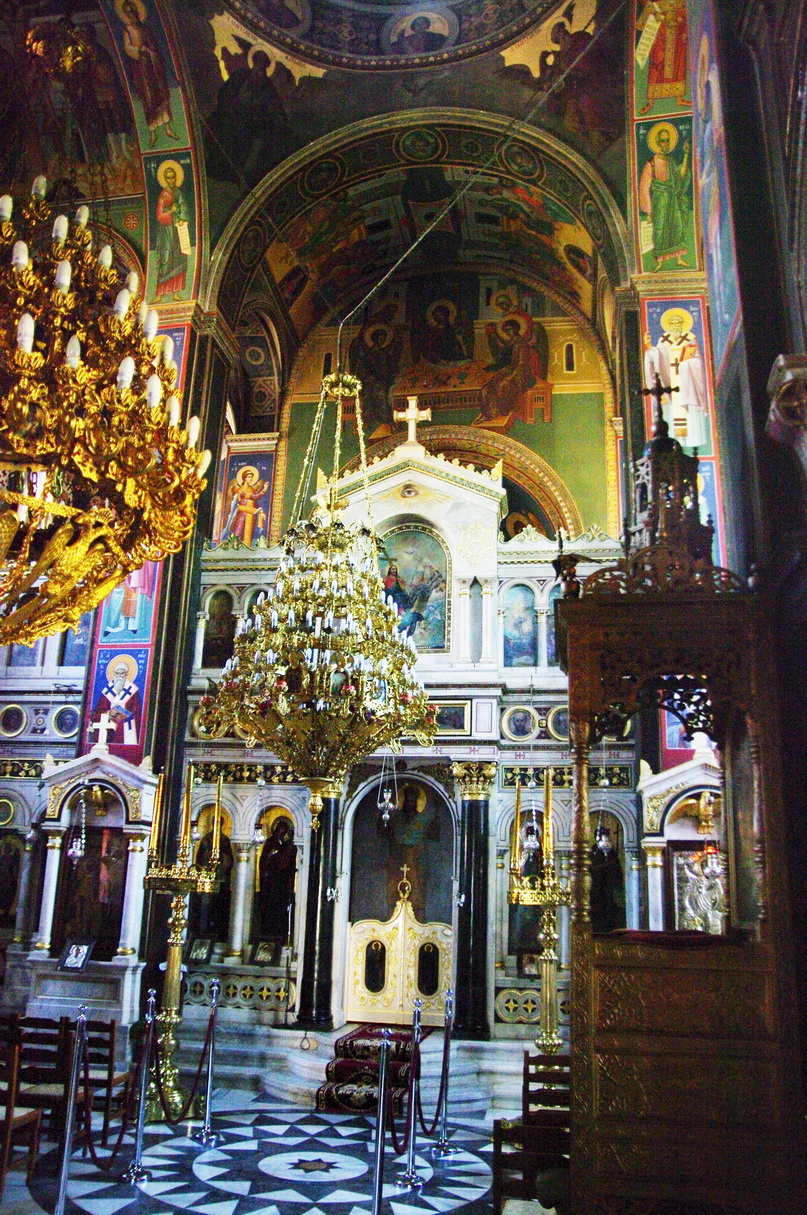
3 Agios Nektarios along the road to Agia Marina is a large, elaborate, modern Orthodox church and monastery. It's dedicated to Metropolitan St Nektarios (Anastasios Kephalas 1846-1920), a monk who ministered in Cairo, Libya and Athens before retiring to Aegina.
Do
Beaches: the best are Souvala on the north coast, Agia Marina to the east, Marathonas 5 km south of Aegina town, and Perdika. Climb the highest peak on Aegina at 532 m, helpfully called Oros which is Greek for "mountain". It's 5 km southeast of town, follow Lefkis road towards Anitseo. The well-marked path leads past the remains of a temple to Zeus and takes 45 min. From the top there's a panorama over the Saronic Gulf. Aegean Sailing School, 8 Martyros Leontiou, Aegina town (two blocks back from harbour), ☏ +30 22970 25852, [email protected]. M-Sa 09:00-17:00, Su 14:30-19:00. A sailing school offering RYA sailing courses in English. Courses usually start on Sunday at 17:30. (updated Apr 2020)
Eat
Aegina town waterfront is lined with cafes. Good choices are Flisvos north of the pier (daily 10:00-00:00) and Pantarei on the harbour (daily 07:30-03:00). Agia Marina has Pita Tom (daily 12:00-00:00), where souvlaki and gyros are fresh and inexpensive. Perdika, at the southwest tip of the island, has a whole row of good tavernas. Vagia has Aeredes, Vagia beach (just west of marina), ☏ +30 22970 71122, [email protected]. Daily 10:00-00:00. Good Greek food, sea views and friendly staff.
Drink & nightlife
Perdikiotika at 38 Apheas in Aegina town has charming decor and casual food. Bartan and Barrera are on Irioti north end of Aegina harbour, with Belle Epoque on Pileos a couple of blocks inland. The rest of the island doesn't do free-standing bars, head for one of the waterfront tavernas
Overview adapted from Wikipedia, travel guide fromWikivoyage (CC BY-SA). Photography via Wikimedia Commons.