
West Highland Line
旅遊行程
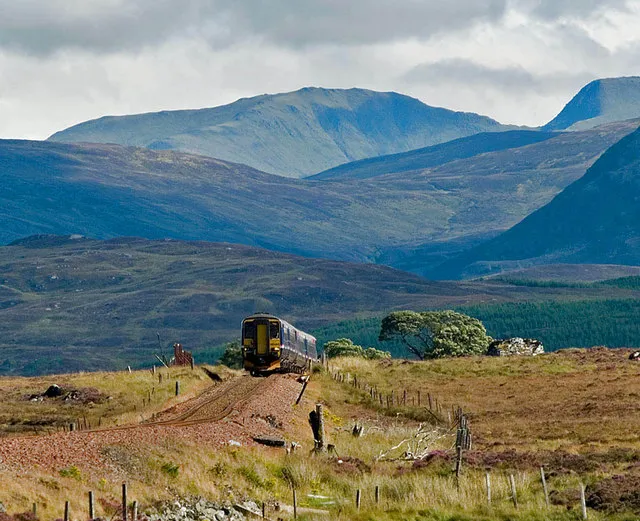
The West Highland Line is a railway in Scotland running from Glasgow to Fort William and Mallaig, with a branch to Oban. It's rated one of the most scenic railways in the world, but is a practical everyday route for passengers and freight. It's a lifeline not only for communities along it but for Hebridean islands connected by ferry to the terminuses, as indicated by its Gaelic name Rathad Iarainn nan Eilean - "Iron Road to the Isles".
Understand
In the mid-19th century, a frenzy of railway expansion reached all the cities of Scotland, even Inverness, but the northwest remained blank on the map. As the easy-to-build, profitable lowland railways were completed, increasingly hare-brained proposals were put forward for outlying routes — one for the West Highlands reckoned trains could be sucked over the hills, with an almighty thhhhhwurp! to out-do the sucking of the bogs they crossed. Eventually from 1866 a line was built in fits and starts from the existing network near Stirling via Callander, Killin and Crianlarich, with a complete route to Oban by 1880. Much more difficult terrain lay north, and much poorer prospects for either passenger or freight revenue. The ground was either too soft or too rock-hard, and there was no locally-available labour or materials. Costs were higher and investors (already burnt) were wary. A further obstacle was existing railway companies, who squealed at anything that might threaten their local monopolies. What changed government thinking was rural poverty sparking civil unrest in the Highlands, as it had in Ireland. So funding and legal assent were obtained, ground was broken in 1889 on what would become the West Highland Railway, and it reached Fort William in 1894, extending to Mallaig in 1901. At Crianlarich it crossed the Callander-Oban line, with the minimum of cooperation between the two routes until the Beeching cuts of 1965 — then the Callander-Crianlarich section was abandoned and the Glasgow-Oban route became a branch of the West Highland line.
Prepare
The train is the easy bit. Timetables, fares and discounts are described on the National Rail website, which directs you to the multiple train operators to buy your ticket. Scotrail operates the regular day-time train but you can buy from any, including for connecting journeys from England to Glasgow. Reservations are essential for the sleeper from London (the booking horizon is 12 months), and recommended for day-time trains in July, August and around public holidays. The rail service connects with several Hebridean ferries and gets busy at peak times, and you don't want to be standing in the corridor all that way. Off-peak there's no problem buying tickets for immediate travel, but advance returns are generally a better deal. These may tie you to specific trains but this is not the sort of route you hop-on, hop-off on a whim. You need accommodation, probably both in Glasgow and at your intended terminus. Glasgow itself is a great destination that deserves a few days to explore. It gets chock-a-bloc in August during the Edinburgh Festival, as everywhere within an hour's travel of that city is booked solid. What do you intend to do at the north end? If it's just a stroll on the promenade and purchase of a souvenir tea-towel, preparation is simple. More is involved for water activities or mountain hikes, where you have to factor in changes in the weather and the logistics around train times. At any rate be better prepared than Sir Robert MacAlpine (1847-1934), founder of the construction firm, who set off with six colleagues to survey the intended route over Rannoch Moor. On a bleak January day in 1889, facing a 70-km hike over trackless bog, they were dressed as if sauntering down the street to the bank on a mild morning in May. Two days later they were rescued; it's a miracle they all survived. Their ordeal did some good as further evidence of the need for a railway.
Get in
Glasgow is the start of the West Highland Line, and the usual springboard for exploring it. The city has good air connections across Europe and within the UK, and trains and buses from London and all over Scotland; it has never been a ferry or liner port. There's lots to see and do here, and plenty of places to eat, drink and sleep. Glasgow Central is the arrival terminus for trains from London Euston, Birmingham and Manchester, via Preston and Carlisle; the fastest trains from Euston run hourly and take 4 hours 30 min. Some trains from London Kings Cross via Newcastle and Edinburgh terminate here, but it's quicker to change in Edinburgh. Trains from southwest Scotland also run here, from Lanark, Motherwell, Dumfries, Kilmarnock, Stranraer (for Belfast ferry), Ayr, Prestwick Airport, Ardrossan (for Arran ferry), Largs, Troon, Wemyss Bay (for Bute ferry), Greenock and Gourock (for Dunoon ferry). Central station is 500 m southwest of Queen Street station. It's simplest to walk, unless the weather is foul or you're laden with luggage or sprogs. Bus 398 is free if you show an onward rail ticket. Don't use the Underground, it's just as far to walk. Buchanan Street bus station is 100 m west of Queen Street and has buses from London, Belfast, just about everywhere in Scotland, and from the main airport (GLA IATA). Glasgow Queen Street is the start for trains along the West Highland line. It has fast trains from Edinburgh via Falkirk, so this is your usual arrival point from London Kings Cross, Leeds, York, or Newcastle, changing at Edinburgh. (Slower trains from Edinburgh, including through-trains from England, trundle across the industrial central belt to Glasgow Central.) Services from Inverness, Aberdeen, Dundee, Perth and Stirling also terminate at Queen Street. Saturdays it's thronged with football fans and drunks, but few of these are taking the West Highland train.
Scotrail trains are the principal service, running the length of the route six times M-Sa and thrice on Sunday. The first departs shortly after 05:00 and the last towards 18:30. These are composed of two-coach diesel (Class 156 Sprinter) units, and they start from Queen Street with two or thre
Go
The full route from Glasgow takes 5½ hours to Mallaig or 3 hours to Oban, diverging at Crianlarich. Between Oban and Mallaig takes about 5 hours, with a 30 minute wait at Crianlarich.
Glasgow to Crianlarich 1 Glasgow Queen Street (0 km) is the terminus for trains from Inverness, Aberdeen, Dundee, Perth, Stirling and the faster trains from Edinburgh. Local through-trains use the basement platforms. The West Highland route carves away from this leash of tracks to rattle through the suburbs north of the Clyde. 2 Dalmuir (16.1 km) at the northwest edge of the city is near Auchentoshan Distillery. Kilpatrick, Bowling and Dumbarton East are platform halts with trains from Glasgow to Helensburgh and Balloch, but the West Highland trains don't stop there. 3 Dumbarton Central (26.6 km) is where trains branch for Helensburgh Central and for Balloch on Loch Lomond. The town is tatty and industrial but has a fine castle on a crag overlooking the Clyde estuary. If you landed at Glasgow Airport, you could take a taxi direct here across Erskine Bridge to bypass Glasgow. Dumbarton marks the boundary of the Highlands, and the first major transport obstacle in the shape of the "Argyll Alps". The road heads north along the bank of Loch Lomond, and a former railway did so, now a cycle track. The mainline railway however swings west to follow the shore of Gareloch, a sea inlet, and from here on is single track, not electrified. 4 Helensburgh Upper (41.0 km) is close to Hill House, built and decorated by Charles Rennie Mackintosh in 1902/04. It's a mile uphill from the main town, which is more easily reached by the frequent trains to Helensburgh Central. 5 Garelochhead (51.9 km) is a Victorian beach resort blighted by the Royal Navy submarine base at Faslane, and other industry. 6 Arrochar and Tarbet (62.9 km) are neighbouring villages on a low saddle of land between the hills flanking Loch Lomond and Loch Long. The A82 towards Inveraray also crosses here, so the villages are busy with traffic. 7 Ardlui (82.1 km) at the north end of Loch Lomond has water sports. The route now climbs Glen Falloch. 8 Crianlarich (96.2 km, two hours out of Glasgow) is where the tracks diverge and
Go next
Glasgow is Scotland's largest city, full of interesting architecture, museums and culture. Edinburgh is only an hour away. Oban has
本指南改寫自 Wikivoyage (CC BY-SA)