
88 Temple Pilgrimage
旅遊行程
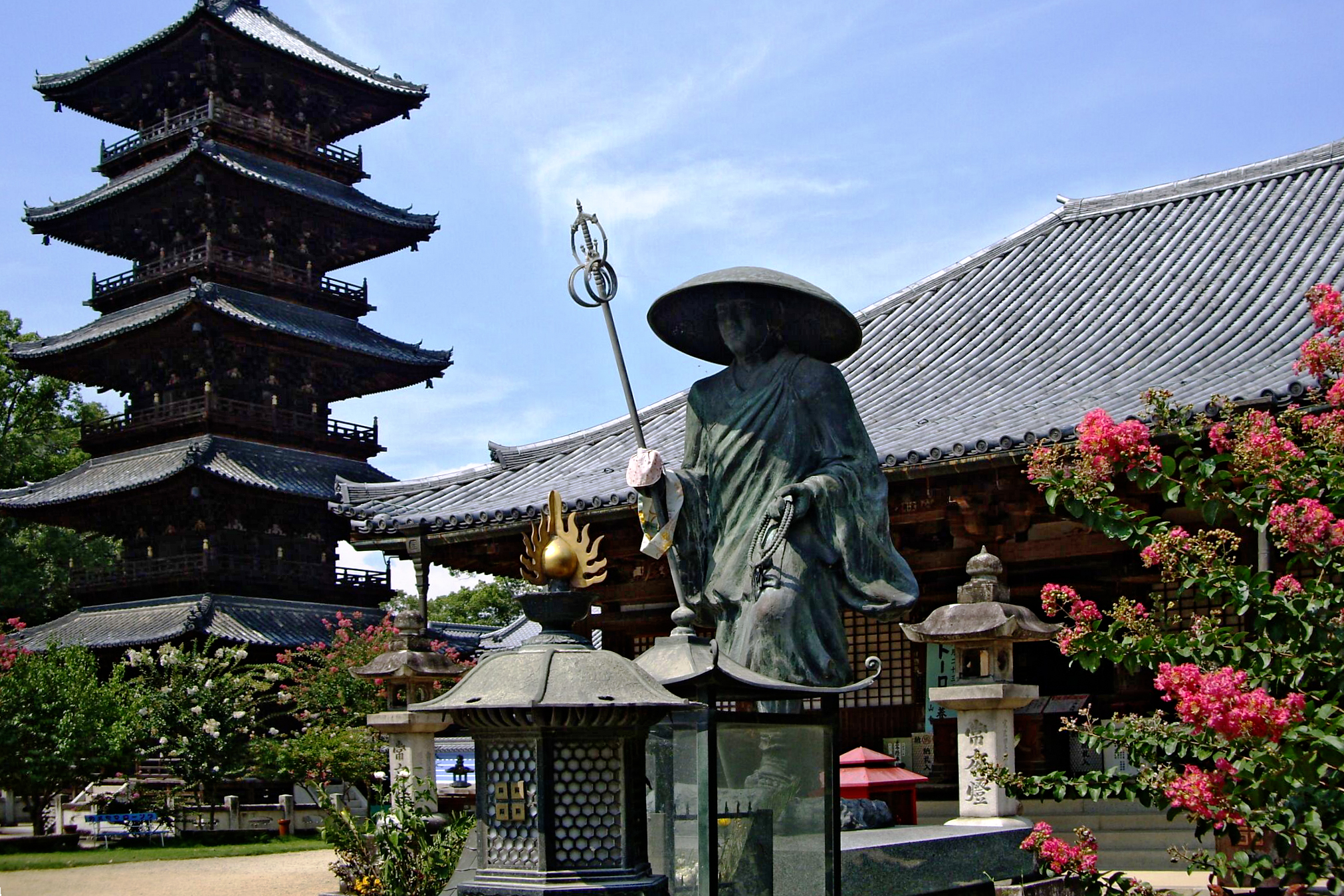
The 88 Temple Pilgrimage (八十八ヶ所巡り hachijūhakkasho-meguri) is Japan's most famous pilgrimage route, a 1,200-km loop around the island of Shikoku. It is also known as the Shikoku Henro (四国遍路).
Understand
Many of the temples are said to have been founded or restored by the revered monk and scholar Kūkai (空海), better known by his posthumous title Kōbō Daishi (弘法大師). Among his many achievements, he is said to have created the kana syllabary, brought the tantric teachings of Esoteric Buddhism from China, developed it into the uniquely Japanese Shingon sect, and founded Shingon's headquarters on Mount Koya near Osaka. The number 88 is symbolic of the 88 earthly desires believed to cause human suffering, with each temple representing a step toward purification. While most modern-day pilgrims (an estimated 150,000 yearly, mostly Japanese) travel by tour bus, a small minority still set out the old-fashioned way on foot, a journey which takes about six weeks to complete. Pilgrims, known as o-henro-san (お遍路さん), can be spotted in the temples and roadsides of Shikoku clad in a white jacket emblazoned with the characters Dōgyō Ninin (同行二人), meaning "two traveling together"—the other traveler being the spirit of Kobo Daishi.
This pilgrimage is not prescriptive; it can be done in installments, it can be done via public transport, cycling, driving, tour groups, or any combination of those. Many pilgrims also split up their journey over multiple visits, completing a section of the pilgrimage each time. None of these methods are "better" or "more authentic" than any other. Understanding that everybody goes about the journey in their own way is the first step towards developing true pilgrim spirit. That said, completing the course the traditional way on foot has an undeniable appeal and old-world charm. It is however a strenuous journey that can take 40-60 days, depending on your fitness, pace, detours, and how many (if any) of the 20 'optional temples' (bekakku, 別格) you visit. Good physical fitness and stamina are required to endure the stress of constant walking up and down the hills of Shikoku, in the burning sun and the pouring rain. Many pilgrims choose to dress up in traditional white attire:
byakue – the white coat of a pilgrim wagesa – scarf worn around the neck, usually purple, to indicate that you are on a religious pilgrimage sugegasa – conical straw hat kongōtsue –
Get in
It is traditional to prepare by visiting the temple town of Mount Kōya, but the route itself starts at Ryōzenji, near Tokushima, and you have to return here in order to complete your pilgrimage. It is not necessary to start at temple #1 as long as you visit them all, but this is by far the most popular starting point for pilgrims from outside Shikoku, because it is also the nearest temple to Mount Kōya. Each of the capitals of the island's four prefectures has an airport: Takamatsu Airport (Kagawa), Tokushima Awaodori Airport (Tokushima), Matsuyama Airport (Ehime), and Kochi Ryoma Airport (Kochi). These airports are mainly domestic but have a handful of short-haul international routes too. Tigerair Taiwan flies from Taipei to Kochi. Matsuyama has flights from Busan, Seoul and Taipei. Takamatsu has flights from those three cities too, as well as Hong Kong, Shanghai and Taichung. Finally, Tokushima has flights from Seoul. From elsewhere in Japan, aspiring pilgrims can fly to any of the four airports mentioned. If you enter the country by the much larger and more common entry point of Kansai International Airport (Osaka), a bus from the airport to Tokushima costs about 5,000 yen. There are ferries from Hiroshima to Matsuyama, from Osaka to Toyo (Ehime Prefecture, night ferry), and from Beppu and Usuki to Yawatahama (Ehime Prefecture). If all else fails, you can rely on Japan's excellent rail network to get you to your preferred start point for the Shikoku Henro.
Go
Most pilgrims walking on foot average around 25 km daily and complete the trip in five to seven weeks. The canonical list of temples is as follows:
The temples are usually visited in clockwise order, although this too, is just a convention—in practice, as all signs are oriented for pilgrims going clockwise, it's easier to get lost if you go against the flow. However it isn't unheard of for experienced pilgrims to travel anti-clockwise; this is known as gyaku-uchi (逆うち). There are also 20 optional "unnumbered" (番外 bangai) temples. The free Henro Helper app provides guidance for navigation and accommodation.
Sleep
Besides standard hotels and AirBnbs which can be booked online as usual, there are a number of options for your overnight accommodation as a Henro. Many of these will add considerably to your appreciation of Japanese culture and of your pilgrimage, as you are likely to meet other pilgrims at many of these places. Most of these accommodations are the same as what are available to members of the general public. Minshuku (民宿) are family-operated, traditional Japanese-style bed and breakfasts. They typically have a handful of rooms, prices are per person, not per room, and are cash only. To sleep, you roll out your own futon on the tatami mat floor. For an additional charge, they are also able to provide dinner and breakfast (一泊二食 ippaku-nishoku). Knowing their clientelle are mostly exhausted pilgrims, meals are generally huge and home-cooked. Cooking is a labour-intensive process which begins early in the day so if you want dinner, you'll need to call ahead and book. Meals are served communally at set times, usually 18:00-19:00 for dinner, and 06:00-07:00 for breakfast, since pilgrims like to get an early start. Since these are family operations, travellers arriving late can't be fed. Meals are prepared hours in advance so late cancellations are very rude and may not be refunded. If you need to cancel, call ahead before 12:00. The word for 'cancel' is easy: kanseru. Pension (ペンション penshon) means accommodation similar to minshuku, with Western-style amenities, usually on the cheaper side and situated in rural areas. Ryokan (旅館) are like more upmarket minshuku which operate on a larger scale. Because you don't eat communally, you can select your own mealtimes. Guests also generally get nicer facilities and do not have to roll out their own futon. Shukubō (宿坊) offer immersive cultural and spiritual experiences; visitors stay overnight within a working temple complex. Temples offering this accommodation (as of 2024) are listed in the Go section above. The accommodation is traditional Japanese style - similar to minshuku. Henro houses are a network of lodging designed for pilgrims, and offer rooms (and sometimes food) to walking henro for a nominal fee—or sometimes for
Stay safe
Traveling in Shikoku is very safe, especially when you wear the traditional henro robes. People will be very helpful if they recognize you as a pilgrim, and will try to participate in your journey by giving you small gifts (osettai), which you must always accept. The weather can be perilous at times; even during the optimal seasons of spring and fall, it may rain for days—particularly in the south. Proper preparation and staying up to date with weather reports is a must. You are, however, never far from civilization in case of emergency. Kochi Prefecture is the most difficult for walkers, as it is the least populated. The major towns are far apart, and the coast is lined with small fishing towns that tend to shut down by eight or nine in the evening, making it difficult to find accommodation. Shikoku is home to many snakes, including deadly pit vipers. When walking through brush or grass, stomping or otherwise making noise will divert most snakes from your path. July and August are very hot, and attempting to walk the pilgrimage at the peak of summer is asking for a bad case of heatstroke. But for the brave, it can mean small crowds and almost guaranteed space at the henro houses. April and October are the best times to go, though accommodations will be particularly crowded.
Go next
In one tradition you aren't done when you reach the 88th temple—some believe you still have to trek back to the 1st to complete your pilgrimage! Another tradition suggests that closing the circle is not neces
本指南改寫自 Wikivoyage (CC BY-SA)