
Trail of Tears National Historic Trail
旅遊行程
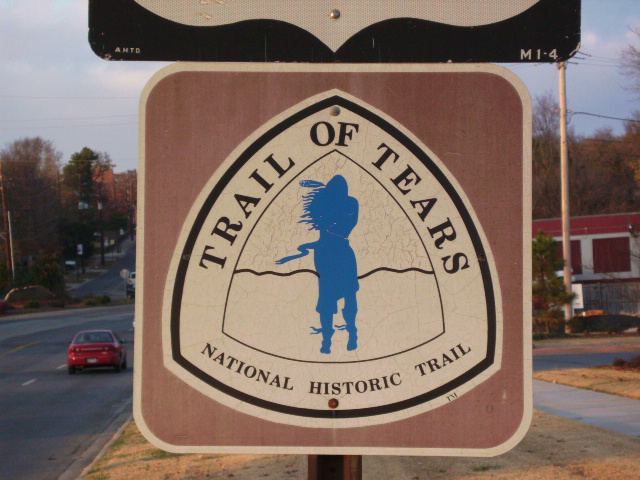
The Trail of Tears National Historic Trail is a 2,200-mile (3,500 km) long trail that follows the route of the forced westward migration of many American Indian tribes in the 1830s, including the entire Cherokee Nation. It is part of the National Trails System.
Understand
The Trail of Tears is the name given to the route followed by members of the Cherokee, Muscogee (Creek), Seminole, Chickasaw, and Choctaw nations as they were forcibly relocated from their homelands in the eastern United States to present-day eastern Oklahoma. The forced migrations were carried out by the U.S. government in the 1830s, in order to clear the land for white settlers. Those who walked on the Trail of Tears suffered from disease, starvation and death; 2,000-6,000 of 16,542 relocated Cherokee died on the trail. The Trail of Tears National Historic Trail commemorates their route and this tragic series of events. The five tribes that were relocated also owned black slaves, and would bring their slaves with them on the Trail of Tears. These slaves were frequently mistreated by their masters, and were for the most part subject to even more brutal conditions than the Native Americans themselves.
National Park Service Trail of Tears Office, ☏ +1 505 988-6098. (updated Oct 2021) National Trail of Tears Association, ☏ +1 918-464-2258, [email protected]. (updated Oct 2021)
Prepare
There are no fees for using the Trail of Tears National Historic Trail. Fees may be charged at some trail-related historic sites and interpretive facilities.
Route
The Trail of Tears is not a single route: it encompasses many routes and destinations through these states (and cities and towns):
the southwest corner of North Carolina: 1 Cherokee the northwest corner of Georgia: 2 Canton 3 Cedartown 4 Rome 5 Dalton northern Alabama: 6 Fort Payne 7 Decatur central and western Tennessee: 8 Athens 9 Cleveland 10 Chattanooga 11 Murfreesboro 12 Nashville 13 Paris 14 Memphis the southwest corner of Kentucky: 15 Paducah 16 Hopkinsville southern Illinois southern Missouri: 17 Jackson 18 Farmington 19 Rolla 20 Springfield northern and central Arkansas: 21 Batesville 22 Harrison 23 Fayetteville 24MISSING WIKILINK Marion 25 Little Rock 26 Russellville 27 Fort Smith the eastern end of Oklahoma: 28 Tahlequah Maps of the trail can be found here.
See
Museum of the Cherokee Indian, 589 Tsali Blvd, Cherokee, North Carolina. Artifacts, artwork, life-sized figures, computer generated animation to tell the story of the Cherokee people and their long life in the southern Appalachians. (updated Oct 2021) Junaluska Memorial and Museum, 1 Junaluska Memorial Dr, Robbinsville, NC, ☏ +1 828 479-3250. This memorial honors Junaluska, an important Cherokee leader during the 1800s. He and members of his family are buried here. There is a medicine plant trail at the site where you can learn about how Cherokees used plants for medicine and food, and see the plants while walking a shaded hilly short trail. The hike is 15-20 min with scenic views. (updated Oct 2021) Big Spring Park, Cedartown, Georgia. The land surrounding the park served as the Cedartown Cherokee Removal Camp. Giles County Trail of Tears Memorial and Interpretive Center, Pulaski, Tennessee. Exhibits on the grounds of the memorial and inside the Trail of Tears Interpretive Center give an excellent overview of the Trail of Tears in general and the Benge and Bell Routes in particular. (updated Oct 2021) Chieftains Museum/Major Ridge Home, Rome, Georgia. Major Ridge was one of the signers of the Treaty of New Echota, which resulted in the forced relocation of the Cherokee people. The museum presents interpretive exhibits, educational programs, and events about the Ridge family and Cherokee history and culture. (updated Oct 2021) Red Clay State Park Museum, Cleveland, Tennessee. Exhibits on the Trail of Tears and Cherokee history. (updated Oct 2021)
Do
There are several parks and historic sites along the trail routes that commemorate and mark the trail.
1 Cherokee Removal Memorial Park, on the banks of the Tennessee River near Blythe Ferry, Meigs County, Tennessee. A 29-acre park with an interpretive center, library, a history wall that chronicles the development of the Cherokee people, w memorial wall that identifies the names of Cherokee who were removed, and map of the Trail of Tears carved in stone on the ground. (updated Oct 2021) Cherokee, North Carolina. Gateway to the Great Smoky Mountains. (updated Apr 2016)
本指南改寫自 Wikivoyage (CC BY-SA)