
Rhine
旅遊行程
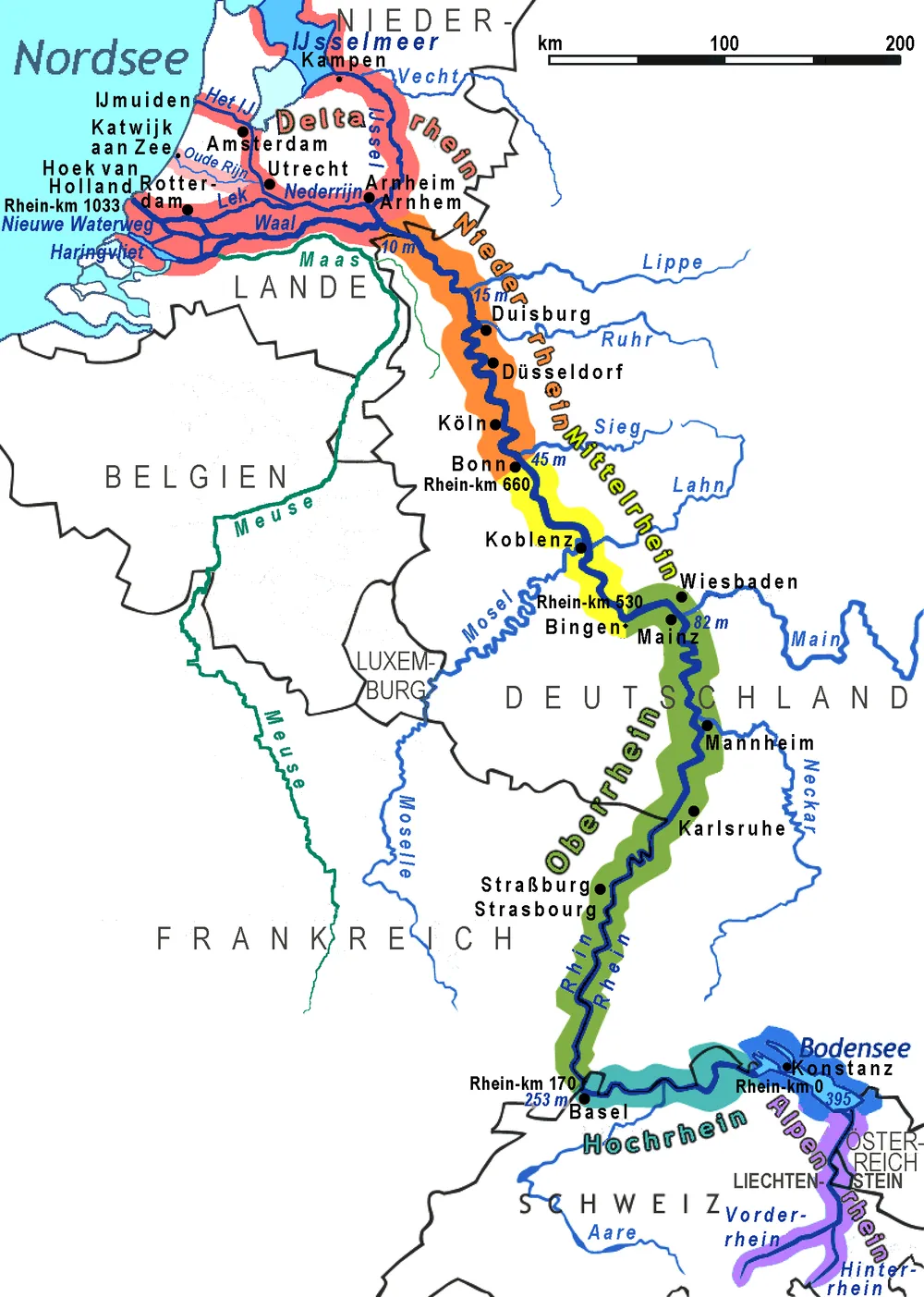
The Rhine River spans Central Europe and Western Europe. It flows through or along the borders of Switzerland, Liechtenstein, Austria, Germany, France and The Netherlands. It is a major navigation way and played an important role in history and culture of Europe.
Understand
The Rhine is 1,230 km long, from its source(s) in the Swiss Alps of Graubünden to its delta estuary on the North Sea, making it the seventh-longest river in Europe (if longer tributaries of the Volga are not counted). Given its location in Central Europe and its course through several densely populated countries and regions, its importance to history, economy, transport and culture, is much greater than its sheer length might suggest. The name Rhine (Rhenus in Latin; Rhein in German, Rhin in French, Rijn in Dutch) is probably derived from the Indo-European radical rei- and therefore etymologically related to the words rheo (Old Greek for "to flow"), rinnen (German for "to trickle"), Latin rivus, Spanish rio and English river. The Rhine is grammatically male in Latin, French, German and Dutch, and personified as a male river deity (Rhenus Pater or "Father Rhine") in art. The Rhine has both connected and divided Europeans through the centuries. For the Roman Empire, it became part of the Limes Germanicus; Roman rule of land north of the Rhine was short. Since then it has been the divide between Germanic and Romance languages. Today it is the border of France and Germany, two nations that clashed in two World Wars, but since then have contracted a close friendship. Some territories along the Rhine (Alsace and the German territories west of the Rhine) have changed their affiliation between Germany and France back and forth through the centuries. The Rhine is proverbially referred to as the "river of fate of the Germans" and "the most German of all rivers", often portrayed by romantic and nationalist painters and poets (most notably however by Heinrich Heine who had a rather difficult relationship to his country of birth and eventually emigrated, ironically, to France). The French Republic chose the "War Song for the Rhine Army" (better known as La Marseillaise) as its national anthem, while Die Wacht am Rhein ("The Watch on the Rhine") was a popular patriotic song in Germany during the late-19th and early-20th century, serving as a de facto national song (in default of an official one), and the national anthem of Liechtenstein starts with the verse Oben am jungen Rh
Prepare
Going by own or bare-boat chartered yacht requires acquaintance with the CEVNI regulations, with this confirmed e.g. by the appropriate mark in the International Certificate for Operators of Pleasure Craft ("ICC").
Get in
By plane The closest airports to the starting point of this itinerary are the major international airport of Zurich (ZRH; 135 km from Tamins, 2 hours by train and bus) and the much smaller one of Saint Gallen (ACH; 100 km). The closest airports to its terminal point are Amsterdam (AMS; 65 km from the Hook of Holland, 1–1:15 h by train), which again is a major international hub, and the less significant Rotterdam (RTM; 30 km, one hour by train and bus). If you do not plan to cruise the whole length of the Rhine, you can use the Euroairport Basel-Mulhouse (BSL/MLH/EAP; High Rhine and Upper Rhine), Frankfurt (FRA; Upper Rhine and Middle Rhine), Cologne (CGN; Middle Rhine and Lower Rhine) or Düsseldorf (DUS; Lower Rhine), all of which are major international airports close to the course of the Rhine. Moreover, there are minor airports at Friedrichshafen (FDH; Lake Constance), Karlsruhe-Baden (FKB; Upper Rhine) and Weeze-Niederrhein (NRH; Lower Rhine), mostly served by low-cost carriers.
By train The closest intercity station to the source of the Rhine is Chur, which is served by frequent intercity trains from Zurich and Basel, buses from Bellinzona, and even a direct ICE high-speed train from Hamburg, Hanover and Frankfurt once a day (that does not, however, travel faster than an ordinary intercity within Switzerland). The station of Reichenau-Tamins, only a few hundred metres from the confluence of Anterior and Posterior Rhine (i.e. the origin of this itinerary), is reached by suburban and regional trains from Chur several times per hour in 8–12 minutes. The closest intercity station to the estuary of the Rhine into the North Sea is Rotterdam Centraal, served by Thalys high-speed trains from Amsterdam (both central station and Schiphol airport) and Bruxelles, Intercity Direct (ICD) from Amsterdam and Breda, as well as intercity trains from Utrecht, Groningen, Amersfoort, Leeuwarden. It is connected with the Hook of Holland (Hoek van Holland Haven station) by half-hourly "Sprinter" (i.e. regional express) trains, every second train (=hourly) continues to Hoek van Holland Strand, which is even closer to the estuary mouth. Other major rail hubs along the route
Go
By bicycle EuroVelo 15 – the Rhine Cycle Route (Rhein-Radweg or Rijn-Fietsroute) – from Andermatt to Rotterdam.
By foot Rhine Valley Switzerland Rheintaler Höhenweg from Sargans to Rorschach (Lake Constance) Middle Rhine Valley (Bingen/Wiesbaden to Bonn), Germany Rheinhöhenweg Trail Rheinburgenweg Trail on the left Rhine side Rheinsteig Trail on the right Rhine side
Cruise ships
There are many luxury cruise liners along the river, some just short sections other going from the whole length or into the Main river and to the Danube. From Amsterdam to Basel, Zurich or Strasbourg or from the Rhine cruise up the Main and Danube to Budapest. The leisurely journey with plenty of stopovers typically takes anywhere from one to two weeks, with accommodation on the boat itself. Large operators include Avalon and Viking. The Köln-Düsseldorfer Rheinschiffahrt, better known as KD, runs cruises and scheduled services up and down the river between Cologne and Mainz.
Alpine Rhine
Tamins, confluence of the two headwaters, Anterior and Posterior Rhine. Frequent rail and bus links from/to Chur. Chur. Frequent rail links (suburban train, regional express, intercity) to Sargans. Regional express trains follow the course of the Rhine from here to St. Margrethen on the Alpine Rhine delta and Rorschach on Lake Constance (bypassing Liechtenstein, but stopping in Buchs on the Liechtenstein border) Haldenstein: 12th-century ruined castles and Renaissance castle from the 16th century Sargans on the Swiss-Liechtenstein border. Starting point of the Rheintaler Höhenweg (hiking trail). Two-hourly buses from here to Balzers, Vaduz, Schaan. Or continue by train to Buchs SG which is just on the opposite side of the border from Schaan. Balzers Vaduz Schaan. Bus or Train to Buchs SG. Buchs: Werdenberg Castle. Continue by regional express to St. Margrethen or Rorschach. Alpine Rhine delta: The Alpine Rhine splits into several branches issuing into Lake Constance (much smaller, of course, than the Rhine delta at the North Sea)
St. Margrethen. Here you have to decide if you want to circuit Lake Constance on its southern or its northern shore. Hourly S-Bahn to Bregenz (Austria).
Lake
Go next
North Sea Main River and the Rhein-Main-Danube canal Danube
本指南改寫自 Wikivoyage (CC BY-SA)