
On the trail of Alexander the Great
旅遊行程
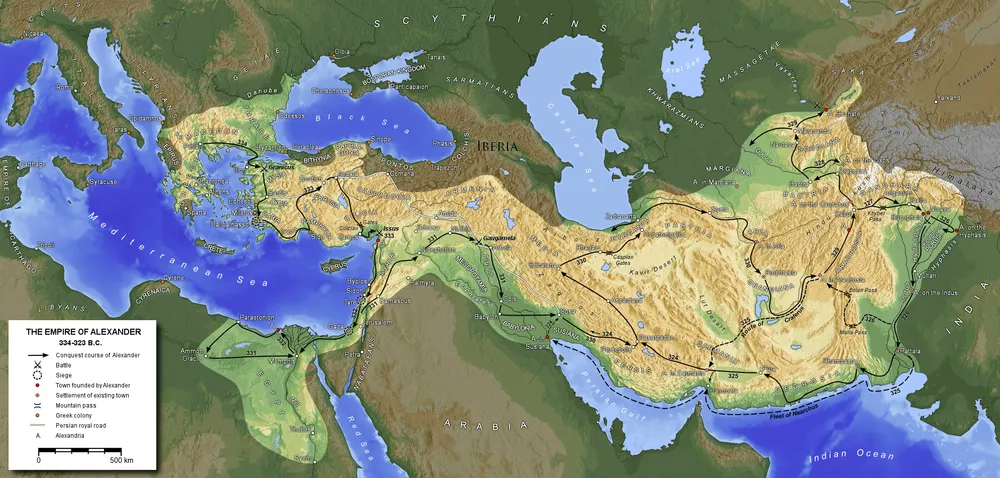
Alexander III of Macedon, more commonly known as Alexander the Great, was king of the Ancient Greek kingdom of Macedon, which today is divided among three countries. He inherited the kingdom at the age of 20 in 336 BC, and by the age of 30 he had forged one of the largest empires in the ancient world, uniting the Greek-city states and neighboring foes, taking Egypt, conquering the Achaemenid (First Persian) Empire and successfully invading the Indian subcontinent. He died at 32 so he did not rule his empire for long, but after his death dynasties descended from his generals ruled parts of it for centuries.
Understand
Alexander's conquests covered a wide area. A first approximation to following his route today would be the Hippie Trail of the 1970s, overland from Istanbul to Delhi. However that route generally omits Greece and various areas he conquered — the Levant, Egypt, Iraq and the northern parts of the Persian Empire in Central Asia. It also extends to Delhi, beyond the part of the subcontinent that he conquered. Trade along the Silk Road became well established not long after Alexander, and much of that route was in territory he had conquered. Alexander founded or renamed many cities; Wikipedia has a list of the more important ones, and we mention some below. Most were in strategic locations, and many of the initial inhabitants were veterans.
Destinations
We list some of the main sites along Alexander's route below, in the order he visited them so mainly west to east. Sites which are important only as battlegrounds have red markers. Other places get green markers, though there were also battles for many of those.
Greece
Philip II of Macedon was Alexander's father. His alliances and conquests, and Alexander's early ones, gave the Macedonians control of all of Greece and some nearby areas:
1 Pella. Alexander's birthplace and Macedonian capital. In 168 BC, it was sacked by the Romans, and its treasury was transported to Rome. Nowadays it's a rich archaeological site with a fine museum. (updated Nov 2020) 1 Chaeronea, Boeotia. In 338 BC, Philip led the Macedonians against the combined forces from Athens and Thebes. Alexander was in charge of the left wing and was the first to break the ranks of the elite force of the Theban infantry, known as the Sacred Band. (updated Aug 2020) In 336 BC Philip was assassinated by his bodyguard and Alexander was proclaimed king. Philip had forged and led an alliance, the Hellenic League, which united most of Greece to attack the Persians, who had invaded Greece during the previous century and still controlled many areas in Anatolia (now Asiatic Turkey) where the population was predominately Greek. After Philip's death, Alexander was appointed its leader.
2 Pelion. In 335 BC, Alexander undertook a siege at Pelion against an Illyrian coalition. The Macedonians defeated the Illyrians, and built a new outpost to secure their northern border. While Pelion is known to be in modern-day Albania, the exact location is not known. (updated Aug 2020) 2 Thebes. This was the most important city-state of central Greece at the time. While Alexander was dealing with the Illyrians, Thebes and other cities of the Hellenic League revolted. Alexander took Thebes and destroyed the city; after that, the other allies became cooperative again. The modern city of Thebes is not particularly large or interesting but does have an excellent archaeological museum.
Mediterranean With the Greek base secured, and many Greek allies, Alexander moved against Mediterranean areas held by Persia:
3 Granicus Riv
After Alexander
Alexander made Babylon the capital of his new empire and retired there after India, building a navy on the Persian Gulf and plotting new conquests, starting with Arabia. He died in Babylon only a few years later in 323 BC; the cause is disputed with typhoid, malaria and poisoning as the leading candidates. After his death, the empire was divided among his generals and there was fighting over the details.
The most important of the generals was Seleucus I Nicator who was given Babylon in the original division and conquered much more. The map shows the Seleucid Empire (light blue) and other Greek-ruled states at the time of his death. This empire lasted until 63 BC when the Roman General Pompey ended it. After seceding from the Seleucid Empire, a Graeco-Bactrian kingdom ruled a large chunk of Central Asia until about 125 BC. In the second century BC, envoys from them and from the Chinese court both reached Kashgar and encountered each other there. This seems to have been the first contact between China and Europeans and it led to the establishment of Silk Road trade, with the Ferghana Valley as the main route between Kashgar and Samarkand. Around 180 BC the Bactrian kingdom invaded the Indian subcontinent and a Graeco-Indian kingdom survived there until about 10 CE. Taxila has a lot of mainly Buddhist art with obvious Greek influences. Another general, Ptolemy, became Pharaoh of Egypt with his capital at Alexandria, and built the famous library and lighthouse there. The last ruler of the dynasty he founded was Cleopatra, who died in 30 BC. After that, Egypt became a Roman province; Romans were appointed to the top jobs, while Ptolemaic Greeks were much of the professional class both in government and outside it. Greek was the language of government and Greek culture was quite influential until the Muslim conquest in 641 CE. The Egyptian language now called Coptic, soon written in a Greek-derived alphabet, is in liturgical use to this day.
Stay safe
While Alexander's conquest established new trading routes and a relative stability in the region, and while it is to some extent co-extensive with the Hippie Trail, much of the route is now dangerous. In 1979 Iran was taken over by Shia extremists and Afghanistan was invaded by the Soviet Union; neither country has been entirely safe since then. In this century US-led coalitions have invaded Afghanistan and Iraq, while Syria has had a vicious civil war. In early 2026, Israel and the US attacked Iran and Israel attacked Lebanon; as of mid-2026 those wars are ongoing. Other countries in the region also have some problems. See our article on War zone safety if you are even considering travel to Afghanistan, Iraq or Syria.
本指南改寫自 Wikivoyage (CC BY-SA)