
Norwegian phrasebook
旅遊會話手冊
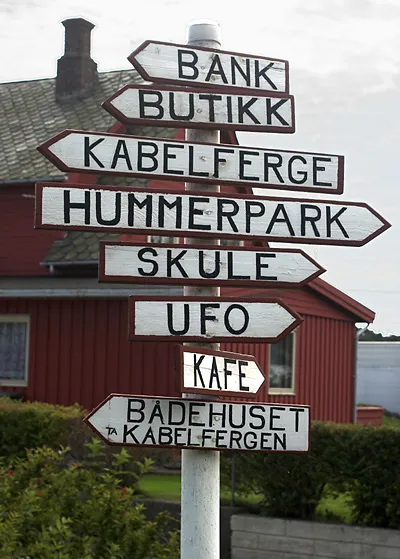
Norwegian (norsk) is the language spoken in Norway. It's closely related to Danish and Swedish, and most speakers of the three languages can understand each other to varying extents. Norwegian is historically closely related to Icelandic and Faroese, but is no longer mutually intelligible with them as it has diverged too much during the last millennium. Norwegian is also related to Dutch, German and English, and English has also borrowed substantially from Old Norse during the Viking Age.
Understand
Unlike many other languages, there is no standard spoken Norwegian, and Norwegians generally speak their native dialects even in the most formal situations. There are even two different standards for writing Norwegian: Bokmål and Nyorsk. Neither of these standards is the native dialect of any single Norwegian; they are both constructed from a variety of Norwegian dialects. Norwegian Bokmål is very close to Danish and phrasebooks for the two languages can largely be used interchangeably (noting some systematic differences in spelling). Nynorsk was constructed from dialects less influenced by Danish and thus seen as more purely Norwegian. Norwegian is written with the "standard Latin alphabet" (identical to the English alphabet) and three additional vowels ("Æ"/"æ", "Ø"/"ø" and "Å"/"å"; respectively added in that order to the end of the other 26 letters; the alphabet is identical to that of Danish). Some of these letters are used very rarely (notably "c", "w" and "x"), often because they may only be found in loanwords, or that they are disfavoured in comparison to more archaic or newer spellings. Like in English, diacritic marks are relatively rare (traits like the dot over the "i" and the circle above the "å" aren't considered diacritics, but as parts of distinct letters); the most common occurrence of them is the use of an acute accent with the final "e" in words of French origin where stress is to be put on that "e", such as in "idé" (idea), allé (avenue) and kafé (café). Because Norwegian is a Germanic language, getting a grasp of some basics shouldn't be too hard if you already speak English, German and/or Dutch.
False friends While the Danish and Norwegian vocabularies are almost identical, Swedish is easier to understand for Norwegians because of similar pronunciation. Norwegian and Swedish however have many differences in vocabulary including "false friends". Swedes in Norway and Norwegians in Sweden often pick up local words to avoid confusion. For instance when a Swede says "rolig" that means "funny, amusing", whereas the Norwegian word "rolig" means "calm, quiet". In Sweden "semester" is vacation, whereas in Norway "semester" is spring or autumn part
Pronunciation Guide
Norwegian spelling is pretty simple and regular (compared to, say, English), but like most real languages, it is unfortunately not completely regular.
Vowels Each vowel can be pronounced either as "long" or "short". A "short" vowel will almost always be followed by a double consonant (i.e. two similar consonants, such as ll or tt). A long vowel is not. For example, in Norwegian "it" will be pronounced as in eet, whereas "itt" will be pronounced as English it. (There are some exceptions to this rule: if the consonant is followed by another consonant, it does not always need to be doubled to make the vowel short.) The Norwegian vowels are pronounced in almost the same way as in German. The Norwegian alphabet has three letters more than the English alphabet, vowels æ (Æ), ø (Ø), and å (Å). Here's the full list:
a like 'a' in "father" e like 'e' in "where" (but like æ if it is followed by an 'r') (some exceptions, see below) i (short) like 'i' in "pin" i (long) like 'ee' in green o (short) mostly like 'o' in how the British say "Ox", rendering it a short 'å'; but in a few cases simply a short "oo", just like a short 'u' o (long) similar to a common pronunciation of 'oo' in "fool" or "cool" u (long) like the "oo" in "shoot" or "ou" in a possible rendering of "route" u (short) same sound as a long 'o' only short (much like the English "put") y like 'i' in "pin" (but narrower; y doesn't correspond to any sound in English. English speakers may have difficulty distinguishing Norwegian's i and y. It's similar to German ü or French u.) Halfway between "ee" and "ewwww". æ like 'a' in "mad"; almost always long. A short "ær" sound is spelled 'er'. ø like 'u' as in "burn" ("bu:n"). One starts with e and rounds one's lips to produce ø. å like 'o' as in "lord" (Note: in older texts or names may be written as "aa"); it is long unless followed by a double consonant.
The letters 'o' and 'u' may give you the most trouble. Some examples to help clarify:
egg (egg or edge) has a short "e" because of the double consonant; elg (moose) also has a short "e"; the 'lg' qualifying as a doubling; ed (oath) has a long "e"; er (is) has a long "æ", as does her (here) and der (there). erke
Phrase list
Basics Bokmål, followed by nynorsk:
Good morning. God morgen. (goo moh-ohrn) - God morgon. ("Go' Morgon") Basically applies to early morning. Good evening. God kveld. (goo kvel) Good night (to sleep) God natt. (goo naht)(with a short 'a') Hello. (formal) God dag. This greeting that can be used at most occasions (except funerals) and times of day. Hello. (informal) Hei. (hay)("hæy") How are you? Hvordan går det? (voord-ahn gawr deh?) Korleis går det? ("kor-læis gohr deh') Note: Not used among strangers. This question is not a nicety for Norwegian. Fine, thank you. (Jo) takk, bare bra. (yoo tak, bar-e brah) (Jau) takk, bærre brah ("Jauh tak, bere brah") What is your name? Hva heter du? (Vah he-ter du) Kva heiter du? ("Kvah hæi-ter du") My name is ______ . Jeg heter ______ . (yei he:h-t'r _____ .) Eg heiter ("eg hei-ter") Nice to meet you. Hyggelig å treffe deg. (Hygg-e-li å treff-e dei) Hyggjeleg å møte deg ("Hyggj-eleg å mø-te deg") Please. Vær så snill. (...)(you may hear "væh shaw snil") (Meaning "be so kind") Not used nearly as often as in English. It can also be considered as to plead, you do not take something for granted. Yes. Ja. (ya) Yes (in reply/opposition to a no in a discussion). Jo. (yoo) Jau. ("Ja-u") No. Nei. (naye)("næi") Excuse me. (getting attention) Unnskyld (meg). (Unn-shill mei) Orsak meg ("Or-sak meg") Excuse me. (begging pardon) Unnskyld (meg). (Unn-shill mei) Orsak meg ("Or-sak meg") I'm sorry. (for a slight mistake) Beklager (be-klag-er) Beklagar ("Be-kla-gar") I'm sorry. (I really didn't mean it) Jeg beklager så mye (Jei be-klag-er så mye) Eg er lei for det ("Eg er leih for det") I'm sorry. Jeg er lei meg. (Jei ær lei mei) Eg er lei meg ("Eg er leih megh")Not used nearly as often as in English, this sincerely means you are sorry, or can even be interpreted to mean you are sad (usually not associated with guilt). Goodbye Ha det bra! (Ha de bra) Farvel ("far-vel") Goodbye (informal) Ha det! (Ha-de) It was nice seeing/meeting you. Goodbye. (bm) Det var hyggelig å treffe deg. Ha det bra! (De var hygg-e-li å treff-e dæi. Ha de bra!) (nn) Det var hyggjeleg å treffe deg. Ha det bra! (De var hyg-yeh-lehg aw treff-eh dehg. Hah deh bra!)
I ca
本指南改寫自 Wikivoyage (CC BY-SA)