
Bengali phrasebook
旅遊會話手冊
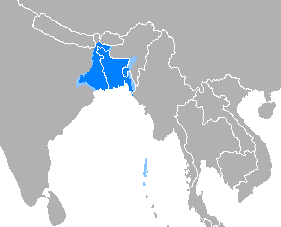
Bengali, also called Bangla (বাংলা Bānlā), is an Indo-Aryan language spoken by 270+ million people worldwide. Most people living in Bangladesh and the Indian states of Tripura and West Bengal use it as a first language. Bengali is the sole official language of Bangladesh and one of the 22 scheduled languages of India.
Pronunciation guide
The pronunciation in Bangladesh differs significantly from that of India and the so-called "Standard Bengali". The difference is basically in pronunciation and a few vocabulary differences, which make it problematic for Indian Bengalis to understand the Bangladeshi dialect and vice versa. There are 11 vowels and 38 consonants in written Standard Bengali, some of which are not distinguished by their pronunciations.
Vowels Bengali vowels can either be independent or hooked on to the consonant in the form of diacritics. The distinction between long (দীর্ঘ dīrgha) and short (হ্রস্ব hrasba) vowels is purely orthographic and both vowels are pronounced the same. The vowel অ does not have any equivalent diacritic and certain consonants in Bengali words are pronounced with the অ-sound.
অ aw/oh like British dawn (IPA: ɔ) or like open (IPA: o) অ্যা a like cat (IPA: æ) আ া ah like father (IPA: a) ই ি ee like free (IPA: i) ঈ ী ee like free (IPA: i) উ ু oo like moon (IPA: u) ঊ ূ oo like moon (IPA: u) ঋ ৃ ree like return (IPA: ri) এ ে ay/a between make and bed (IPA: e), or like cat (IPA: æ) ঐ ৈ oi like boy but more closed (IPA: oi) ও ো oh like boat (IPA: o) ঔ ৌ oh like boat but more exaggerated (IPA: ou)
Consonants Bengali consonants have many qualities not quite familiar to native English speakers, including dental, aspirated and retroflex consonants. Dental consonants are pronounced with the tongue touching the teeth, aspirated consonants are pronounced with a puff of air and retroflex consonants are pronounced with the tip of the tongue flapping against the roof of the mouth.
ক k like skip (IPA: k) খ kh like sinkhole (IPA: kʰ) গ g like go (IPA: ɡ) ঘ gh like loghouse (IPA: ɡʱ) ঙ ng like sing (IPA: ŋ) চ ch like chicken (IPA: tʃ) ছ chh like atchoo (sound of sneezing) (IPA: tʃʰ) জ j like jump (IPA: dʒ) ঝ jh like hedgehog (IPA: dʒʰ) ঞ n like lunch (IPA: n), silent in words like মিঞা (MEE-ah) ট tt like tick but retroflex (IPA: ʈ) ঠ tth like lighthouse but retroflex (IPA: ʈʰ) ড dd like doubt but retroflex (IPA: ɖ) ঢ ddh like mudhut but retroflex (IPA: ɖʰ) ণ n like end (IPA: n) ত t like tick but dental (IPA: t̪) থ th like lighthouse but dental (IPA: t̪ʰ) দ d like doubt
Grammar
Although learning Bengali grammar is not necessary for your trip, it can at least help you parse some sentences in case you face an uncertain situation. Here are some rules of thumb:
Like English but unlike most South Asian languages, Bengali does not have grammatical genders. However, rivers with male names are often called "নদ" (nawd) instead of the usual "নদী" (noh-dee). Like many South Asian languages, there are three equivalents of English "you". When addressing a child or an animal, use "তুই" (twee). When addressing someone familiar, like your friend or family, use "তুমি" (too-mee). In all other cases, use "আপনি" (ahp-nee). Beware of the distinction between the adverb "কি" (kih) and the pronoun "কী" (kee). Although both are used in questions and there's no phonetic distinction between "কি" and "কী", the speakers nonetheless distinguish the two words by the tone of a given question. For example: "আপনি কি খাবেন?" (ahp-nee kih khah-bayn?) means "do you want to eat?", but "আপনি কী খাবেন?" (ahp-nee kee khah-bayn?) means "what do you want to eat?" The kinship words are often used to call someone for attention. Here are some of the most common ones:
"ভাই" (bhigh) for familiar men or boys, meaning "brother". "দাদা" (dah-dah) for men, meaning "elder brother" or "grandfather". "দিদি" (dee-dee) or "দিদিমা" (dee-dee-mah) for women, meaning "elder sister". "দাদি" (dah-dee) for elderly women, meaning "grandmother". "চাচা" (chah-chah) or "কাকা" (kah-kah) for older men, meaning "paternal uncle". "চাচি" (chah-chee) or "কাকিমা" (kah-kee-mah) for older women, meaning "wife of paternal uncle".
Phrase list
Unless otherwise noted, all the Bengali phrases are in Standard Bengali, which is based at Nadia and has been spoken by the people of West Bengal.
Basics
Hello. (Hindu) নমস্কার (NAW-mohsh-kahr) Hello. (Muslim) আসসালামু আলাইকুম (AHSS-sah-lah-moo ah-laee-koom) Hello. (at phone) হ্যালো (HA-loh) Hi. (Muslim) সালাম (SAH-lahm) How are you? কেমন আছেন? (KA-mohn ah-chhayn?) How are you? (familiar) কেমন আছ? (KA-mohn ah-chhoh?) Fine, thank you. ভালো আছি, ধন্যবাদ। (BHAH-loh ah-chhi, DHOHN-noh-bahd) What is your name? আপনার নাম কী? (AHP-nahr nahm kee?) What is your name? (familiar) তোমার নাম কী? (TOH-mahr nahm kee?) My name is ______ . আমার নাম ______। (AH-mahr nahm ______) আমি ______। (AH-mee ______) Nice to meet you. আপনার সাথে পরিচয় করে ভালো লাগল। (AHP-nahr shah-thay poh-ree-choi koh-ray bhah-loh lahg-loh) Nice to meet you. (familiar) তোমার সাথে দেখা করে ভালো লাগল। (TOH-mahr shah-thay da-khah koh-ray bhah-loh lahg-loh) Please. দয়া করুন। (DOI-ah koh-roon) Please. (familiar) দয়া করো। (DOI-ah kaw-roh) Thank you. ধন্যবাদ। (DHOHN-noh-bahd) You're welcome. স্বাগত। (SHAH-gaw-toh) Yes. হ্যাঁ। (HAN) No. না। (NAH) Excuse me. (getting attention) এই যে! (AY-ee jay!) Excuse me. (getting attention, informal) এই! (AY-ee!) Excuse me. (begging pardon) ক্ষমা/মাফ করবেন। (KHAW-mah/mahph kohr-bayn) Excuse me. (begging pardon, informal) ক্ষমা/মাফ করো। (KHAW-mah/mahph kaw-roh) I'm sorry. আমি দুঃখিত (AH-mee doock-khee-toh) আমায় ক্ষমা/মাফ করবেন। (AH-migh khaw-mah/mahph kohr-bayn) I'm sorry. (familiar) আমায় ক্ষমা/মাফ করো। (AH-migh hhaw-mah/mahph kaw-roh) Goodbye. বিদায়। (Bee-digh) Goodbye. (Muslim) খোদা/আল্লা হাফেজ। (KHOH-dah/AHL-lah hah-phayz) Bye. টাটা। (TTAH-ttah) বাইবাই। (BIGH-bigh) I can't speak Bengali [well]. আমি বাংলা [ভালো] বলতে পারি না। (AH-mee bahng-lah [BHAH-loh] bohl-tay pah-ree nah) Do you speak English? আপনি কি ইংরেজিতে বলতে পারেন? (AHP-nee kee eeng-ray-jee-tay bohl-tay pah-rayn?) Do you speak English? (familiar) ইংরেজি বলো? (EENG-ray-jee baw-loh?) Is there someone here who speaks English? এখানে ইংরেজি জানা লোক আছে? (AY-khah-nay eeng-ray-jee jah-nah lohk achhe?) Help! বাঁচাও! (BAHN-chow) Help! (formal) বাঁচান! (BAHN-chahn) Good morning. শুভ সকাল। (SHOO-bhoh shaw-kahl) Goo
本指南改寫自 Wikivoyage (CC BY-SA)